NetSuite Integration for Credit Applications: Automate Customer Onboarding for Mid-Market And Enterprise
Last Updated: 14 July, 2026
•
Soumi Sarkar Fintech content strategist
S
Soumi Sarkar
Soumi specializes in O2C, finance, and accounting transformation with a focus on bringing a domain-led perspective to accounting, finance and order-to-cash transformation. She crafts insight-driven, CFO-aligned content that helps finance teams optimize operational workflows and drive measurable outcomes. Beyond her professional work, Soumi is a published author of two books, a poetess, an avid reader, and a storyteller who enjoys exploring narratives across both B2B and creative formats.
2026 Automation Benchmark Report
HighRadius 2026 Automation Benchmark Report For The Office Of The CFO
Understand if your performance is on par with top 10% of the organizations. Identify gaps, best practices and know how you can drive value through Agentic AI-Driven Automation.
Every customer onboarding process eventually ends in NetSuite. The question is what happens before that customer record is created.
For many finance teams, customer onboarding still depends on emails, spreadsheets, PDF credit applications, financial statement reviews, trade reference checks, and manual approvals before customer data is finally entered into the ERP. NetSuite records the outcome, but much of the credit decisioning process still happens outside it—slowing approvals, delaying first orders, and creating inconsistent customer experiences.
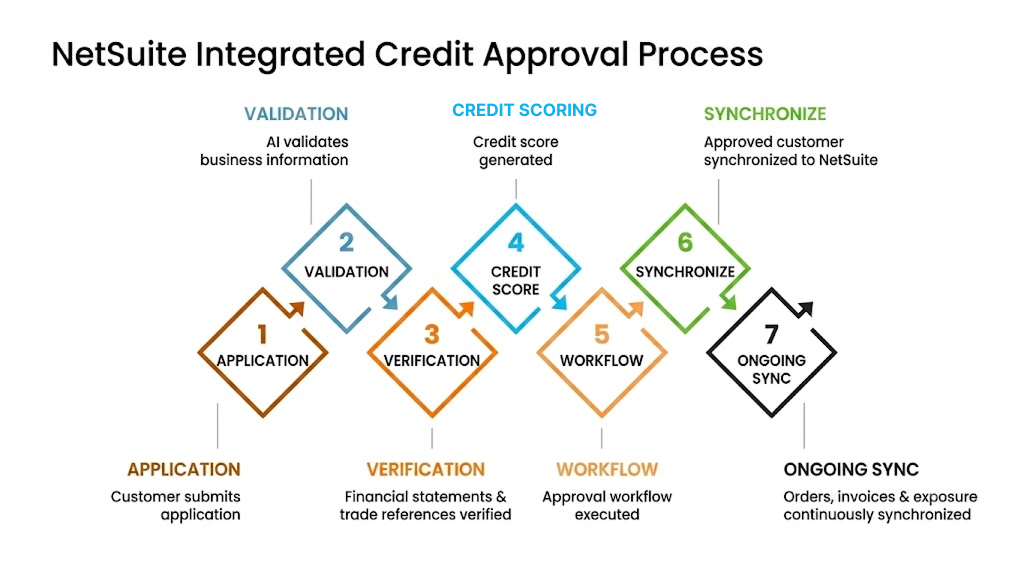
As businesses grow, these disconnected workflows become increasingly difficult to manage. Integrating an automated credit application solution with NetSuite brings customer onboarding, credit decisioning, and ERP synchronization into a single connected workflow, helping finance teams accelerate approvals, standardize risk decisions, and scale credit operations without increasing manual effort.
In this blog, we'll explore how NetSuite credit application integration streamlines customer onboarding, strengthens credit risk management, and helps both mid-market and enterprise businesses build faster, more scalable finance operations.
Guessing your next credit management partner?
Use this Excel-based scorecard to confidently evaluate credit management partners—because top finance teams don’t guess, they measure.
Why Native NetSuite Credit Workflows Become a Bottleneck
NetSuite provides a strong foundation for managing customer records, sales orders, invoices, and accounts receivable. It serves as the system of record for Order-to-Cash operations, ensuring customer and financial data remains centralized across the business.
However, credit decisioning and credit review that occur before a customer is approved often happen outside the ERP. Credit analysts still collect credit applications, review financial statements, verify trade references, gather external credit information, and coordinate approvals across multiple stakeholders. As customer volumes increase, these disconnected activities become the primary source of onboarding delays.
The challenge lies in the manual processes surrounding those transactions:
Credit applications managed through emails, PDFs, or spreadsheets
Manual analysis of financial statements and supporting documents
Trade and bank reference verification through follow-up emails
Credit bureau data collected from multiple external sources
Static credit limits that require periodic manual reviews
Reactive blocked order management after credit thresholds are exceeded
Limited continuous monitoring of changing customer risk
As businesses grow, the challenge isn't NetSuite but the manual work that happens around it. Integrating an agentic AI led credit application solution with NetSuite automates these steps, accelerates approvals, and keeps customer records and credit decisions synchronized.
Why Credit Application Integration Matters in NetSuite
Netsuite is responsible for recording customer accounts, orders, invoices and receivables. However, the credit decisioning happens outside the ERP. The team still needs to collect customer information through emails and PDFs, review financial statements manually, chase trade references over emails and push credit approvals through disconnected workflows before finally creating customer records in NetSuite.
As businesses scale, these manual processes become the biggest obstacle to faster onboarding.
1. Manual Work Slows Customer Onboarding
Without an integrated credit application solution, analysts spend valuable time collecting documents, spreading financial statements, verifying bank and trade references, and re-entering approved customer data into NetSuite. Automating these activities reduces administrative effort, shortens approval cycles, and allows analysts to focus on higher-risk credit decisions.
2. Continuous Risk Intelligence Beyond Approval
Native NetSuite credit workflows typically evaluate risk at the time of onboarding. An integrated credit application solution extends that process by continuously monitoring payment behavior, credit bureau updates, bankruptcy indicators, and credit utilization. Finance teams can identify deteriorating accounts earlier and trigger proactive reviews before risk impacts revenue.
3. Smarter Credit Control at Scale
Static credit limits and reactive blocked orders can slow fulfillment and strain customer relationships. By combining AI-driven credit scoring, configurable approval policies, and ERP synchronization, integrated credit applications help automate routine decisions, recommend appropriate credit actions, and keep customer records aligned with evolving risk, all without increasing analyst workload.
Still Reviewing Every Customer Manually? AI Automates 80–90% of Routine Credit Decisions
See how leading finance teams accelerate customer onboarding by up to 70% and deliver 2–3× faster credit approvals with automated credit application tools.
The challenges a business faces during customer onboarding evolve with scale. While every organization wants faster credit approvals, the capabilities required to achieve that look very different for a growing mid-market business than for a global enterprise.
Growing Mid-Market Businesses
As customer volumes increase, lean credit teams quickly outgrow spreadsheets and manual reviews. Their priority is to automate routine work through AI-powered credit applications, financial statement extraction, ERP synchronization, and low-risk auto-approvals, accelerating onboarding without adding analyst headcount.
Large Enterprise Organizations
As operations expand across multiple entities, ERPs, and regions, the focus shifts from speed alone to governance at scale. Enterprise teams need configurable approval hierarchies, continuous risk monitoring, blocked order management, portfolio-wide analytics, and standardized credit policies that work consistently across global operations.
Case Studies
How this manufacturing giant unlocked 17,000+ annual credit reviews
Learn how FBM modernize credit operations with AI-driven scoring, automated workflows, and centralized visibility across entities.
What Gets Synchronized Between NetSuite and Online Credit Applications
A successful NetSuite integration isn't simply about moving data between systems. It's about ensuring credit teams always work with current customer information while NetSuite remains the single source of record for operational transactions.
The table below highlights how customer and credit data flows between NetSuite and an integrated credit application platform.
From NetSuite
From Credit Application Solution
Customer master records
Approved customer profile
Credit limits
Updated credit limits & recommendations
Payment terms
Revised payment terms
Open A/R & customer exposure
AI-generated credit risk score
Sales orders
Credit approval status
Invoices & payment history
Financial statement analysis
Customer payment behavior
Bank & trade reference verification
Customer hierarchy
Bankruptcy alerts & continuous risk monitoring
Instead of re-entering information across multiple systems, finance teams maintain synchronized customer, risk, and approval data throughout the onboarding and credit lifecycle.
When real-time sync matters and when batch processing is better
Not every integration requires real-time synchronization. The most effective NetSuite implementations use a combination of real-time and scheduled batch processing based on business requirements.
Use Real-Time Synchronization For
Use Batch Synchronization For
Credit approvals
Invoice synchronization
Blocked order management
Customer master updates
Credit freezes
Payment history
Credit limit changes
Financial statements
Urgent risk alerts
Historical transaction loads
Real-time synchronization is essential when a decision immediately impacts order fulfillment or customer risk. Batch synchronization is often the preferred approach for high-volume transactional data because it is faster, more reliable, and easier to recover if failures occur.
Templates
Your Credit Team Could Be Saving Hundreds of Hours Every Year
Use our interactive ROI calculator to estimate productivity gains, annual cost savings, and the business impact of AI-led credit management
How Credit Application Management for NetSuite Transforms the Credit Management Process
While integration provides the foundation, the real transformation comes from intelligent credit management automation. This is where credit management application software for NetSuite plays a critical role.
It enhances NetSuite by adding advanced capabilities such as AI-driven scoring, automated workflows, and real-time risk monitoring, turning a manual process into a strategic advantage.
Digitized Credit Application Intake
Traditional credit applications often involve static forms and incomplete data submissions. Digital applications standardize data capture, ensuring that all required information is collected upfront. This reduces delays caused by missing information and minimizes the need for repeated follow-ups with customers.
AI-Driven Credit Decisioning
AI models analyze multiple data points, including payment behavior, financial statements, and external credit data. This enables faster and more accurate credit scoring compared to manual evaluation. By removing subjectivity, businesses can ensure consistent and data-driven credit decisions across all applications.
End-to-End Workflow Automation
From submission to final approval, the entire process is automated. Applications are routed based on predefined rules, ensuring that high-risk cases receive the right level of scrutiny. This significantly reduces turnaround time while maintaining strong control over credit policies.
What an Ready NetSuite Credit Integration Should Handle
A scalable NetSuite integration should do more than exchange data between systems. It should support enterprise-grade governance, reliability, and intelligent decision-making as transaction volumes grow.
An enterprise-ready integration should handle:
Multi-entity and multi-subsidiary NetSuite environments
Custom fields and configurable business rules
High-volume historical and incremental data loads
Secure encrypted data transfer via SFTP or HTTPS
Middleware support for MuleSoft, Boomi, SAP PI, and REST APIs
The next evolution is moving beyond integration to intelligent execution.
Traditional Integration
Agentic AI Integration
Data moves between systems
Data moves between systems
People review every application
AI evaluates routine applications
Analysts make every decision
Analysts review only exceptions
Manual follow-ups drive onboarding
AI automates validation, scoring, and approvals
Instead of simply connecting NetSuite to a credit platform, Agentic AI transforms the integration into an autonomous workflow, keeping customer onboarding fast while ensuring governance remains firmly under finance's control.
How Automated Credit Platforms Compare to Traditional NetSuite Connectors
Most NetSuite integrations successfully synchronize data between systems. The real difference lies in what happens after the data arrives, whether finance teams still perform every credit task manually or AI automates the routine work while analysts focus on exceptions.
Capability
Traditional NetSuite Connector
Automated Credit Application Solution
Data synchronization
Yes
Yes
Customer application intake
Manual
AI-powered
Financial statement analysis
Manual
AI-assisted extraction and analysis
Bank & trade reference verification
Manual
Automated
Credit scoring
Rules-based
AI-driven
Bankruptcy detection
Limited
Predictive monitoring
Blocked order management
Reactive
Predictive recommendations
Continuous risk monitoring
Limited
Yes
Business Impact of Integrating Credit Applications with NetSuite
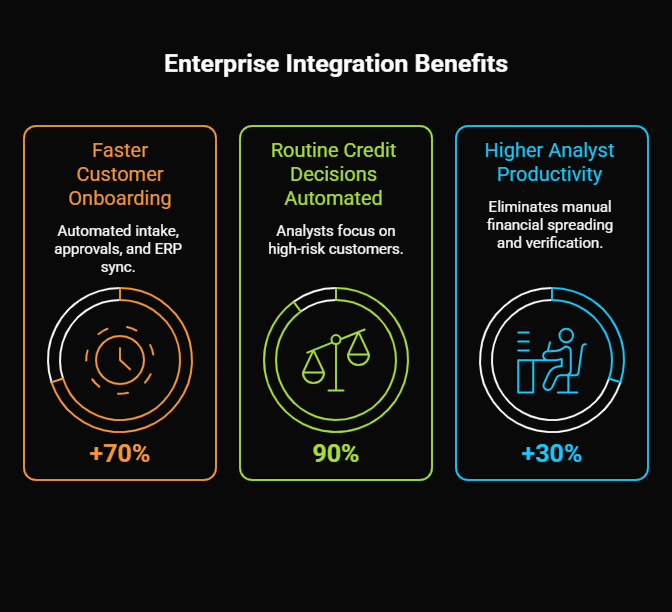
Integrating credit application management with NetSuite delivers measurable improvements across customer onboarding, credit operations, and risk management. By automating application processing, synchronizing customer and ERP data, and applying AI-driven decisioning, finance teams reduce manual effort while improving both speed and governance.
70% faster customer onboarding through automated application intake, approvals, and ERP synchronization.
80–90% of routine credit decisions are automated, allowing analysts to focus on high-risk customers and exceptions.
2–3× faster credit approvals using AI-powered financial analysis, policy-driven workflows, and automated risk scoring.
40% fewer blocked orders through predictive credit monitoring and proactive credit limit management.
20% lower bad debt exposure with continuous monitoring of customer payment behavior and external risk signals.
30% higher analyst productivity by eliminating manual financial spreading, reference verification, and repetitive administrative work.
How HighRadius Helps Automate NetSuite Credit Applications with Agentic AI
As businesses grow, faster customer onboarding depends on more than connecting NetSuite to another application. It requires intelligent credit automation. HighRadius extends NetSuite with automated credit management software that offers financial statement analysis, trade and bank reference verification, policy-driven approvals, and continuous risk monitoring. The result is faster customer onboarding, stronger credit decisions, and enterprise-grade governance without increasing analyst headcount.
With real-time credit risk management tools, finance teams can receive alerts for changes in customer credit profiles and make faster, data-driven decisions using unlimited credit reports. The platform integrates with ERP systems and can begin monitoring customers in as little as 30 days.
With real-time credit risk analysis software and credit decisioning software, you can receive alerts for any changes in your customers’ credit profile and make data-driven credit decisions from unlimited credit reports. Our software integrates with your ERP system and can start monitoring your customers in just 30 days.
We offer configurable credit scoring software and approval workflows that can be customized based on geography, customer segments, business units, and other factors. You can fast-track credit approvals through complex corporate hierarchies, making the credit application process more efficient and streamlined.
Our highly configurable online credit application allows you to onboard customers across the globe with multi-language, customized credit applications embedded on your website. You can automatically capture financials, personal guarantees, and check bank references, reducing the need for manual data entry.
Our software also automatically extracts credit data from over 40+ global and local agencies, including credit ratings, financials, and credit insurance information. You can configure the auto-extracted data in your preferred currency, making it easier to analyze and interpret.
With AI-based blocked order management, you can auto-predict blocked orders based on the customers’ credit limit utilization and payment history. You can leverage AI-based release or partial payment recommendations for faster credit decisions, reducing the need for manual intervention.
Struggling With Slow Credit Approvals and Credit Reviews?
Explore the #1 software that makes onboarding customer faster and easier
Accelerate payment recovery from delinquent customers and boost cash flow through automated collection workflows.
Cash App
Achieve same day cash application with automated remittance aggregation
Credit
Mitigate credit risk, reduce bad debt, and streamline customer onboarding with AI-powered insights.
Deductions
Reduce Revenue Leakage with AI Prediction models that identify valid and invalid deductions.
Online Credit Application
Onboard customers seamlessly with a configurable online credit application. Cut down on back-and-forth and collect all customer details in one go.
FAQs
1. What is NetSuite ERP integration for credit applications? It connects credit application workflows directly with NetSuite, enabling seamless data flow between systems. This eliminates manual data entry and ensures faster, more accurate credit decisions. It also improves visibility across the credit lifecycle.
2. How does credit management software for NetSuite improve efficiency? It automates data collection, scoring, and approvals, reducing manual effort significantly. AI-driven insights help teams make faster decisions. This improves productivity and reduces processing time.
3. What is NetSuite credit risk management? It involves monitoring and managing customer credit risk using real-time data within NetSuite. AI models continuously assess risk and flag potential issues. This helps businesses prevent bad debt and improve financial stability.
4. How does HighRadius integrate with NetSuite? HighRadius uses the HEX integration layer to enable secure, bi-directional data exchange. It syncs customer, invoice, and payment data in real time. It also writes back updates like credit limits and disputes into NetSuite.
5. What are the benefits of integrating credit applications with NetSuite? The integration speeds up approvals, improves risk accuracy, and enhances cash flow. It also reduces manual effort and operational costs. Overall, it enables finance teams to scale efficiently.
Resource Library
Resource Hub
Order to Cash
Order to Cash software data sheet
Disconnected workflows can leave teams chasing data, while automated O2C has delivered 20% lower past dues.
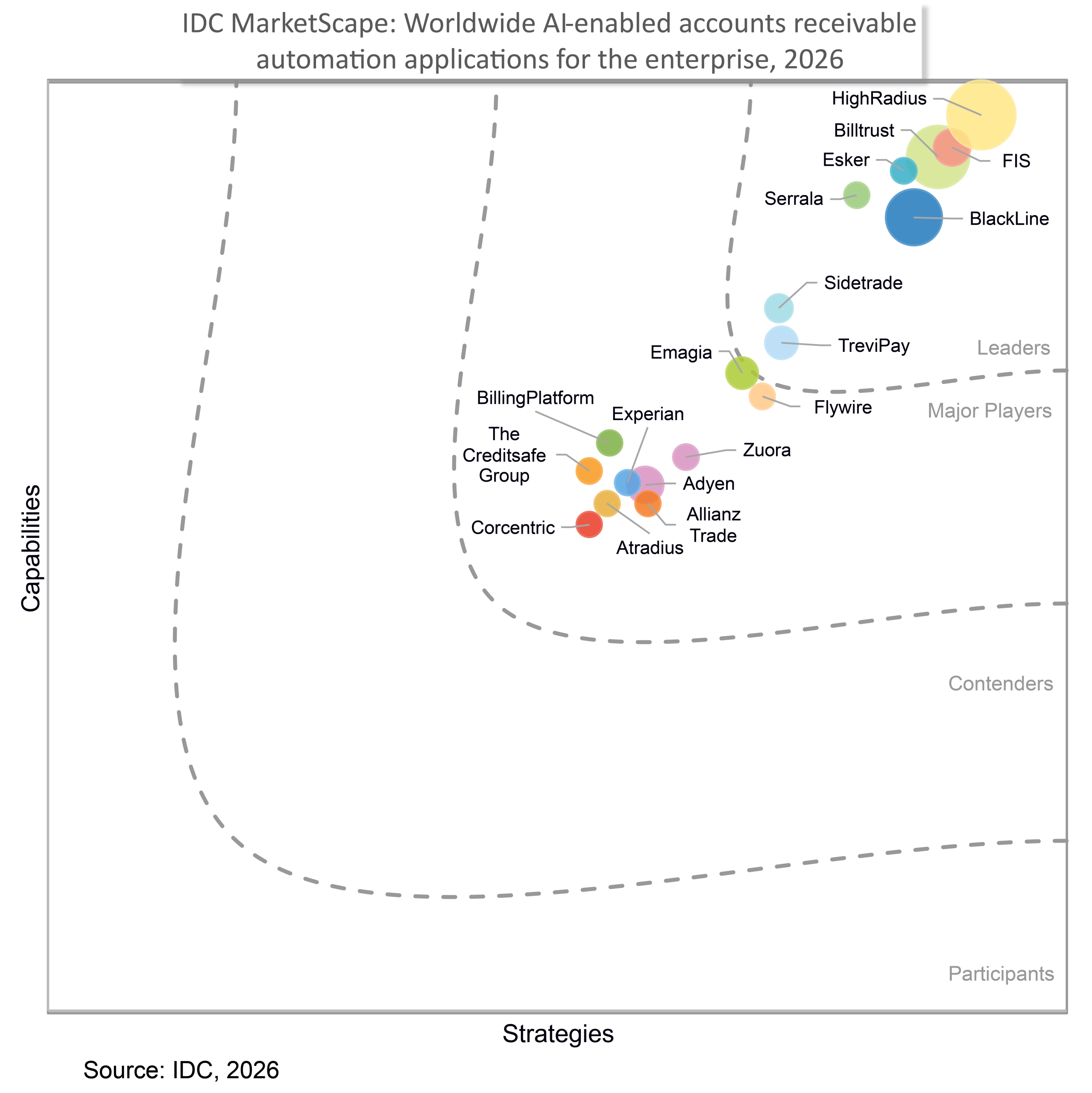
HighRadius recognized as a "Leader" in IDC Marketscape: Worldwide AI-enabled accounts receivable automation applications for the enterprise 2026 vendor assessment
Recognized as a Leader in 2026 Vendor Assessment for unifying credit, collections, cash application, deductions, e-invoicing, and payments on one AI platform to advance enterprise-wide invoice-to-cash transformation.
Forrester Recognizes HighRadius in The AR Invoice Automation Landscape Report, Q1 2023
Forrester acknowledges HighRadius’ significant contribution to the industry, particularly for large enterprises in North America and EMEA, reinforcing its position as the sole vendor that comprehensively meets the complex needs of this segment.