Best Credit Scoring Systems (2026): HighRadius vs Esker vs Billtrust vs Gaviti
Last Updated: 12 October, 2026
•
Soumi Sarkar Fintech content strategist
S
Soumi Sarkar
Soumi specializes in O2C, finance, and accounting transformation with a focus on bringing a domain-led perspective to accounting, finance and order-to-cash transformation. She crafts insight-driven, CFO-aligned content that helps finance teams optimize operational workflows and drive measurable outcomes. Beyond her professional work, Soumi is a published author of two books, a poetess, an avid reader, and a storyteller who enjoys exploring narratives across both B2B and creative formats.
2026 Automation Benchmark Report
HighRadius 2026 Automation Benchmark Report For The Office Of The CFO
Understand if your performance is on par with top 10% of the organizations. Identify gaps, best practices and know how you can drive value through Agentic AI-Driven Automation.
What if your credit scoring software could deliver 3× faster credit reviews and reduce bad debt exposure by up to 20%? HighRadius' credit scoring does that for you.
Modern credit scoring software goes beyond bureau scores by combining AI, ERP payment behavior, financial data, and continuous risk monitoring to improve decision accuracy.
The right platform depends on your business priorities, whether you’re replacing spreadsheets, scaling a lean credit team, or standardizing credit operations across global entities.
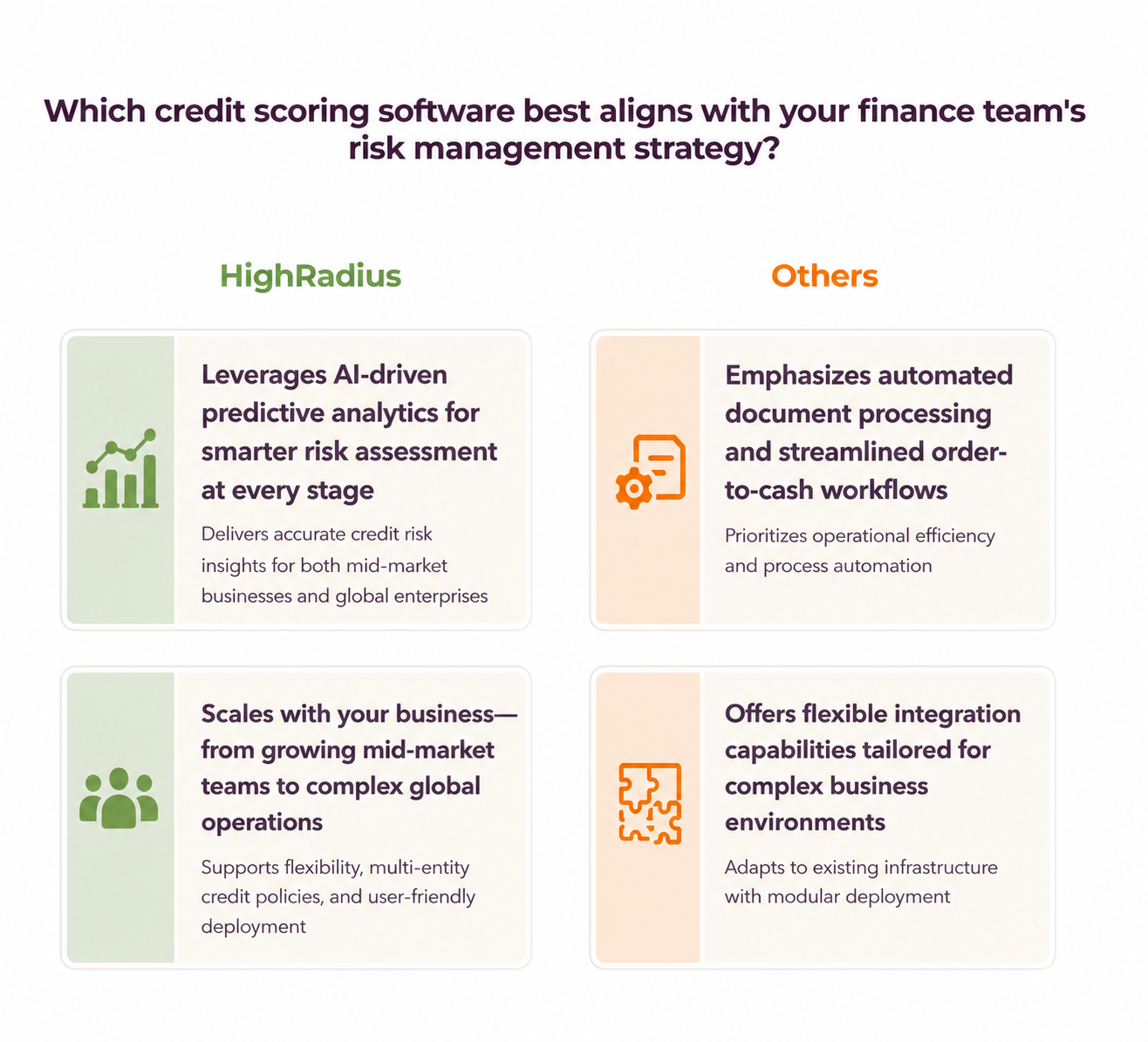
HighRadius differentiates with Agentic AI, 35+ credit bureau integrations, and automated credit decisioning, helping finance teams accelerate reviews by 3× while reducing bad debt exposure by up to 20%.
A Credit Score That Doesn't Change With Customer Risk Can Become a Liability.
Credit teams make decisions based on a customer’s risk profile. But how often are they monitoring? By the time they return to routine checks, that profile may have changed. Payment behavior shifts. Credit utilization rises. Financial health weakens. Exposure grows. Yet many teams still rely on periodic bureau checks, spreadsheet scorecards, and manual reviews. The result: the credit score reflects a point in time while the customer keeps changing.
That gap reaches collections: higher past-due exposure, blocked orders, and more manual intervention. When collections depend on credit reviews, an unstructured scoring model can delay decisions and increase the risk collections teams must manage.
That’s where choosing the credit system becomes imperative. An automated credit scoring platform closes this gap by connecting ERP payment behavior, credit intelligence, financial statements, credit utilization, and AI-powered risk models.
Instead of waiting for the next review, finance teams can reassess risk, prioritize accounts, recommend credit limits, and automate low-risk decisions. The payoff? Up to 80–90% automation of low-risk approvals, up to 40% fewer blocked orders, and 20–40% lower bad debt exposure.
So the question is no longer whether a platform can calculate a credit score, but how quickly it can turn changing risk into action across credit and collections. This guide compares four high-rated vendors: HighRadius vs BillTrust vs Esker vs Gaviti to find out the best ai tools for credit analysis, what is the most commonly used credit scoring system and how HighRadius' credit scoring software solutions differentiates from others.
80–90% of Credit Evaluations Don't Need Manual Review.
Automate routine approvals, focus analysts on high-risk accounts, and improve portfolio visibility with continuous AI-driven risk monitoring.
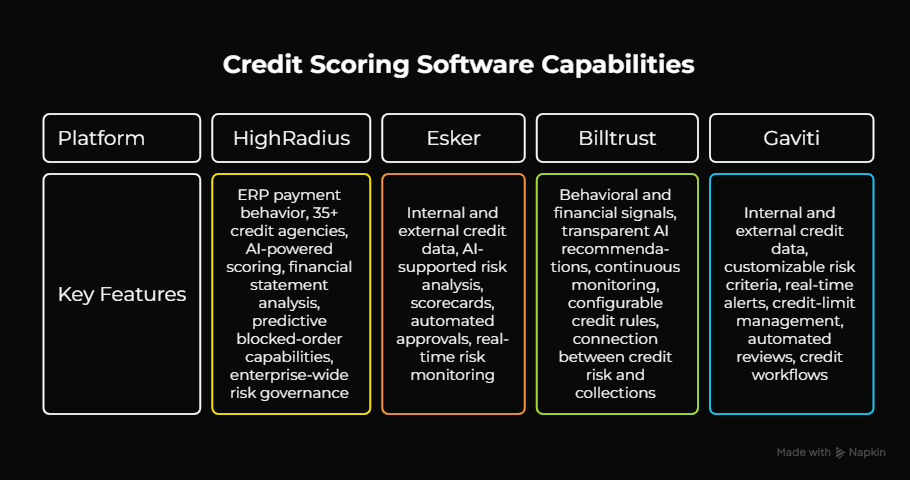
Credit Scoring Systems: HighRadius vs. Esker vs. Billtrust vs. Gaviti
The right credit scoring system should do more than assign a risk score. For B2B finance teams, it should combine customer and payment data, risk assessment, credit decisioning, and ongoing monitoring to help teams manage exposure before it impacts collections and cash flow.
Here’s how four platforms compare across the capabilities that matter most for modern B2B credit operations.
Vendor
Credit Scoring & Risk Management Strengths
HighRadius
Combines ERP payment behavior, 35+ credit bureau integrations, financial data, predictive AI scoring, continuous risk monitoring, and automated credit decisions. Its AI-led approach helps both growing mid-market teams and complex global enterprises automate routine reviews, monitor changing customer risk, and scale credit operations without proportionally increasing analyst workload.
Esker
Combines credit management with broader O2C workflow automation, including order management and collections. Its automation and workflow capabilities can help teams connect credit reviews with downstream receivables activity and manage risk as part of a broader O2C process.
Billtrust
Brings credit activity closer to invoicing, payment processing, and receivables workflows. Its emphasis on invoice and payment visibility can help credit teams incorporate customer payment activity into ongoing risk assessment and collections decisions.
Gaviti
Focuses on usability, automation, collections efficiency, and real-time receivables visibility. These capabilities can help teams connect credit activity with customer payment behavior and day-to-day collections workflows while modernizing credit operations.
What Are Credit Score Systems?
In Accounts Receivable, credit score systems help finance teams assess the creditworthiness of commercial customers and decide how much risk the business is willing to take. Unlike consumer credit scoring, B2B credit assessment considers a broader set of signals, including payment behavior, credit exposure, financial health, trade relationships, and external credit intelligence.
A modern credit score system connects four stages of the credit lifecycle:
1. Application
The process starts when a customer applies for credit. Credit application tools can capture company information, financial statements, bank and trade references, and supporting documents through a digital application. This gives credit teams the data needed to build a complete risk profile.
2. Scoring
The system combines internal and external signals to assess customer risk. Internal ERP data can include payment history, Average Days to Pay, past-due trends, credit utilization, and ordering behavior. External sources can add credit reports, ratings, financial information, and public filings.
This is where AI-led credit scoring models can help identify patterns across large volumes of customer data and support more consistent risk assessment.
3. Decisioning
A credit score becomes useful when it informs an action. A credit scoring solution with credit decisioning capabilities can translate risk assessments into credit-limit recommendations, review priorities, and approval workflows. Low-risk customers can move through predefined rules, while higher-risk accounts receive analyst attention.
4. Monitoring
Customer risk doesn't stop changing after approval. A credit scoring platform can continuously monitor payment behavior, utilization, financial health, and external risk signals using credit risk assessment software to identify deterioration and trigger timely reviews.
70% of Credit Scoring Software Never Delivers the Business Case It Promised.
Use this free vendor evaluation scorecard to find out if your credit platform will improve customer approval, risk review, and credit decision for years.
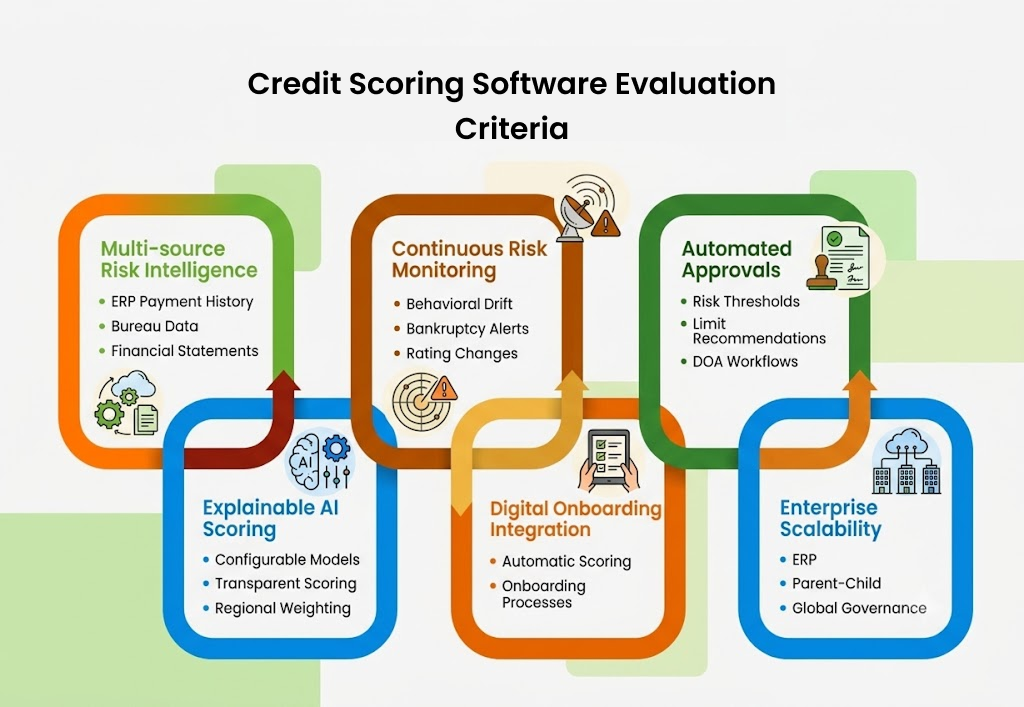
Not every credit scoring tool solves the same problem. A system may generate a risk score, but that alone does not tell finance teams whether it can support faster decisions, improve customer coverage, or help collections act before risk turns into exposure. We evaluated the four platforms against six capabilities that matter when finance teams assess modern credit score systems for Accounts Receivable:
1. Multi-Source Risk Intelligence
A reliable score needs more than a bureau report. We looked at whether each platform can bring together:
Internal ERP payment behavior — payment history, Average Days to Pay, past-due trends, credit utilization, and ordering behavior
External credit intelligence — credit bureau reports, ratings, public filings, and other third-party data
Financial information — financial statements and ratios that strengthen risk assessment
The more complete the data behind the score, the more useful it becomes for credit decisions.
2. Configurable and Explainable Scoring
A credit team should understand why a customer receives a particular risk score—not simply accept a number generated by a black box.
We evaluated whether each credit scoring solution supports:
Configurable scoring models and weightings
Customer, industry, regional, or exposure-based scoring criteria
Transparent scoring logic and explainable recommendations
This matters because different customers carry different levels and types of risk.
3. Connected Customer Onboarding
Credit scoring should start with the right customer data, not after analysts have spent hours collecting it.
We looked at whether the credit scoring platform can connect with digital credit applications and automatically use submitted customer information, financial statements, references, and supporting data to initiate risk assessment.
The key question: Can scoring begin as soon as the credit application is complete, without creating another manual handoff?
4. Continuous Risk Monitoring
A score becomes outdated when customer behavior changes but the assessment does not.
We evaluated whether each platform can continuously monitor signals such as:
Changes in payment behavior and credit utilization
Rating changes and financial deterioration
Bankruptcy and adverse-event alerts
Other behavioral shifts that warrant a review
The goal is to identify changing risk before it becomes a collections or bad-debt problem—not wait for the next annual review.
5. Automated Credit Decisions
Scoring should lead to action. We assessed whether each platform can turn risk assessments into:
Automated approval thresholds
Credit-limit recommendations
Low-risk auto-approvals
Delegation-of-authority workflows
Prioritized analyst reviews for higher-risk accounts
This is where AI tools for credit analysis can move beyond analysis and help finance teams reduce routine manual work.
6. Scalability Across Customers, Entities, and ERPs
A credit score system must work as the business grows. We evaluated whether each platform can support:
Complex parent-child customer hierarchies
Multiple legal entities and geographies
Multi-currency operations
Multiple ERP environments
Consistent credit policies and governance across the organization
For mid-market companies, scalability means supporting growth without continually adding manual work. For global enterprises, it means maintaining a consistent view of customer risk across complex environments.
Vendor Reviews
Four platforms can solve the same credit problem in very different ways. The difference comes down to the depth of risk intelligence, level of automation, integration with credit and collections workflows, and ability to scale with the business.
1. HighRadius
Best for: For all B2B organizations, from mid-market companies scaling beyond spreadsheet-driven credit reviews to global enterprises managing complex, multi-ERP credit operations.
Mid-market
For growing finance teams, HighRadius' credit scoring system combines AI-driven risk decisioning, automated approvals, and continuous risk monitoring to replace manual, spreadsheet-driven credit reviews. Its credit scoring capabilities bring together ERP payment behavior, external credit intelligence, public financials, and configurable scoring models.
Its AI agents can automate 80–90% of credit evaluations, while credit decisioning capabilities support faster onboarding and automated low-risk approvals.
This makes it relevant for mid-market organizations looking to increase credit-review capacity without adding analyst headcount. The broader workflow connects customer onboarding, scoring, approvals, and monitoring rather than treating credit scoring as a standalone activity.
Enterprise
For global enterprises, HighRadius extends the same credit decisioning capabilities across complex operating environments, with multi-ERP customer exposure, parent-child hierarchies, centralized credit intelligence, standardized policies across entities and geographies, and continuous risk monitoring.
It integrates with 35+ global credit agencies and combines external credit data with ERP payment behavior and financial information. Its predictive capabilities extend beyond scoring to blocked-order prediction, proactive risk alerts, credit-limit recommendations, and automated decisioning.
Considerations: The breadth of capabilities makes HighRadius particularly relevant for organizations looking to connect credit scoring with broader credit-management and O2C workflows rather than adopting scoring as an isolated capability.
Analyst Reports
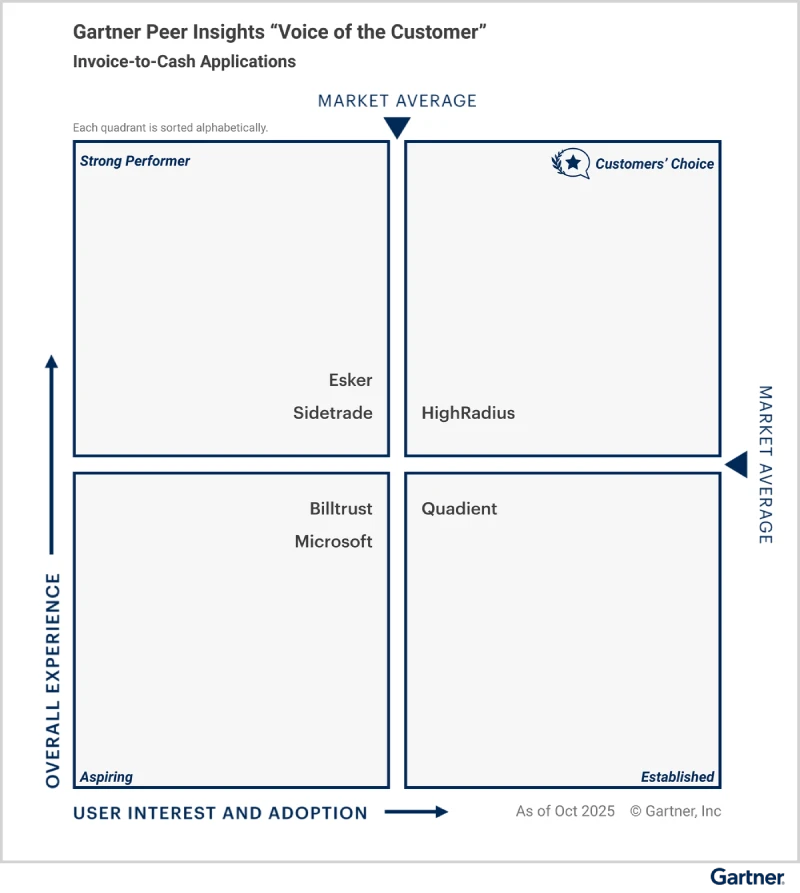
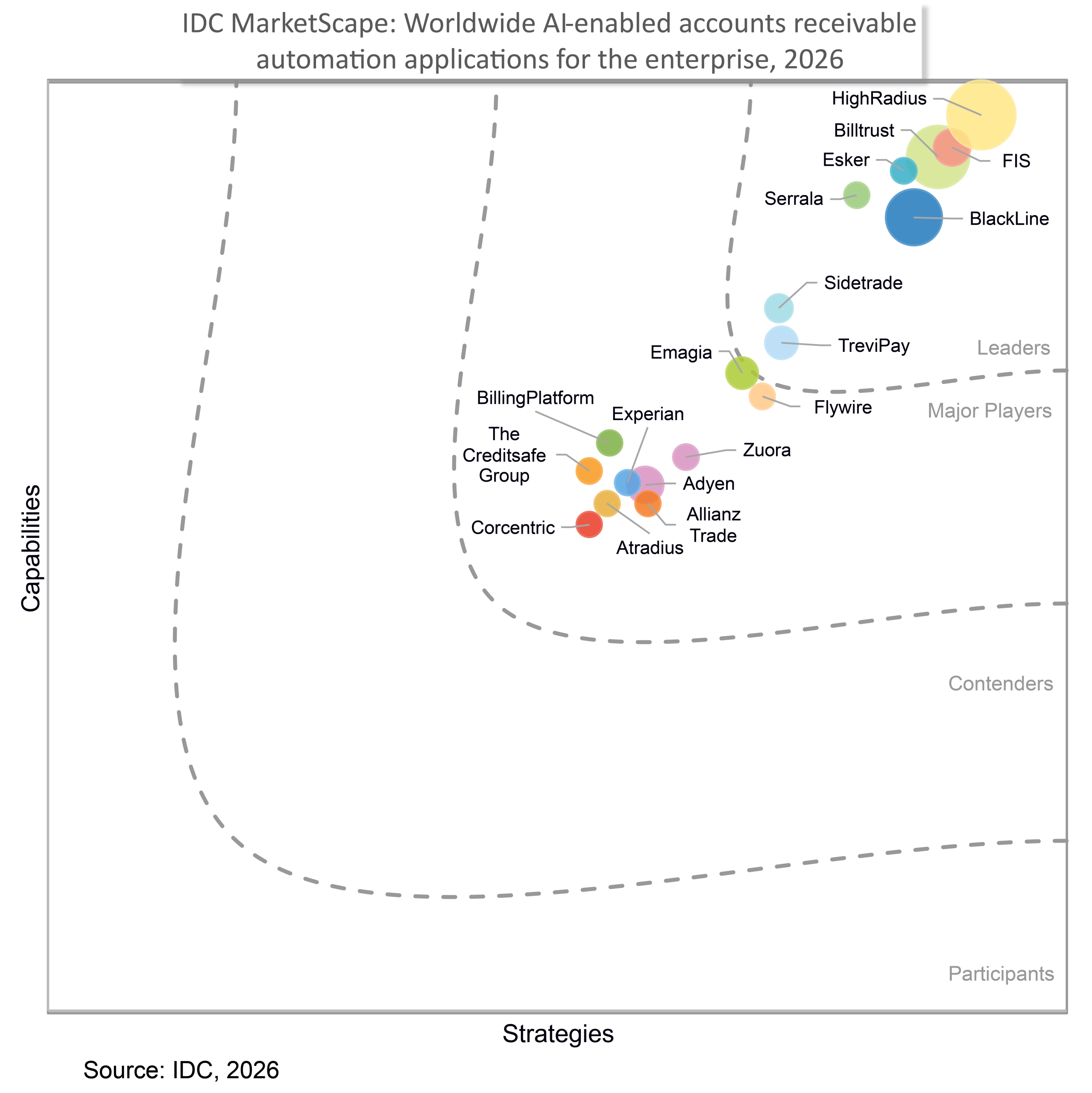
Recognized as an IDC MarketScape Leader in AR Automation
IDC recognized HighRadius for AI-driven AR automation across both enterprise and mid-market organizations.
Best for: Organizations looking to embed credit management within a broader AI-powered Procure-to-Pay environment.
For credit teams, Esker provides credit-management workflows, risk assessment, scorecards, external credit information, and automated approval processes. Its broader finance automation platform connects credit activity with receivables workflows.
Strengths: Broad procure to pay coverage, integrated credit and collections workflows, AI-driven automation, ERP connectivity, centralized receivables visibility.
Considerations: Organizations evaluating Esker specifically for credit scoring should assess how its broader platform approach aligns with their requirements for scoring depth, customization, decisioning, and credit-specific workflows.
61% of Companies Still Can't Prove AI Is Improving the Bottom Line.
Don’t be one of them. Use this credit analysis software buyer guide to buy solutions that scale across business and provide higher ROI.
Best for: B2B organizations looking to connect credit activity closely with payments, invoicing, and collections.
Billtrust brings credit and receivables activity closer together, with capabilities spanning credit assessment, payment behavior, invoicing, and collections. Its broader platform provides visibility into invoice and payment activity that can help credit teams incorporate customer payment behavior into ongoing risk assessment and collections workflows.
Strengths: Behavioral and financial risk signals, transparent AI recommendations, automated decisioning, continuous monitoring, credit-to-collections connectivity.
Considerations: Businesses evaluating Billtrust for credit scoring should assess how its credit capabilities align with requirements for scoring depth, governance, customization, and complex multi-entity credit operations.
4. Gaviti
Best for: Growing B2B organizations looking to connect credit and collections workflows with an emphasis on usability and streamlined day-to-day operations.
Gaviti combines credit management with collections, dispute management, cash application, and AR analytics. Its credit-management capabilities support digital credit applications, approval workflows, credit-limit management, and risk alerts. Configurable criteria around payment behavior, credit scores, and other risk factors can help teams align credit assessment with their internal policies.
Strengths: User-friendly workflows, integrated credit and collections, real-time risk alerts, customizable risk criteria, strong mid-market fit.
Considerations: Organizations evaluating Gaviti should assess how its capabilities align with their requirements for scalability, integration, customization, and credit governance as their operations grow.
How Much Is Manual Credit Management Costing You Every Year?
Every hour spent gathering credit information, updating ERP records, or reviewing customers has a measurable cost. Put a number on it before you invest.
There is no single approach to B2B credit scoring that fits every organization. The right platform depends on your credit operations, data environment, automation goals, the complexity of your customer portfolio and how well it orchestrates with end-to-end accounts receivable cycle, from replacing manual reviews in a growing finance team to standardizing credit decisions across global entities.
Use the guide below to evaluate platforms based on the capabilities that matter most to your credit and collections operation.
If your priority is
Look for…
Platform to evaluate
Why it may fit
Scale credit decisions without adding analyst headcount
Combines AI-led scoring, automated decisioning, and continuous monitoring to help growing teams increase review capacity without scaling manual effort at the same rate.
Connect credit with the wider O2C cycle
Credit, collections, and receivables workflows within one platform
Esker
Connects credit management with broader O2C workflows, helping teams incorporate credit activity into downstream receivables processes.
Use payment intelligence in ongoing credit assessment
Customer payment behavior, receivables visibility, risk signals, and credit-to-collections workflows
Billtrust
Brings credit activity closer to invoicing, payments, and receivables workflows, helping teams incorporate payment activity into ongoing risk assessment.
Simplify day-to-day credit and collections operations
Configurable workflows, risk alerts, credit-limit management, and usability
Gaviti
Combines credit and collections workflows with automation and receivables visibility to support streamlined day-to-day credit operations.
Standardize credit across entities, geographies, and ERPs
Each platform connects credit with downstream receivables activity, but the depth of scoring, automation, data intelligence, workflow coverage, and scalability varies.
Why Choose HighRadius for B2B Credit Scoring
Unlike traditional credit scoring software that relies on periodic bureau updates or static scorecards, HighRadius combines Agentic AI, internal ERP payment behavior, external credit intelligence, and continuous risk monitoring to help finance teams make faster, more accurate credit decisions. Whether you're a growing mid-market business replacing spreadsheet-driven reviews or a global enterprise managing complex credit portfolios, HighRadius delivers AI-powered credit scoring that scales with your business.
Here’s why finance teams choose HighRadius
Automate up to 80–90% of low-risk credit decisions with AI-powered scoring, automated approvals, and configurable credit policies.
Combine internal and external risk intelligence using ERP payment history, financial statements, and 35+ global credit bureau integrations to generate more accurate customer risk profiles.
Continuously monitor customer risk with AI Agents that detect behavioral payment changes, bankruptcy signals, rating downgrades, and other early warning indicators before they impact cash flow.
Accelerate customer onboarding by up to 70% with online credit applications, AI-driven scoring, and automated approval workflows that eliminate manual reviews.
Scale from mid-market to global enterprise operations with multi-ERP support, parent-child customer hierarchies, centralized policy governance, and predictive blocked-order prevention across regions.
Reduce bad debt exposure by up to 20% while enabling analysts to focus on high-value exceptions instead of repetitive manual reviews.
Case Studies
How this manufacturing giant unlocked 17,000+ annual credit reviews
Learn how FBM modernize credit operations with AI-driven scoring, automated workflows, and centralized visibility across entities.
How HighRadius Credit Risk Software Helps Improve Credit Risk Assessment
HighRadius credit management software helps finance teams move from periodic, spreadsheet-driven credit reviews to connected, AI-powered credit decisioning. The platform combines customer payment behavior, external credit intelligence, financial data, configurable scoring, automated approvals, and continuous risk monitoring to give teams a clearer view of changing customer risk. For mid-market companies scaling with lean credit teams, this means automating routine decisions and reducing manual reviews without adding headcount. For global enterprises, it brings credit risk visibility, policy governance, and decisioning across complex customer portfolios, entities, and ERP environments.
With real-time credit risk analysis software and credit decisioning software, you can receive alerts for any changes in your customers’ credit profile and make data-driven credit decisions from unlimited credit reports. Our software integrates with your ERP system and can start monitoring your customers in just 30 days.
We offer configurable credit scoring software and approval workflows that can be customized based on geography, customer segments, business units, and other factors. You can fast-track credit approvals through complex corporate hierarchies, making the credit application process more efficient and streamlined.
Our highly configurable online credit application allows you to onboard customers across the globe with multi-language, customized credit applications embedded on your website. You can automatically capture financials, personal guarantees, and check bank references, reducing the need for manual data entry.
Our software also automatically extracts credit data from over 40+ global and local agencies, including credit ratings, financials, and credit insurance information. You can configure the auto-extracted data in your preferred currency, making it easier to analyze and interpret.
With AI-based blocked order management, you can auto-predict blocked orders based on the customers’ credit limit utilization and payment history. You can leverage AI-based release or partial payment recommendations for faster credit decisions, reducing the need for manual intervention.
Struggling With Slow Credit Approvals and Credit Reviews?
Explore the #1 software that makes onboarding customer faster and easier
Accelerate payment recovery from delinquent customers and boost cash flow through automated collection workflows.
Cash App
Achieve same day cash application with automated remittance aggregation
Credit
Mitigate credit risk, reduce bad debt, and streamline customer onboarding with AI-powered insights.
Deductions
Reduce Revenue Leakage with AI Prediction models that identify valid and invalid deductions.
Online Credit Application
Onboard customers seamlessly with a configurable online credit application. Cut down on back-and-forth and collect all customer details in one go.
FAQs
1. What does credit scoring do for Accounts Receivable?
Credit scoring helps AR teams assess customer risk, set appropriate credit limits, prioritize reviews, and identify deteriorating accounts. Modern systems combine payment behavior, financial data, and external credit intelligence to support faster, more informed decisions.
Credit scoring helps AR teams assess customer risk, set appropriate credit limits, prioritize reviews, and identify deteriorating accounts. Modern systems combine payment behavior, financial data, and external credit intelligence to support faster, more informed decisions.
2. How does credit scoring software monitor customer risk?
Modern credit scoring platforms continuously track payment behavior, credit utilization, ratings, financial health, and other risk signals. When risk changes, they can alert credit teams, trigger reviews, or recommend changes to credit limits and approvals.
Modern credit scoring platforms continuously track payment behavior, credit utilization, ratings, financial health, and other risk signals. When risk changes, they can alert credit teams, trigger reviews, or recommend changes to credit limits and approvals.
3. Can credit scoring systems automate credit decisions?
Yes. Configurable scoring models, risk thresholds, and approval rules can automate routine low-risk decisions while routing higher-risk or exception cases to analysts. This helps teams reduce manual reviews without giving up control over credit policies.
Yes. Configurable scoring models, risk thresholds, and approval rules can automate routine low-risk decisions while routing higher-risk or exception cases to analysts. This helps teams reduce manual reviews without giving up control over credit policies.
4. How does credit scoring connect with collections?
Credit risk can directly inform collections priorities. When a customer’s risk increases, connected systems can alert both credit and collections teams, helping them tighten credit limits, prioritize exposed accounts, and act before deteriorating risk becomes a larger receivables problem.
Credit risk can directly inform collections priorities. When a customer’s risk increases, connected systems can alert both credit and collections teams, helping them tighten credit limits, prioritize exposed accounts, and act before deteriorating risk becomes a larger receivables problem.
5. Can credit scoring systems integrate with ERP and external data?
Yes. Modern systems can combine ERP payment behavior with external credit bureau data, financial information, and other risk signals. ERP integration also helps keep credit limits, customer exposure, payment activity, and credit decisions connected across the credit lifecycle.
Yes. Modern systems can combine ERP payment behavior with external credit bureau data, financial information, and other risk signals. ERP integration also helps keep credit limits, customer exposure, payment activity, and credit decisions connected across the credit lifecycle.
Resource Library
Resource Hub
Order to Cash
Order to Cash software data sheet
Disconnected workflows can leave teams chasing data, while automated O2C has delivered 20% lower past dues.
HighRadius recognized as a "Leader" in IDC Marketscape: Worldwide AI-enabled accounts receivable automation applications for the enterprise 2026 vendor assessment
Recognized as a Leader in 2026 Vendor Assessment for unifying credit, collections, cash application, deductions, e-invoicing, and payments on one AI platform to advance enterprise-wide invoice-to-cash transformation.
Forrester Recognizes HighRadius in The AR Invoice Automation Landscape Report, Q1 2023
Forrester acknowledges HighRadius’ significant contribution to the industry, particularly for large enterprises in North America and EMEA, reinforcing its position as the sole vendor that comprehensively meets the complex needs of this segment.