Order to Cash (O2C) Process Guide: Steps, Best Practices & Automation
Last Updated: 26 August, 2026
•
Anisha Jha Content Writer
2026 Automation Benchmark Report
HighRadius 2026 Automation Benchmark Report For The Office Of The CFO
Understand if your performance is on par with top 10% of the organizations. Identify gaps, best practices and know how you can drive value through Agentic AI-Driven Automation.
Inefficiencies or breakdowns at any step affect cash flow, working capital, and customer satisfaction. An order to cash automation software streamlines these stages by automating repetitive tasks, centralizing data, and providing real-time insights. When you deploy the best order to cash software, you not only accelerate the cycle but also reduce DSO by 30%, minimize errors, improve compliance, and free up your finance team to focus on strategy rather than manual processing.
The Order-to-Cash (O2C) process is the lifeblood of a business, flowing from the moment a customer places an order until the payment is securely in your bank account. Think of it as a relay race: different teams handle order management, credit checks, invoicing, and collections. Each handoff must be smooth to ensure the baton (your cash flow) crosses the finish line without dropping
In today’s fast-moving business environment, manual O2C processes are a severe bottleneck. Finance and operations teams struggle with siloed and reactive workflows. That’s why leading organizations invest in purpose-built order-to-cash software to unlock faster cash flow, reduce DSO, get higher accuracy, and ensure a frictionless customer experience.
In this guide, we’ll break down each stage of the end-to-end order-to-cash process flow, explore what makes an automation solution best-in-class, and share practical tips to modernize your cycle.
Order-to-Cash vs. Quote-to-Cash (Q2C)
It is easy to confuse these two terms, but they cover different parts of the customer journey:
Quote-to-Cash (Q2C): This is the larger, overall process. It includes everything that happens before the sale – like discussing exactly what the customer needs, creating a price quote, and signing a contract – as well as the final billing and payment.
Order-to-Cash (O2C): This is a smaller part of the Q2C process. It only begins after the contract is signed and the customer has officially placed the order.
Procure-to-Pay (P2P) vs. Order-to-Cash (O2C)
It is common to hear these two acronyms used together in finance, but they actually represent opposite sides of the corporate transaction coin:
Procure-to-Pay (P2P):Procure-to-Pay process is the purchasing process from your company’s perspective. It covers everything from requesting goods or services from a supplier, issuing a purchase order, receiving the supplier’s invoice (Accounts Payable), and sending the payment out. In this cycle, your company is the buyer.
Order-to-Cash (O2C): O2C is the sales process from your company’s perspective. It begins when a customer places an order with you, includes delivering the product or service, sending your invoice (Accounts Receivable), and collecting the cash. In this cycle, your company is the seller.
In short, P2P governs how money leaves your business to pay vendors, while O2C governs how money enters your business from customers.
How Top 1% Companies Modernized Their O2C Process
Learn how to build lasting cash flow impact through smarter O2C.
A company’s financial stability relies heavily on how well it manages its order-to-cash cycle. Basis our experience in transforming the process in over 1500s of companies, a highly efficient process provides three major benefits:
Faster Cash Flow: By speeding up order delivery and sending invoices immediately, businesses shorten the time it takes to get paid. This ensures the company always has cash on hand to pay its own bills and invest in growth.
Fewer Costly Errors: Manual typing often leads to mistakes, such as sending the wrong item or charging the wrong price. A streamlined, automated process prevents these errors, saving time and money.
Happier Customers: Customers want a smooth experience. When they receive their orders on time, get clear and accurate invoices, and have an easy way to pay, they are much more likely to do business with you again.
What Are The 8 Key Steps in the Order-to-Cash Process?
Step
Process Phase
Core Action
Business Impact & Best Practices
1
Order Management
Validate incoming purchase orders to ensure requested items are in stock, pricing matches the contract, and delivery details are accurate.
Catching data entry errors immediately prevents costly shipping and billing mistakes down the line.
2
Credit Management
Verify the customer’s financial reliability. Establish safe spending limits for new buyers and check current balances for existing accounts.
Protects the business from unpaid invoices and bad debt by ensuring orders do not exceed approved credit thresholds.
3
Order Fulfillment & Shipping
Route the approved order to the warehouse so the logistics team can locate, pack, and ship the correct items promptly.
Updating inventory records in real-time prevents selling out-of-stock items, avoiding delayed shipments and frustrated customers.
4
Customer Invoicing
Generate and send a highly accurate bill detailing purchases, total costs, taxes, and strict payment deadlines as soon as the product ships.
Using electronic invoicing ensures the bill arrives instantly, preventing it from getting lost and starting the payment clock immediately.
5
Accounts Receivable (Collections)
Monitor accounts as deadlines approach. If unpaid within the agreed timeframe, send polite reminders and follow up to resolve issues.
Consistent, professional communication secures the necessary cash flow without damaging the long-term customer relationship.
6
Dispute Resolution
Quickly investigate claims (deductions or short-pays) when a customer pays less than the full amount due to damaged goods, delays, or missing discounts.
Rapid resolution allows finance to approve valid discounts or swiftly recover the remaining balance if the deduction was an error.
7
Cash Application
Accurately match the incoming corporate bank payment to the specific open invoice it was meant to cover.
Officially clears the customer’s debt in the financial system and restores their available credit limit for future purchases.
8
Reporting & Data Analysis
Track key performance metrics across the entire cycle, such as Days Sales Outstanding (DSO), to measure collection speed.
Allows leadership to spot bottlenecks (like slow invoicing or high dispute rates) and implement strategies to make the cash flow engine run faster.
A successful O2C cycle requires different departments – like sales, the warehouse, and accounting – to work together smoothly. Here are the standard steps involved:
1. Order Management
The O2C cycle officially begins the moment a customer submits a purchase order, whether through an eCommerce portal, an email, or an automated system. The first priority is order validation. The company must quickly review the incoming order to ensure the requested items are in stock, the pricing matches the customer’s specific contract, and all delivery details are accurate. Catching data entry errors here prevents costly shipping and billing mistakes later on.
2. Credit Management
Before committing inventory to an order, the company needs to verify that the customer is financially reliable. For new buyers, the finance team reviews their credit history to establish a safe spending limit. For existing customers, checking their current account balance to ensure the new order will not exceed their approved credit threshold or add to overdue debt is important. This crucial step protects the business from unpaid invoices and bad debt. The best credit management software will help you be on top of your customers’ credit status without spending hours pulling reports from D&B or Experian. You can expedite customer onboarding 70% faster and do 3X credit reviews daily resulting in improved productivity and 30% lower blocked orders.
3. Order Fulfillment and Shipping
Once the customer’s credit is approved, the order is routed to the warehouse for fulfillment. The logistics team locates the correct items, packs them securely, and arranges for prompt delivery based on the carrier schedule. It is vital that inventory records are updated in real-time during this step. This prevents the company from accidentally selling out-of-stock items, which often leads to delayed shipments and frustrated customers.
4. Customer Invoicing
Billing delays directly cause payment delays, so timing is everything. As soon as the product ships or the service is delivered, the accounting team must generate and send an accurate invoice. This document needs to clearly outline exactly what was purchased, the total cost, any applied taxes, and the strict deadline for payment. Utilizing electronic invoicing software ensures the bill arrives instantly, preventing it from getting lost in the mail and starting the payment clock immediately thereby reducing DSO by upto 30%.
5. Accounts Receivable (Collections)
After the invoice is delivered, the Accounts Receivable (AR) team monitors the account as the payment deadline approaches. If a customer fails to pay within the agreed-upon timeframe (such as 30 days), the collections process begins. The team will send polite payment reminders and follow up with the customer to resolve any issues. Consistent, professional communication at this stage is key to securing the cash without damaging the customer relationship. Modern softwares like HighRadius Agentic AI AR Collections Software help with automated dunning for small customers and auto-upload of invoices to over 600 AP portals for large customers – thereby improving your team’s productivity by 30% and reducing DSO by 20%.
6. Dispute Resolution
In B2B transactions, it is common for a customer to pay less than the full invoice amount. This often happens if they received damaged goods, experienced a shipping delay, or expected a promotional discount. The company must quickly investigate these claims, known as deductions or short-pays. Rapid dispute resolution allows the finance team to approve valid discounts or swiftly recover the remaining balance if the deduction was a mistake.
7. Cash Application
Receiving the money in the corporate bank account is not the final step; the accounting team must correctly record it. Cash application is the process of taking that incoming bank payment and accurately matching it to the specific open invoice it was meant to pay. Once the payment is successfully matched, the customer’s debt is officially cleared in the company’s financial system, and their available credit limit is restored for future purchases. Automated Cash Application Softwares can help in driving 90%+ straight-through cash posting via automated remittance e-mails capture. This will ensure your team spends time focusing on pending invoices than applying cash manually.
8. Reporting and Data Analysis
The final component of a healthy O2C cycle involves looking back at the data from the entire process. Finance leaders track key performance metrics, such as Days Sales Outstanding (DSO), which measures the average number of days it takes to collect a payment. By analyzing this data, leadership can easily spot bottlenecks – like a slow invoicing step or a high number of disputes – and implement strategies to make the entire cash flow engine run faster.
What Are The Best Practices for a Strong Order-to-Cash Process?
Building a highly efficient O2C cycle requires more than just understanding the steps; it requires strong internal habits and clear guidelines. Implementing the following best practices can significantly improve your operations:
Track Key Performance Metrics: Consistently monitor numbers like Days Sales Outstanding (DSO) – which measures the average number of days it takes to collect payment. Tracking these cash flow metrics helps you quickly identify bottlenecks and measure improvement over time.
Standardize Customer Data Entry: Ensure that customer information (like billing addresses and contact details) is entered into your system exactly the same way every time. Clean data prevents invoices from being sent to the wrong person.
Establish Clear Payment Terms Upfront: Make sure your sales team clearly communicates payment expectations (like “Net 30” or late fee policies) before the contract is signed. This prevents confusion when the bill arrives.
Conduct Regular Credit Reviews: Do not just check a customer’s credit once during onboarding. Regularly review the financial health of your existing customers so you can adjust their credit limits if their payment habits change.
Break Down Department Silos: Encourage regular, transparent communication between your sales, fulfillment, and accounting teams. If the warehouse knows about a large upcoming order from sales, they can prepare inventory in advance
Automating Key Tasks: Automate key tasks such as credit reviews, electronic invoicing, collections management, dispute resolution and cash application to streamline the process and improve cash flow efficiency. You can learn more about order to cash automation in the linked blog.
Ebooks
2026 Playbook: AI vs Legacy AR Tools
Discover why AI-led AR is the new standard for speed, accuracy, and scale.
How To Fix Common Order-to-Cash Process Challenges?
Here are some challenges that businesses may face with the Order to Cash process:
1. Delays in order processing
Challenge: Orders can be delayed due to manual entry errors, verification issues, or slow fulfillment processes.
Solution: Implement automated order management systems to streamline the order process. Automation reduces manual errors and speeds up order entry, verification, and fulfillment, ensuring faster processing times.
2. Inaccurate billing and invoicing
Challenge: Errors in billing and invoicing can lead to disputes and delays in payment.
Solution: Adopt automated invoicing solutions to ensure accuracy and consistency. Automated systems can generate correct invoices and verify amounts before sending them to customers, reducing the risk of billing errors.
3. Inefficient payment collection
Challenge: Manual payment collection processes can be slow and prone to errors, affecting cash flow.
Solution: Utilize electronic payment systems to expedite transactions and improve security. Automated Dunning Software helps with payment reminders and follow-ups to streamline the collection process and enhance payment rates.
4. Poor visibility into accounts receivable
Challenge: Lack of real-time visibility into accounts receivable process can hinder effective management of outstanding invoices.
Solution: Integrate accounts receivable management tools with your O2C process. Use dashboards and reporting features to track outstanding invoices and monitor cash flow, providing better visibility and control.
5. Inconsistent credit risk assessment
Challenge: Inadequate or inconsistent credit risk assessment can lead to extending credit to high-risk customers.
Solution: Implement the best credit management software to consistently assess and monitor customer credit risk. Regularly review and adjust credit limits based on customer payment behavior and financial stability.
6. Inventory management issues
Challenge: Poor inventory management can lead to stockouts or overstock situations, affecting order fulfillment.
Solution: Integrate inventory management with the O2C process to ensure accurate tracking of stock levels. Automated systems update inventory in real-time, helping maintain optimal stock levels.
7. Communication breakdowns with customers
Challenge: Ineffective communication with customers can lead to misunderstandings and delays.
Solution: Establish clear communication channels and use automated notifications to keep customers informed about order status, payment due dates, and any issues. Regular contact helps address concerns promptly.
8. Manual and error-prone processes
Challenge: Manual processes can be error-prone and inefficient, leading to delays and inaccuracies.
Solution: Automate repetitive tasks such as order entry, billing, and implement invoice processing automation. Quality control measures should be implemented to ensure data accuracy and reduce manual errors.
9. Compliance and data security risks
Challenge: Ensuring compliance with financial regulations and protecting sensitive data can be challenging.
Solution: Implement secure systems and protocols to comply with regulations and protect customer information. Regularly review and update security measures to safeguard against data breaches.
10. Difficulty in managing customer disputes
Challenge: Handling customer disputes can be complex and time-consuming, impacting satisfaction and cash flow.
Solution: Develop a clear process for managing disputes and complaints. Use automated dispute management tools to track and resolve issues efficiently, aiming for timely resolution and improved customer satisfaction.
Addressing these challenges with effective solutions can streamline the O2C process, improve efficiency, and enhance financial outcomes for businesses. Learn our top strategies for optimizing the order to cash cycle.
Ebooks
How to Choose an O2C Solution that Drives Process Efficiency?
Discover key factors in SaaS O2C solutions to streamline processes, boost performance, and cut costs in postmodern ERP.
Difference Between Manual And Automated O2C Process?
Many businesses still rely on human workers to type data from one system to another. From our decades of digital transformation experience in finance, we have seen that moving to an automated O2C system provides a much smoother, faster experience for the teams and customers. In addition to that, it will also help in productivity gains up to 70% and improved DSO by 30% thereby adding value to the business.
Here is a simple comparison:
Step in the Process
Traditional Manual Approach
Automated O2C Approach
Entering Orders
Staff manually type order details from emails into the computer, which can lead to typos.
Software automatically reads and enters the order information instantly and accurately.
Checking Credit
Employees spend days reviewing financial reports to decide if a customer is trustworthy.
The system checks financial data and safely approves credit limits in real time.
Sending Invoices
Staff print and mail bills, or manually attach PDFs to emails.
The system automatically creates and emails accurate invoices the moment an order ships.
Applying Cash
Workers look at bank statements and manually match each payment to a customer’s bill.
Smart software automatically matches the incoming bank payments to the correct invoices.
Improve Your Order-to-Cash Process with HighRadius
Trusted by 1500+ companies to deliver speed-to-value, including P&G, Ferrero, Johnson & Johnson, and Danone, HighRadius has been a Gartner Magic Quadrant Leader 3 years in a row, placed highest in the ability to execute and furthest in the completeness of vision.
FreedaGPT, a Gen AI assistant integrated with LiveCube, a spreadsheet-like tool, helps manage data, analyze information, and generate insightful reports – all using simple, plain English commands.
HighRadius’ AI-powered accounts receivable automation platform can help streamline your O2C process and maximize cash flow. Here are some tangible benefits that can be realized in weeks: 10% DSO/Past Dues Reduction, 40% Productivity Improvement, 30% Net Recovery Rate Improvement & 20% Bad Debt Reduction.
Learn More about HighRadius’ Accounts Receivable Software
Achieve lower DSO, improved working capital, and enhanced productivity with our AI-powered accounts receivable platform that seamlessly integrates with modern ERPs.
Accelerate payment recovery from delinquent customers and boost cash flow through automated collection workflows.
Cash App
Achieve same day cash application with automated remittance aggregation.
Credit
Mitigate credit risk, reduce bad debt, and streamline customer onboarding with AI-powered insights.
Deductions
Reduce Revenue Leakage with AI Prediction models that identify valid and invalid deductions.
FAQs On Order To Cash Process
1. What is the O2C process?
The order-to-cash (O2C) process is the complete operational and financial lifecycle of a customer’s purchase. It begins the exact moment a buyer places an order and officially ends when their final payment is received and recorded in your accounting system. Simply put, it is the engine that turns sales into actual cash in the bank.
The order-to-cash (O2C) process is the complete operational and financial lifecycle of a customer’s purchase. It begins the exact moment a buyer places an order and officially ends when their final payment is received and recorded in your accounting system. Simply put, it is the engine that turns sales into actual cash in the bank.
2. What are the steps in order-to-cash process?
The order-to-cash process typically follows seven core steps to ensure a smooth, end-to-end transaction. These include order management, credit approval, inventory fulfillment and shipping, customer invoicing, accounts receivable (collections), cash application, and final reporting. Together, these steps seamlessly turn a customer’s purchase into realized revenue
The order-to-cash process typically follows seven core steps to ensure a smooth, end-to-end transaction. These include order management, credit approval, inventory fulfillment and shipping, customer invoicing, accounts receivable (collections), cash application, and final reporting. Together, these steps seamlessly turn a customer’s purchase into realized revenue
3. What is the difference between O2C and P2P?
Order-to-Cash (O2C) and Procure-to-Pay (P2P) are two opposite financial workflows within a business. The O2C process focuses on the sales side, managing how you sell goods and collect money from customers. Conversely, P2P focuses on the purchasing side, managing how you buy supplies and pay your vendors.
Order-to-Cash (O2C) and Procure-to-Pay (P2P) are two opposite financial workflows within a business. The O2C process focuses on the sales side, managing how you sell goods and collect money from customers. Conversely, P2P focuses on the purchasing side, managing how you buy supplies and pay your vendors.
4. What are the biggest challenges in the order-to-cash process?
The biggest challenges in the order-to-cash process include manual data entry typos, delayed invoicing, poor departmental communication, and slow payment collections. These bottlenecks typically arise when companies rely on disconnected, manual systems. Implementing integrated order-to-cash software helps eliminate these costly errors and speeds up the entire cycle.
The biggest challenges in the order-to-cash process include manual data entry typos, delayed invoicing, poor departmental communication, and slow payment collections. These bottlenecks typically arise when companies rely on disconnected, manual systems. Implementing integrated order-to-cash software helps eliminate these costly errors and speeds up the entire cycle.
5. How do you optimize the order-to-cash process?
You can optimize the order-to-cash process by standardizing how customer orders are entered and establishing clear payment terms upfront. Additionally, conducting regular credit reviews and breaking down communication silos between departments is crucial. Finally, replacing manual typing with automated billing and collection software drastically accelerates payment times.
You can optimize the order-to-cash process by standardizing how customer orders are entered and establishing clear payment terms upfront. Additionally, conducting regular credit reviews and breaking down communication silos between departments is crucial. Finally, replacing manual typing with automated billing and collection software drastically accelerates payment times.
6. Why is credit management a critical step in the order-to-cash process?
Credit management acts as a vital financial safeguard within the O2C cycle. By evaluating a customer’s credit history before shipping an order, a business ensures it is not extending credit to buyers who cannot pay. This proactive step prevents bad debt and keeps the company’s cash flow healthy.
Credit management acts as a vital financial safeguard within the O2C cycle. By evaluating a customer’s credit history before shipping an order, a business ensures it is not extending credit to buyers who cannot pay. This proactive step prevents bad debt and keeps the company’s cash flow healthy.
7. What does "cash application" mean in the O2C cycle?
Cash application is the final accounting step in the order-to-cash process. It occurs when the finance team takes the money received in the corporate bank account and matches it to the specific open invoice the customer was paying for. This step officially clears the customer’s debt in the financial system.
Cash application is the final accounting step in the order-to-cash process. It occurs when the finance team takes the money received in the corporate bank account and matches it to the specific open invoice the customer was paying for. This step officially clears the customer’s debt in the financial system.
8. How does the order-to-cash process impact customer satisfaction?
A well-run order-to-cash process ensures customers receive their exact orders on time and get accurate bills without pricing surprises. It also provides them with an easy, secure way to submit their payments. This frictionless purchasing experience builds trust, prevents frustration, and encourages repeat business.
A well-run order-to-cash process ensures customers receive their exact orders on time and get accurate bills without pricing surprises. It also provides them with an easy, secure way to submit their payments. This frictionless purchasing experience builds trust, prevents frustration, and encourages repeat business.
9. How does O2C automation improve cash flow?
Automation removes the dead time between process steps to significantly speed up payments. Because invoices are generated instantly upon shipping and payment reminders are sent automatically, customers receive their bills faster. This accelerates the collection cycle and keeps more available cash in the business’s bank account.
Automation removes the dead time between process steps to significantly speed up payments. Because invoices are generated instantly upon shipping and payment reminders are sent automatically, customers receive their bills faster. This accelerates the collection cycle and keeps more available cash in the business’s bank account.
10. What are the key metrics used to measure the order-to-cash cycle?
The most important metric is Days Sales Outstanding (DSO), which measures the average number of days it takes to get paid after a sale. Other key metrics include the order fulfillment rate, invoice accuracy rate, and the percentage of unapplied cash. Tracking these numbers helps businesses identify bottlenecks and speed up cash flow.
The most important metric is Days Sales Outstanding (DSO), which measures the average number of days it takes to get paid after a sale. Other key metrics include the order fulfillment rate, invoice accuracy rate, and the percentage of unapplied cash. Tracking these numbers helps businesses identify bottlenecks and speed up cash flow.
Resource Library
Resource Hub
Order to Cash
Order to Cash software data sheet
Disconnected workflows can leave teams chasing data, while automated O2C has delivered 20% lower past dues.
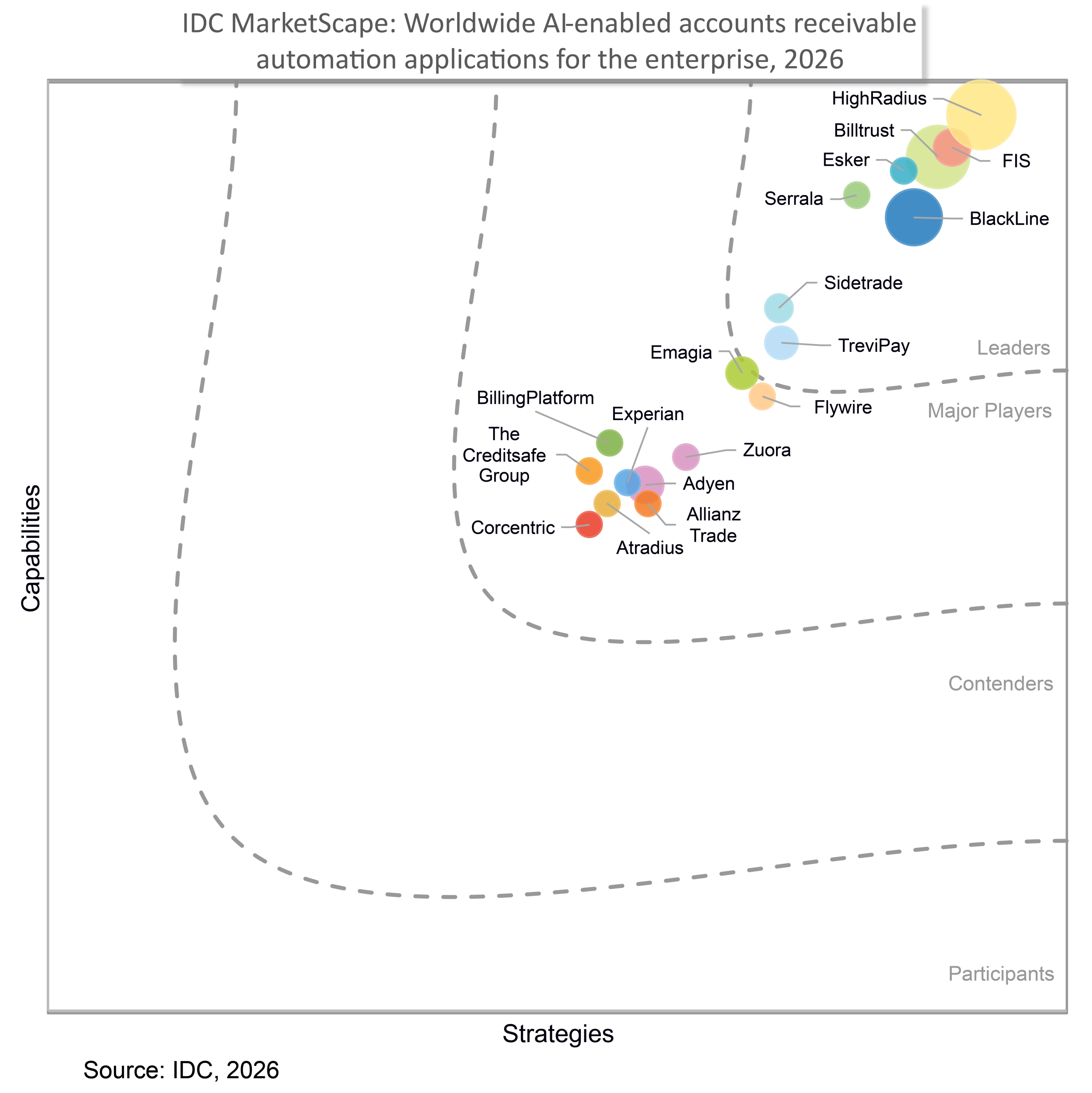
HighRadius recognized as a "Leader" in IDC Marketscape: Worldwide AI-enabled accounts receivable automation applications for the enterprise 2026 vendor assessment
Recognized as a Leader in 2026 Vendor Assessment for unifying credit, collections, cash application, deductions, e-invoicing, and payments on one AI platform to advance enterprise-wide invoice-to-cash transformation.
Forrester Recognizes HighRadius in The AR Invoice Automation Landscape Report, Q1 2023
Forrester acknowledges HighRadius’ significant contribution to the industry, particularly for large enterprises in North America and EMEA, reinforcing its position as the sole vendor that comprehensively meets the complex needs of this segment.