Automated Cash Application: A Strategic CFO Priority in 2026
Last Updated: 20 May, 2026
•
Divya Verma Finance Content Expert
D
Divya Verma
Divya Verma specializes in finance transformation strategy, bringing a content-driven perspective to the rapidly changing FinTech space. With seven years of experience navigating the B2B SaaS landscape, she understands how modern finance leaders think and delivers insights that speak directly to their priorities. When she is not analyzing the latest in enterprise finance, Divya enjoys traveling and getting lost in a good book. Her writing is rooted in sharp domain thinking and a deliberate focus on clarity that finance leaders can act on.
2026 Automation Benchmark Report
HighRadius 2026 Automation Benchmark Report For The Office Of The CFO
Understand if your performance is on par with top 10% of the organizations. Identify gaps, best practices and know how you can drive value through Agentic AI-Driven Automation.
For most cash application teams, the workday often starts with a high volume of payments but very little clarity on where they actually belong. Money hits the bank account, but the details needed to apply it are usually buried in an inbox, a customer portal, or a PDF attachment somewhere else. This gap between receiving a payment and actually posting it is a major time-sink. In fact, research shows that 27% of an analyst's time is spent just linking payments with email remittances.
Manual cash application creates delays, errors, and inefficiencies that frustrate finance teams and slow down cash flow. That’s why more businesses are turning to automated cash application to streamline payment matching, reduce errors, and accelerate reconciliation.
In this blog, we’ll explore the key benefits of cash application automation, the features to look for in cash application software, and why enterprises are adopting it to transform their AR operations.
What Is Cash Application Automation?
Cash application automation, also referred to as automated cash application, is the process of using AI and machine learning to automatically match incoming payments with open invoices. Instead of finance teams manually reviewing bank statements, remittances, and ERP records, automated cash application software handles the reconciliation process in seconds.
Unlike manual cash application, which is slow, error-prone, and heavily dependent on human effort, automation solutions streamline accounts receivable (AR) workflows.
By leveraging AI-driven tools, automated remittance capture, and seamless ERP integrations, cash app automation allows organizations to process payments faster, improve accuracy, and free up AR teams for higher-value tasks like exception handling and customer relationship management.
HighRadius: Recognized Leader 3 Years in a Row in Gartner® Magic Quadrant™ for Invoice-to-Cash
What Are The Steps In The Cash Application Process?
Cash application is a critical process in managing accounts receivable and cash flow. It involves matching incoming payments with open invoices to ensure accurate and timely posting of payments. Cash application teams receive checks, ACH, wire, or card payments and match those payments with the outstanding invoices to mark them as paid.
However, this seemingly simple process can be complicated and error-prone due to several factors, such as incomplete or inaccurate remittance advice, discrepancies between payment amount and invoice amount, and deductions taken from payments.
Is Your Cash Application Process Leaking Capital?
Use this Excel-based ROI calculation template to quantify your potential savings through automated cash application.
Here are the six major steps that cover the cash application process flow:
Aggregating Payment and Remittance Data Gathering payment notifications from banks while simultaneously collecting remittance details trapped in emails, PDF attachments, and customer portals.
Linking of Payment & Remittance Pairing disconnected bank line items with their corresponding remittances. This is a manual "detective" process that currently consumes 27% of analyst time.
Matching Payments to Open Invoices Verifying that the payment amounts align perfectly with specific open line items in your ERP to ensure accounts are accurately credited.
Identifying & Coding Deduction Investigating short-payments or discounts and applying the correct internal reason codes to ensure the ledger reflects why the full amount wasn't paid.
Handle Exceptions Researching missing invoice numbers or unidentified senders to resolve "unapplied cash" and clear the "stop signs" in the reconciliation workflow.
Posting Cash to the ERP The final transfer of verified, clean data directly into your ERP system to align your aging report with your actual bank balance in real-time.
Why Should Businesses Automate Cash Application?
Automating the cash application process can bring significant benefits to organizations in terms of efficiency, accuracy, and cost savings. Manual cash application processes can be time-consuming and error-prone, leading to delays in posting payments and strained relationships with customers.
Additionally, organizations end up spending a lot on FTE costs, processing fees for third-party vendors, or bank lockbox key-in fees, making cash application an expensive process.
Don’t Let Manual Cash Application Drain Your Team’s Potential
See how modern finance teams achieve 90%+ automation in cash application with AI agents.
The most common hurdle is the lack of "clean" data for matching. While payments hit the bank via ACH or Wire, the remittance advice is often decoupled, arriving separately via email bodies, PDF attachments, or customer A/P portals. Manually aggregating these unstructured sources to identify which invoices are being settled is a repetitive task that prevents same-day cash posting.
2. High Volume of Unidentified Payments and MICR Failures
When a payment arrives without a recognizable MICR (Magnetic Ink Character Recognition) match or a valid customer reference, it falls into the "Unidentified Cash" bucket. Without cash application automation, analysts must manually cross-reference bank details with historical data or search customer portals to solve the mystery, leading to a growing backlog of unposted funds.
3. Manual Deduction Coding and Short-Pay Research
When a customer takes a trade discount or makes a short-payment, the straight-through process grinds to a halt. Analysts must stop to investigate the discrepancy and manually map the customer’s reason code to your internal ERP deduction codes. This research-heavy task is often the primary reason for a delayed month-end close.
4. Sub-ledger Latency and Re-keying Errors
Manual posting is inherently slow, creating a "data lag" in your A/R Sub-ledger. This latency means your records don't reflect the bank balance in real-time. Furthermore, manual data entry into the ERP increases the risk of transcription errors, which eventually require time-consuming course corrections during bank reconciliation.
5. Low Straight-Through Processing (STP) Rates
A manual workflow is limited by the speed of human review. Without automated cash application, your STP rates remain low because every "exception", like a missing invoice number or a penny difference requires a person to touch the file. Automation allows you to move to exception-based processing, where only the truly broken files need human eyes, while everything else posts touchlessly.
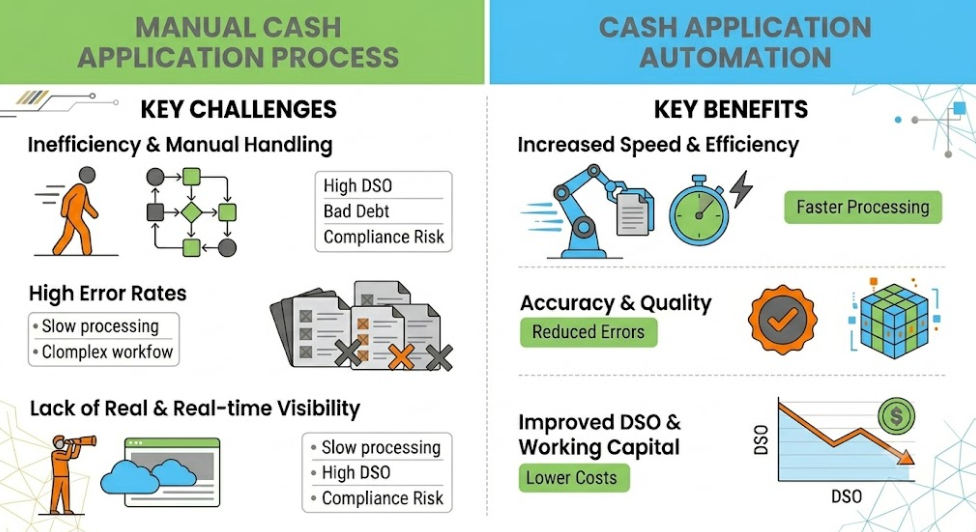
Below the table explains how automated cash application differs from manual cash application process.
How does cash application automation works?
Cash application automation transforms the manual, error-prone task of matching payments into a touchless, high-speed digital workflow. The process follows 5 critical steps:
Step 1: Autonomous Remittance Capture
Cash application system autonomously extract data from 500+ portals, unstructured emails, and digital check images. This converts messy attachments into structured digital records, eliminating the need for manual data entry.
Step 2: Real-Time Bank Integration
The system pulls electronic bank feeds and lockbox files to identify incoming payments the moment they arrive. This ensures every credit signal is immediately available to be paired with its corresponding remittance.
Step 3: AI-Powered Multi-Way Matching
The engine performs a multi-way match between captured remittances, bank payments, and open invoices in the ERP. It identifies complex payment patterns, achieving a higher straight-through processing rate without human intervention.
Step 4: Intelligent Exception Management
For mismatches or short payments, AI provides pattern-based recommendations and automatically codes deductions. This replaces manual research, allowing analysts to resolve complex exceptions with a single click.
Step 5: Instant ERP Posting
Validated matches are posted directly to the ledger, closing open invoices and instantly refreshing customer credit lines. This provides real-time cash visibility and ensures the sub-ledger is always accurate.
Automated cash application can reduce operating costs by streamlining cash posting steps and eliminating the need for manual data entry, reconciliation, and fetching. With more than 95% straight-through cash posting rates, businesses can reduce their processing costs and improve their bottom line.
Top 8 Benefits of Automating the Cash Application Process
With cash app automation, payments and remittances are auto-matched to invoices, reducing processing time dramatically. The benefits of automating your cash application process are many, let’s take a closer look at some of them below:
1. Touchless Auto-Cash Posting
Automatically match incoming payments to outstanding invoices without any manual effort. By leveraging smart algorithms, the software reduces processing time, lowers the risk of human errors, and accelerates payment reconciliation. This allows your finance team to focus on strategic tasks rather than spending hours on repetitive cash posting.
2. Faster Exception Handling
Cash application software speeds up the way your finance team deals with payment issues. Automated cash application workflow instantly spot mismatched or problematic payments, such as short payments, missing remittance information, or overpayments. Using AI and pre-set rules, these exceptions are flagged and routed to the right team for quick resolution, helping reduce delays and keeping your cash application process smooth and efficient.
3. Improved Item Automation Rates
Cash application software boosts the number of line items processed automatically, minimizing the need for manual intervention. By handling more transactions through automation, your finance team experiences fewer errors, less repetitive work, and faster processing times. This not only improves overall accuracy but also frees up staff to focus on higher-value tasks, enhancing operational efficiency across the board.
Templates
Build Your Business Case for Cash Application Automation
Project your ROI and build a data-backed case for automated cash application with our Excel template.
Automating repetitive, time-consuming tasks like payment posting, remittance matching, and exception management with cash application system frees up valuable hours for your finance team. This allows them to focus on strategic, high-value work, improving productivity while reducing operational costs.
5. Increased Accuracy and Reduced Errors
Automation minimizes manual data entry and reconciliation errors, helping your finance team avoid costly mistakes. At the same time, it ensures invoices are matched accurately, maintaining consistent and reliable financial records for better decision-making.
6. Enhanced Team Productivity
By reducing repetitive tasks, finance teams gain more time to focus on strategic, high-value initiatives that drive business impact. Automated remittance matching handles multiple payment formats and sources seamlessly, streamlining processes and boosting overall team efficiency.
7. Improved Customer Experience
Faster payment processing ensures customers receive timely updates on their payment status, keeping them informed and confident. Accurate matching also minimizes errors that could lead to payment disputes, helping strengthen relationships and boost overall customer satisfaction.
8. Reduced Operational Cost
Manual cash application is expensive, often involving high per-transaction "key-in" fees charged by banks for lockbox services. By using AI to capture remittance data directly from check stubs and electronic files, you can eliminate these bank fees entirely. This results in increased productivity and faster cash application rates.
9. Scalability for Growing Businesses
Designed to handle high volumes of payments effortlessly, this solution grows with your business without needing extra resources. It also integrates smoothly with existing ERP and financial systems, making the transition to automation seamless and hassle-free.
How Cash Application Automation Impacts Cash App Teams' KPI?
CFOs are prioritizing implementing cash application system to accelerate cash flow, reduce errors, and free finance teams for strategic work. Automated cash application helps cash app team improve following KPIs:
1. Straight-Through Processing (STP) Rate
This is the "no-touch" metric. It measures the percentage of payments that match and post to your ERP without any human intervention.
The Impact: Most manual teams have an STP impacted by manual cash app process. With automated cash application, that number usually jumps to 90% or higher. This means 9 out of 10 payments post themselves while your team is still having their morning coffee.
75% Payments Happened Automatically and the Team Did Less
Invoice delivery, ACH payments, real-time tracking, all on autopilot. Here’s how Addison Group made invoicing effortless.
This tracks how long it takes from the moment money hits the bank to when it is actually applied to the customer’s account in the ERP.
The Impact: In a manual setup, it’s common for payments to sit for 2–3 days while the team searches for remittances. Automation enables same-day cash posting, ensuring your Aging Report is always an accurate, live reflection of what is actually owed.
3. Unapplied Cash Volume
This is the total amount of money sitting in your "suspense" or unidentified accounts because it couldn't be matched to an invoice.
The Impact: High unapplied cash makes month-end a nightmare. Automation uses AI to identify MICR matches and suggest the right reason codes for short-pays. This keeps the unidentified queue small and ensures the "mystery" payments don't pile up.
4. Cost Per Payment Processed
This is the total cost (bank fees + team labor) of processing a single check or ACH payment.
The Impact: Manual posting is expensive because of high bank "key-in" fees and the hours spent on data entry. By removing those bank fees and allowing your team to handle much higher volumes without extra help, the cost to process each payment drops significantly.
Losing $250K a Year—Without Even Noticing?
Manual cash application might be bleeding your bottom line. Before you sink another dollar into manual AR, find out how much you could be really saving.
10 Proven Tips for Successful Cash Application Automation
Automating the cash application process can have a significant impact on an organization’s financial health. However, it’s essential to consider the right focus areas to ensure a smooth transition to automation. Here are the top ten focus areas that any A/R leader should consider while automating their cash application process:
1. Capture of Remittances from Multiple Sources
You should automate the capture of remittance details across emails(both email body and attachments), web portals, EDIs, and other formats. Additionally, you must accept all standard file formats, including CSVs, PDFs, JPEG, PNG, XML, HTML, excel.
Want to overcome remittance challenges and build a seamless workflow for checks and e-payments?
2. Accurate Capture of Check Remittance to Reduce Lockbox Key-In Fees
To reduce dependency on bank lockbox key-in fees or in-house resources, cash application teams should leverage AI-based OCR engines to accurately capture check stub information. This is how they can eliminate lockbox key-in fees.
3. Automatic Linking of Remittance and Payments for e-Payments
For electronic payments, customers send cash remittances through emails, EDIs, or even upload them to their A/P portals. Cash application teams manually extract these remittances and map them to the incoming payments with the correct invoice number, payment data, etc. However, exceptions often arise due to incomplete and non-standard remittance information. Organizations should implement cash application automation to automatically link payment and remittance files for e-payments.
4. Customer Identification for Incoming Payments
As soon as the payment information is received, the cash application system should be able to auto-match the payments to the customers’ open invoices. Customer identification takes place through customer reference fields such as MICR and IBANs for checks and account numbers in the case of e-remittance and payments.
Mapping payments to customers is often complicated due to the parent-child relationships. In some scenarios, sales invoices are closed on a parent account level, but the deductions are posted at the child level. Technology should help your cash application teams to identify and map parent-child relationships in the customer master to avoid exceptions during cash posting.
6. Open A/R Invoice Matching and Exception Handling
Cash application teams often encounter exceptions such as missing remittance information or incorrect invoice number. This leads to unapplied payments or, sometimes, delays in cash posting. How could you prevent unapplied and misapplied payments?
The answer is through automation. Cash application automation should be able to match invoices to payments even in exceptions with the help of AI-based technology.
7. Short-Payment Identification and Application of Reason Codes
Sometimes, customers make short payments and might not share the reason code information how you expect them to. An ideal cash application system should identify short payments and map the customer-provided reason code to your internal reason codes.
8. Post Cash Directly to Your ERP
Cash application system should be able to generate output files that are compatible with any ERP system. This requires the capability to generate file formats as per the particular ERP system’s requirements, including BAI, EDI, and several others. Therefore it reduces the manual effort to reconfigure the file, and the cash directly gets posted to the ERP system.
9. AI and Machine-Learning to Contextual Intelligence
Cash application teams would ideally want to encounter fewer exceptions so that they can spend more time on root-cause analysis. With the help of AI and machine learning algorithms, the auto cash application tool can self-learn from the exceptions and the analyst behavior in the past so that these exceptions can be automatically resolved in the future without human intervention.
10. Generate Performance Metrics and Reports
Automation in cash application should help A/R managers and executives to monitor day-to-day activities, analyst KPIs, and cash application process metrics. With intuitive reports and dashboards, the C-suite will be able to analyze the performance of the cash application process in O2C on a global and regional scale.
Case Studies
Achieved 96% automated cash application
See how RedBull streamlined its cash application process, achieving 96% straight-through cash application
Key Features of Cash Application Automation Software
Modern cash application systems are built with advanced technology to maximize accuracy and speed. Some of the most critical features include:
AI-driven invoice matching – Automatically matches payments with invoices, even when remittance data is missing or incomplete.
Bank & ERP integration – Connects seamlessly with banks and ERP systems to pull real-time payment data.
Auto reconciliation – Ensures transactions are reconciled instantly without manual intervention.
Exception handling – Flags discrepancies and routes them for quick resolution, reducing write-offs.
Remittance capture – Extracts remittance data from multiple sources (emails, portals, EDI, PDFs) to improve accuracy.
These features often overlap with payment matching automation, AI reconciliation software, and auto cash posting, giving finance teams a complete toolkit for reducing delays and errors in the AR cycle.
Choosing The Right Vendor To Automate Cash Posting
When choosing a vendor for automating cash application, it’s crucial to consider the benefits and features of their solution. This chapter will help you develop a business case for implementing cash allocation system, focusing on identifying and quantifying the benefits of the solutions provided by various vendors
To choose the right vendor, here are the questions you should ask before buying or implementing the automated cash application solution:
IT Effort:
How much internal IT effort is required to implement the solution?
Does the solution work with your existing ERP, or will additional IT efforts be required?
Will you need to re-code RPA systems every time there’s a new payment or remittance format?
Is the solution on-premise or cloud-based?
Implementing an automatic cash application system can require significant internal IT effort. With HighRadius’ Cash Application Software, you can minimize that effort. The automation system is designed to work seamlessly with your existing ERP, eliminating the need for additional IT efforts. HighRadius’ cloud-based solution also ensures that you don’t have to re-code RPA systems every time there’s a new payment or remittance format.
Cost:
Does the automation tool have an annual or monthly payment scheme?
What is the ROI from the vendor’s other implementations with customers?
It is essential to consider the cost of the automated cash application system while choosing any vendor. HighRadius’ automated cash application system offers a budget-friendly annual payment scheme for organizations of all sizes. Additionally, the ROI from HighRadius’ other implementations with customers has been significant, improving financial health and cash application processes.
Purpose-built:
How customizable is the cash application system?
Would the vendor be able to custom-build features based on your business requirements?
Customization is crucial when it comes to automating your cash application process. HighRadius’ cash application tool is highly customizable, and the vendor can custom-build features based on your business requirements. This makes the solution purpose-built for your specific needs, ensuring maximum benefits.
Decision-making:
Will the solution only follow a set of rules, or will it also assist in decision-making?
A cash application solution should not only follow a set of rules but should also assist in decision-making. HighRadius’ AI and ML-based proactive exception-handling features enable the solution to self-learn from the exceptions and analyst behavior in the past. This allows for better decision-making and proactive handling of exceptions.
When evaluating vendors, it’s essential to consider these factors to ensure that the selected solution meets your business needs and provides maximum benefits. By choosing HighRadius as your vendor for automating cash posting, you can benefit from key features such as 100% automated remittance aggregation, automated invoice matching, and faster exception resolution. HighRadius’ solution is purpose-built, and customizable, and assists in decision-making, providing maximum benefits for your business.
Why Businesses Are Adopting Cash App Automation in 2026
The shift toward digital AR automation has accelerated as companies face increasing transaction volumes and tighter working capital goals. In 2026, businesses can no longer afford the inefficiencies of manual processes.
According to recent market studies, over 70% of enterprises are investing in AR automation, with cash application as a top priority. Companies report up to 80% faster invoice-to-cash cycles and 40–60% reductions in manual workload after adopting cash app automation software.
Beyond efficiency, the future of cash application automation lies in predictive intelligence, systems that not only match payments but also forecast potential exceptions, blocked orders, and customer payment trends. This makes cash application automation a must-have for CFOs and AR leaders aiming to stay competitive in 2026 and beyond.
How HighRadius Can Help Automate Your Cash Application Process
HighRadius provides an AI-powered cash application automation solution designed to eliminate the manual effort of matching payments to invoices. As a 3X Gartner Magic Quadrant Leader for Invoice-to-Cash, HighRadius helps AR teams move away from repetitive data entry toward intelligent, exception-based processing.
Why Leading AR Teams Choose HighRadius for Cash Application Automation:
Same-Day Cash Posting: Align your aging report with your bank balance instantly. Real-time posting ensures your collections team isn't calling customers for invoices that have already been settled.
95% Straight-Through Processing (STP): Our AI-driven matching engine achieves industry-leading STP rates, allowing the vast majority of your payments to post toothlessly to your ERP, including SAP, Oracle, and NetSuite.
Zero Bank Lockbox Fees: By using AI-based OCR to capture remittance data directly from check stubs and electronic files, HighRadius eliminates the need for expensive bank "key-in" services.
Automated Remittance Aggregation: Our software automatically pulls remittance data from email bodies, attachments, and over 500+ customer portals, reclaiming the analyst time usually lost to manual searching.
AI-Powered Exception Handling: For short-payments or missing invoice numbers, the system suggests the most likely match based on historical patterns, turning hours of research into a single click.
Learn more about HighRadius' Cash Application Management Software
Achieve same day cash application with automated remittance aggregation
Automatically capture remittances – from any source, in any format.
Remittance Auto-Matching
Cut down manual effort by 95%. Payments auto-matched before your first coffee.
AI Guided Exception Management
Staying late to manage exceptions? Manage exceptions at 2X speed with AI predictions.
FAQs on Cash Application Automation
1. Is it possible to achieve 100% cash application process automation?
The cash application process in O2C can be automated, and across industries, the A/R teams have achieved more than 95% straight-through cash posting. While the cash posting rates differ with industries because of their unique business problems, organizations should always focus on improving their cash application process and analyst productivity.
The cash application process in O2C can be automated, and across industries, the A/R teams have achieved more than 95% straight-through cash posting. While the cash posting rates differ with industries because of their unique business problems, organizations should always focus on improving their cash application process and analyst productivity.
2. What are the benefits of cash application automation?
Cash application automation provides numerous benefits such as improved efficiency, reduced errors, faster exception resolution, and enhanced cash flow visibility. It also frees up time for your finance team to focus on more strategic tasks, making your organization more productive and profitable.
Cash application automation provides numerous benefits such as improved efficiency, reduced errors, faster exception resolution, and enhanced cash flow visibility. It also frees up time for your finance team to focus on more strategic tasks, making your organization more productive and profitable.
3. What is the most appropriate method of cash application?
The most effective cash application method is to implementing automation solution. These systems quickly matches payments to invoices using AI and machine learning, improving accuracy, speed, and efficiency. By eliminating manual data entry, it reduces errors, speeds up processing, and enhances cash flow, making it ideal for businesses managing high transaction volumes.
The most effective cash application method is to implementing automation solution. These systems quickly matches payments to invoices using AI and machine learning, improving accuracy, speed, and efficiency. By eliminating manual data entry, it reduces errors, speeds up processing, and enhances cash flow, making it ideal for businesses managing high transaction volumes.
4. How does automated cash application system reduce errors?
Automated cash application simplifies payment matching, remittance capture, and reconciliation, eliminating manual data entry mistakes, reducing exceptions, and improving accuracy across accounts receivable workflows.
Automated cash application simplifies payment matching, remittance capture, and reconciliation, eliminating manual data entry mistakes, reducing exceptions, and improving accuracy across accounts receivable workflows.
5. Is cash application automation suitable for enterprise & mid-market finance teams?
Yes. Enterprise & Mid-market teams benefit from scalable automation, multi-entity support, ERP integration, and AI-driven exception handling, enabling faster processing and improved cash flow visibility.
Yes. Enterprise & Mid-market teams benefit from scalable automation, multi-entity support, ERP integration, and AI-driven exception handling, enabling faster processing and improved cash flow visibility.
6. What payments can cash application automation handle?
It handles ACH, wire transfers, checks, credit cards, and electronic remittances, automatically matching them to invoices for seamless reconciliation in accounts receivable.
It handles ACH, wire transfers, checks, credit cards, and electronic remittances, automatically matching them to invoices for seamless reconciliation in accounts receivable.
7. How does AI improve cash application automation?
Automated cash application leverages AI to identify patterns, predicts exceptions, auto-match invoices, and continuously learn from historical data to reduce errors and accelerate cash posting.
Automated cash application leverages AI to identify patterns, predicts exceptions, auto-match invoices, and continuously learn from historical data to reduce errors and accelerate cash posting.
8. Can cash application automation system integrate with my ERP?
Yes. Modern cash application systems integrate with major ERP systems, banks, and payment portals, ensuring real-time data synchronization for accurate and efficient cash application.
Yes. Modern cash application systems integrate with major ERP systems, banks, and payment portals, ensuring real-time data synchronization for accurate and efficient cash application.
Resource Library
Resource Hub
ASSETS
12 Collection Strategies for Every Aging Bucket (FREE)
Optimize collections across aging buckets with data-driven strategies that reduce costs and improve recovery rates.
HighRadius Named as a Leader in the 2024 Gartner® Magic Quadrant™ for Invoice-to-Cash Applications
Positioned highest for Ability to Execute and furthest for Completeness of Vision for the third year in a row. Gartner says, “Leaders execute well against their current vision and are well positioned for tomorrow”
HighRadius Named an IDC MarketScape Leader for the Second Time in a Row For AR Automation Software for Large and Midsized Businesses
HighRadius stands out as an IDC MarketScape Leader for AR Automation Software, serving both large and midsized businesses. The IDC report highlights HighRadius’ integration of machine learning across its AR products, enhancing payment matching, credit management, and cash forecasting capabilities.
Forrester Recognizes HighRadius in The AR Invoice Automation Landscape Report, Q1 2023
Forrester acknowledges HighRadius’ significant contribution to the industry, particularly for large enterprises in North America and EMEA, reinforcing its position as the sole vendor that comprehensively meets the complex needs of this segment.