According to a recent McKinsey survey of senior credit-risk leaders from 24 major financial institutions, 20% have already implemented at least one generative AI use case in credit, while another 60% plan to do so in the next year. In other words, nearly 80% of major lenders and B2B credit providers are preparing to embed AI deeply into their credit-risk workflows, marking one of the fastest technology shifts the industry has seen.
AI is now redefining the credit landscape by automating document analysis, extracting insights from financial statements, generating credit memos, accelerating underwriting steps, and strengthening early-warning systems for portfolio risk. These capabilities reduce manual work, boost risk accuracy, and enable businesses to deliver faster, more standardized commercial credit decisions at enterprise scale.
While this guide reviews the top tools available, most global enterprises are now moving beyond standalone tools to an integrated platform for automated credit decisions, credit application management software solutions, and real-time credit score software for 2026—designed to help credit teams leverage AI and data-driven tools to modernize operations and make more informed decisions.
Credit scoring tool and application platform is a digital tool that evaluates a customer’s creditworthiness and automates credit application decisions using financial and behavioral data, helping businesses approve or decline requests faster and more consistently.
Modern software go a step further by automating the entire lifecycle of credit applications, from document capture and validation to risk scoring, approvals, and credit limit assignment, ensuring consistency, speed, and policy alignment. It's the next-generation evolution of credit scoring engines, combining AI, predictive analytics, and cloud automation to deliver faster, more accurate credit evaluations.
HighRadius Named a Leader for the 3rd Year in the Gartner Magic Quadrant - #1 in Execution and Vision for Invoice-to-Cash.
Download the full reportUnlike traditional engines of credit scoring that depends on fixed parameters and manual efforts, modern credit tools learn from historical and transactional data and ensure dynamic risk assessment. Such credit score software uses credit scoring models that use factors like payment history, credit utilization, and account activity to calculate a score that predicts how likely a customer is to default. Higher credit scores indicate lower risk.

For enterprises seeking to streamline the credit assessment process, here’s a snapshot of the top credit scoring systems and application software solutions in 2026:
| Software | Best Suited For |
| HighRadius | Mid to large enterprises that need end-to-end, AI-driven credit decisioning with real-time risk monitoring and fully automated credit application workflows. |
| Esker | Organizations that require compliant, policy-driven credit decisioning supported by bureau integrations. |
| SideTrade | Companies managing high-volume portfolios that benefit from predictive analytics and multi-source risk intelligence. |
| Quadient | Credit teams prioritizing structured, document-led credit workflows with standardized scoring and approval routing. |
| Gaviti | Mid-market teams shifting from manual processes to a simple, fast digital credit application and scoring workflow. |
| Serrala | SAP-centric enterprises needing deeply embedded, ERP-native credit scoring and automated credit-limit decisions. |
To identify the best credit application solutions and credit scoring platform options, we evaluated tools across five enterprise-grade dimensions: data aggregation depth, scoring flexibility, workflow automation, real-time risk monitoring, and scalability across multi-entity credit score systems.
We prioritized solutions that function as a comprehensive credit scoring platform rather than isolated credit application tools, ensuring seamless integration between onboarding, risk assessment, and credit decision workflows.
For businesses, accurate credit decisions prevent bad debt and protect cash flow amid rising transaction volumes. Credit scoring and application software automate risk assessment using data like payment history and financials, delivering consistent scores in minutes. This minimizes defaults, speeds onboarding, and scales approvals without bias. Finance teams gain portfolio visibility, enabling dynamic terms and compliance. By leveraging AI-driven models and enriched data sources, these systems deliver consistent, real-time risk insights that strengthen cash-flow predictability and support faster, policy-aligned credit processes.
In 2026, leading platforms are moving beyond static scoring formulas and manual workflows to deliver AI-powered, real-time credit assessments. These solutions streamline every step of the scoring and credit application lifecycle, including data capture, verification, scoring, and approvals.
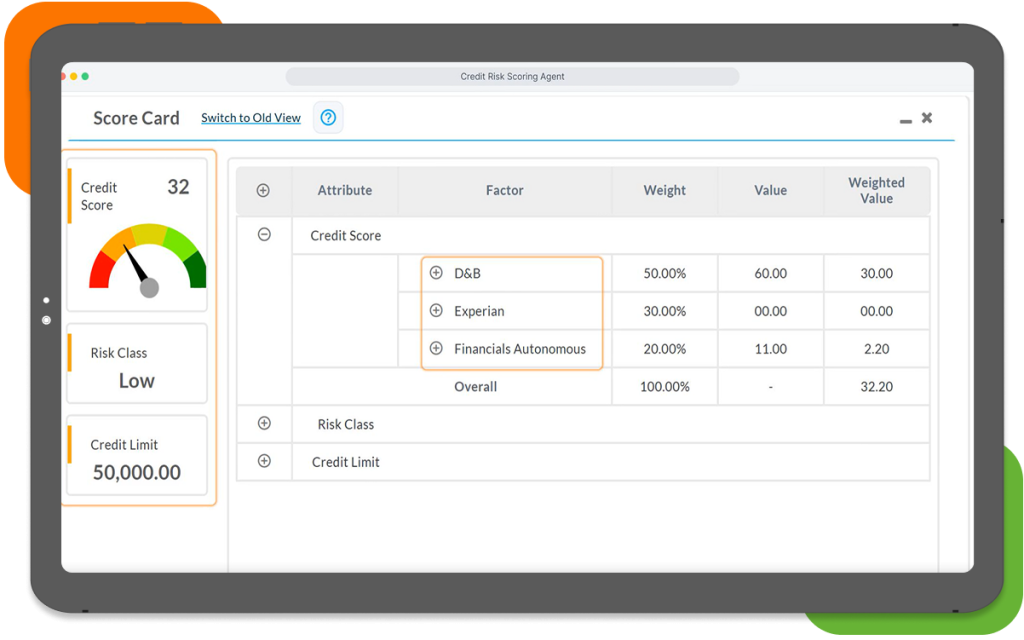
HighRadius’ credit scoring tool and credit application software solution offers AI-powered credit scoring and online credit application software capabilities. With the help of AI agents, the platform automates the complete credit application lifecycle, capturing documents, verifying customer information, scoring creditworthiness, and recommending credit limits based on risk policies. Its AI models learn from historical data, payment patterns, industry risk indicators, and macroeconomic fluctuations to deliver dynamic scoring instead of static, rule-based assessments.
Key capabilities:
What sets HighRadius apart is its continuous, real-time risk monitoring that automatically updates scores as new data flows in from ERPs, credit bureaus, financials, and trade references. Credit teams gain a comprehensive 360° view of customer risk and can approve, hold, or escalate applications directly within the platform.
Streamline Your Credit Decisions with AI
Leverage AI-powered credit scoring, automate approvals, and gain real-time insights to reduce risk and accelerate cash
Download The DatasheetEsker’s credit application aggregates data from credit bureaus, financial documents, and ERP systems to produce reliable risk scores. AI assists with document validation and data extraction, minimizing manual review.
Key Capabilities:
Esker is ideal for enterprises requiring consistent, compliant decisioning across multiple regions, offering visibility, audit trails, and predictive insights to manage credit exposure effectively.
SideTrade’s credit application solution and credit scoring tool emphasizes predictive analytics to help businesses assess customer risk more effectively. It consolidates financial data, payment histories, and market trends to generate actionable risk scores, highlighting accounts that may require attention.
Key Capabilities:
SideTrade is especially suited for large and mid-sized companies managing extensive customer portfolios, offering a blend of automation, predictive insights, and analytics-driven credit decisioning.
Quadient’s credit scoring systems and application module focuses on automation and process compliance. It captures and validates customer data, generates risk scores based on internal and external inputs, and routes applications through predefined approval paths.
Key Capabilities:
Quadient is particularly suitable for enterprises that value structured, compliant processes and need a solution that integrates credit scoring with document validation efficiently.
Gaviti provides credit management software with smarter credit scoring tool and application functionality aimed at simplicity and speed for SMBs and mid-market organizations. It digitizes document collection, validates customer data, and calculates risk assessments using financials, payment history, and predefined credit rules.
Key Capabilities:
Gaviti is ideal for businesses moving away from spreadsheets and email-based approvals, offering a streamlined workflow that improves turnaround times while maintaining risk control and operational efficiency.
Serrala provides ERP-native credit application software solution for SAP-centric enterprises. It analyzes financials, credit exposure, and bureau data to generate contextual risk scores.
Key Capabilities:
Serrala is best suited for large SAP users seeking embedded, policy-aligned credit decisioning within their core ERP system, combining speed, accuracy, and governance.
When evaluating credit application platform and credit scoring tool, it is important to understand the core capabilities that enable accurate risk assessment, faster decisioning, and consistent credit governance. The most effective platforms bring together automation, integrated data sources, and advanced analytics to streamline the entire credit lifecycle - reducing manual effort, lowering bad-debt risk, and supporting confident, policy-aligned credit approvals.
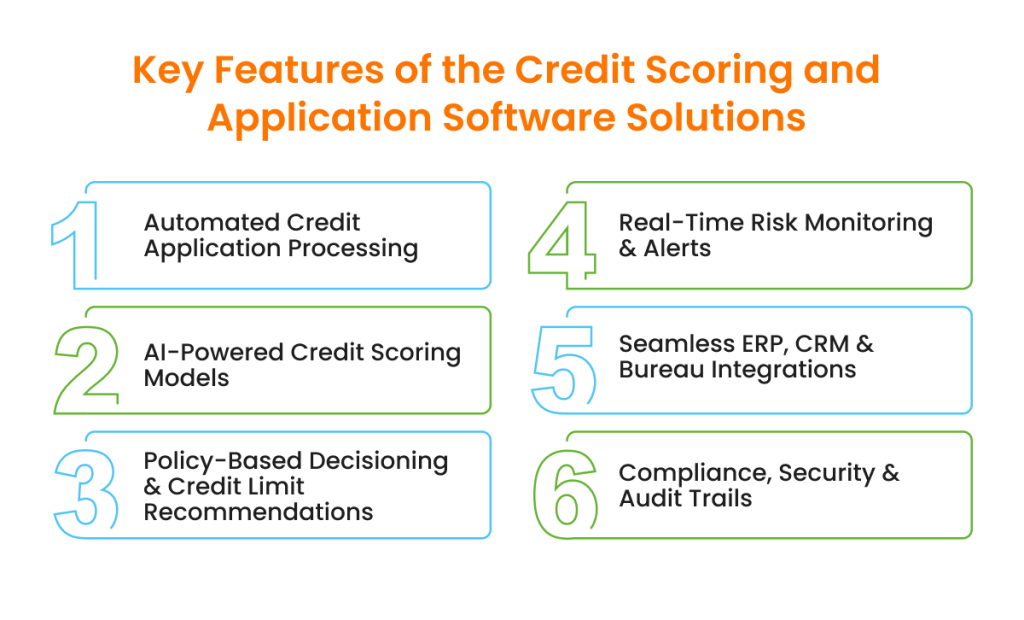
Choosing the best tools for credit application and risk scoring demand a strategic evaluation tailored to your credit operations. Finance leaders must prioritize tools that deliver AI-driven accuracy, real-time data integration, and scalable automation for overall process efficiency. Here’s what to consider:
Enterprises evaluating a modern credit scoring solution should ensure the tool extends beyond application capture and functions as a unified credit scoring platform that supports scalable risk assessment, dynamic limit assignment, and enterprise-wide credit score systems.
Managing credit risk doesn’t have to be a constant challenge. The right credit scoring and application software can make a real difference by automating manual processes, providing real-time insights, and helping your team make faster, smarter lending decisions. The key is finding a solution that fits your business, integrates seamlessly with your existing systems, and is easy for your team to adopt.
With the right platform, you can reduce the risk of defaults, standardize decision-making, and scale your credit operations without adding complexity. Automation transforms credit management from a reactive task into a strategic advantage, giving your team the time and data to focus on high-value activities, such as growing customer relationships and making informed financial decisions.
Modern credit scoring platform and credit application tools bring clarity, efficiency, and intelligence to your credit processes, helping businesses manage risk confidently while supporting growth and long-term financial stability.
** This blog reviews 6 credit scoring and application software solutions; the 1–6 sequence is for reference only and does not indicate ranking or quality.
Yes, modern credit application solutions integrate with banking platforms, ERP, and accounting systems, allowing real-time access to financial data. This enables automated credit decisions, synchronized records, improved workflow efficiency, and reduced errors. Integration ensures that credit evaluations are based on the most accurate and up-to-date financial information available.
Almost all industries extending credit benefit from credit application solutions to manage risk and streamline processes. This includes banking, B2B commerce, retail, e-commerce, telecommunications, utilities, healthcare, and insurance. These sectors rely on accurate credit assessments to reduce financial risk, speed up approvals, monitor customer portfolios, and ensure that both consumer and business clients meet their payment obligations reliably.
The cost depends on the business size, software features, and deployment type. Cloud-based solutions for small businesses are more affordable, while mid-sized and large enterprises investing in AI-driven scoring, advanced analytics, and full system integrations can expect higher subscription or licensing fees.
A credit scoring tool is a system that evaluates customer risk by analyzing financial data, payment behavior, and credit exposure to generate a credit score or risk classification. Modern credit scoring tools function as part of a broader credit scoring platform that supports onboarding, risk assessment, and credit limit management.
A strong credit scoring platform should include automated credit application workflows, configurable scoring models, real-time risk monitoring, enterprise-grade reporting, and integration with credit score systems. Scalability and governance controls are critical for large portfolios.
Positioned highest for Ability to Execute and furthest for Completeness of Vision for the third year in a row. Gartner says, “Leaders execute well against their current vision and are well positioned for tomorrow”

Explore why HighRadius has been a Digital World Class Vendor for order-to-cash automation software – two years in a row.

HighRadius stands out as an IDC MarketScape Leader for AR Automation Software, serving both large and midsized businesses. The IDC report highlights HighRadius’ integration of machine learning across its AR products, enhancing payment matching, credit management, and cash forecasting capabilities.

Forrester acknowledges HighRadius’ significant contribution to the industry, particularly for large enterprises in North America and EMEA, reinforcing its position as the sole vendor that comprehensively meets the complex needs of this segment.

Customers globally
Implementations
Transactions annually
Patents/ Pending
Continents
Explore our products through self-guided interactive demos
Visit the Demo CenterPlease fill in the details below
Please fill in the details below

We have seen financial services costs decline by $2.5M while the volume, quality, and productivity increase.

Colleen Zdrojewski
Trusted By 1300+ Global Businesses


