6 Best Credit Application Software Solutions for B2B Enterprises And Mid-Market
Last Updated: 12 October, 2026
•
Nimisha Ghosh B2B Finance Content Strategist
N
Nimisha Ghosh
Nimisha specializes in Order-to-Cash (O2C) transformation, crafting strategic narratives at the intersection of B2B SaaS and FinTech. With over four years of experience, she brings deep expertise in electronic invoicing, receivables automation, and digital payments, translating complex autonomous finance capabilities into actionable insights for modern finance leaders. When she’s not analyzing trends in enterprise finance, Nimisha enjoys reading and traveling. Her approach to writing is rooted in clarity, precision, and a strong understanding of real-world financial challenges.
2026 Automation Benchmark Report
HighRadius 2026 Automation Benchmark Report For The Office Of The CFO
Understand if your performance is on par with top 10% of the organizations. Identify gaps, best practices and know how you can drive value through Agentic AI-Driven Automation.
Modern credit application platform goes beyond digital forms by combining online applications, automated document collection, ERP and credit-data integrations, and approval workflows to accelerate customer onboarding.
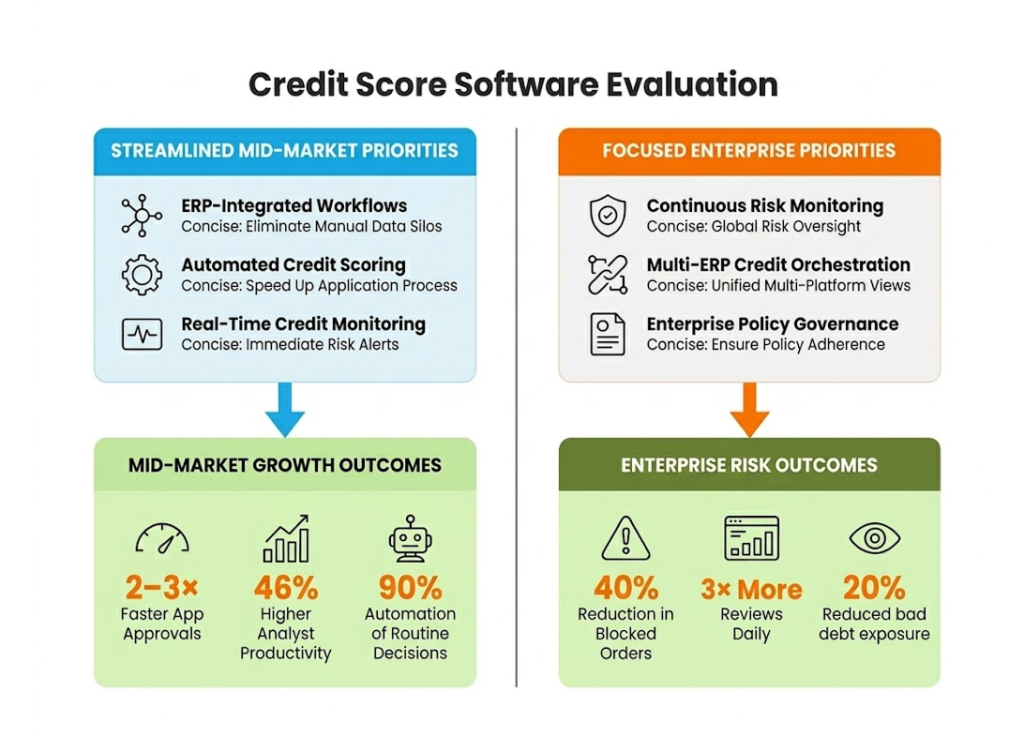
Mid-market businesses prioritize faster application processing, automated approvals, and reduced manual follow-ups, while enterprises focus on scalable workflows, policy standardization, and consistent credit processes across customers, entities, and geographies.
Platforms like HighRadius help credit teams automate application intake, collect and validate customer information, and seamlessly move applications into credit assessment and approval workflows.
Credit Scoring Has Shifted From Static Risk Assessment to Continuous Credit Decisioning
Credit applications are no longer just about collecting customer information through paper forms, PDFs, or emails. As businesses face increasing pressure to accelerate revenue recognition while reducing credit risk, finance teams are expected to onboard customers faster without compromising credit quality. Traditional credit application processes, built around manual document collection, email-based approvals, disconnected ERP systems, and spreadsheet-driven reviews, can no longer support the speed, scale, and governance required for modern B2B operations.
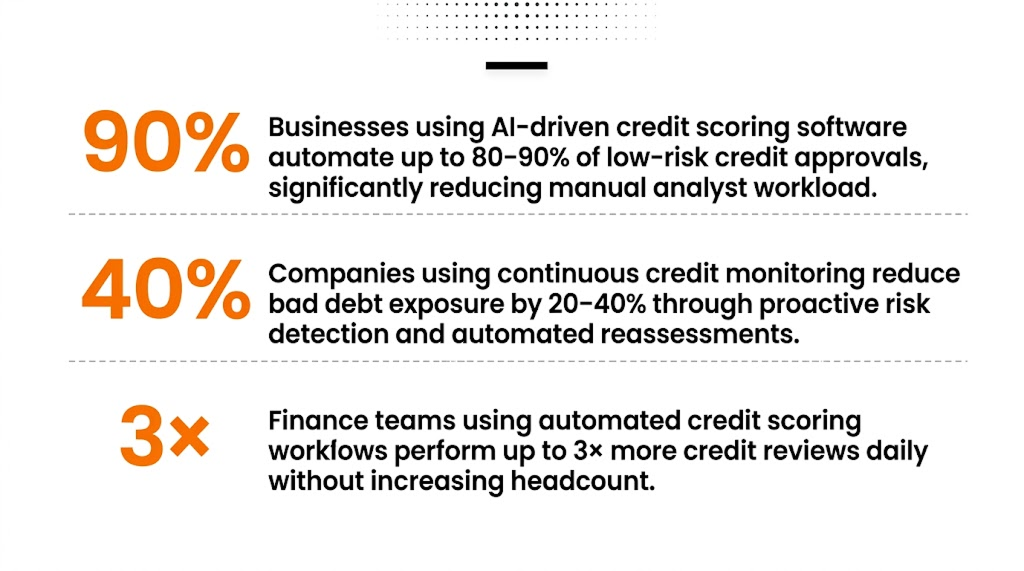
This is why businesses need modern credit scoring tools and credit application platform. They combine B2B credit applications, automated scoring models, continuous risk monitoring, blocked-order prediction, and ERP-integrated approval workflows into a unified decisioning engine. Businesses adopting AI-powered credit application now automate up to 80–90% of routine low-risk approvals, accelerate credit decisions by 2–3×, reduce blocked orders by up to 40%, and lower bad debt exposure by 20–40%.
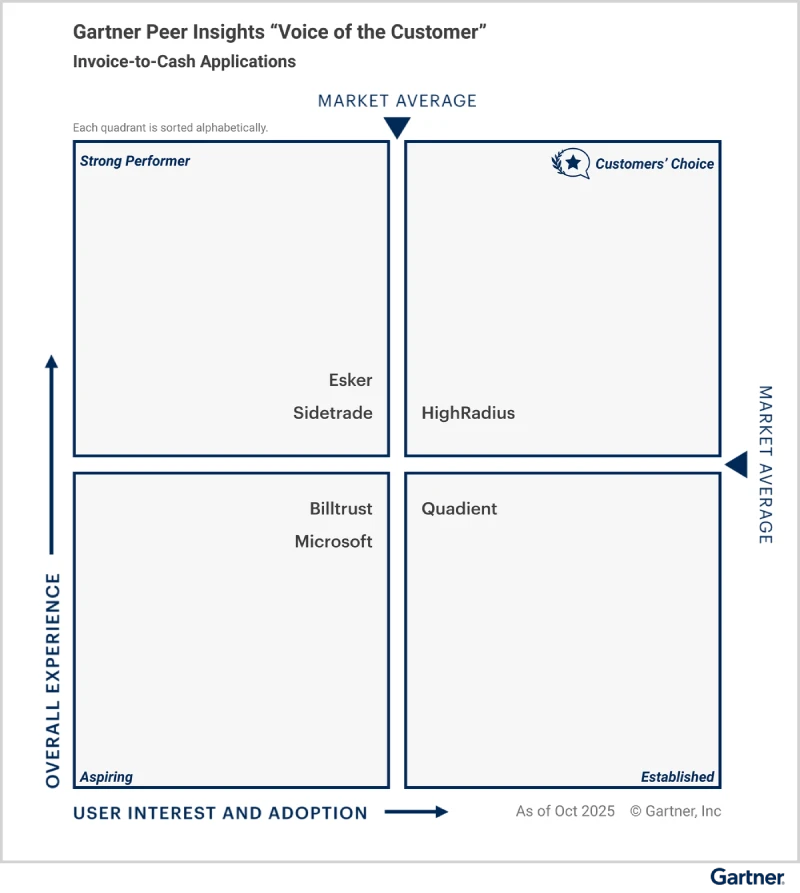
In this guide, we evaluate 6 leading B2B credit application tools, including HighRadius, Esker, Gaviti, Serrala, Sidetrade and Quadient, based on their ability to automate credit applications, improve real-time risk visibility, reduce operational bottlenecks, and scale credit operations across both mid-market and enterprise environments.
6 Best Credit Application Tools And Credit Scoring Solution at a Glance
Modern credit scoring software and credit application tools help finance teams automate onboarding, improve risk visibility, accelerate approvals, and reduce bad debt exposure. Here are the leading credit scoring solutions helping mid-market and enterprise Businesses modernize credit decisioning in 2026.
Mid-market and enterprise Businesses seeking AI-driven credit application processing system, automated credit scoring and predictive blocked-order prevention. With integrations across 35+ credit agencies, HighRadius helps automate 80–90% of low-risk approvals, accelerate onboarding by up to 70% and deliver 2–3× faster credit approvals.
What is Credit Application Platform And Credit Scoring Tool?
Credit scoring software and credit application platform is a digital tool that evaluates a customer’s creditworthiness and automates credit application decisions using financial and behavioral data, helping businesses approve or decline requests faster and more consistently.
Modern credit management processes go a step further by automating the entire lifecycle of credit applications, from document capture and validation to risk scoring, approvals, and credit limit assignment, ensuring consistency, speed, and policy alignment. Unlike traditional engines of credit scoring that depend on fixed parameters and manual efforts, modern credit tools learn from historical and transactional data and ensure dynamic risk assessment. They use AI-led credit scoring that uses factors like payment history, credit utilization, and account activity to calculate a score that predicts how likely a customer is to default. Higher credit scores indicate lower risk.
Unlike traditional engines of credit scoring and credit application solutions that depends on fixed parameters and manual efforts, modern credit tools learn from historical and transactional data and ensure dynamic risk assessment. Such credit score software uses credit scoring models that use factors like payment history, credit utilization, and account activity to calculate a score that predicts how likely a customer is to default. Higher credit scores indicate lower risk.
Did you know 60% of applications don't need human eyes at all?
Learn how automated B2B credit application unlocks 70% faster customer onboarding with utmost accuracy.
What Should Modern Credit Application Solution Include?
Traditional credit application processing systems rely heavily on spreadsheets, PDFs, email-based document collection, and manual approvals. Credit analysts spend hours collecting financial statements and trade references, validating customer information, consolidating data from ERP and bureau sources, and routing applications for review.
As businesses scale across customers, entities, and geographies, these manual workflows make it harder to onboard customers quickly and consistently. Applications get stuck waiting for missing documents or approvals, customer data remains fragmented across systems, and credit teams spend more time coordinating the process than evaluating risk.
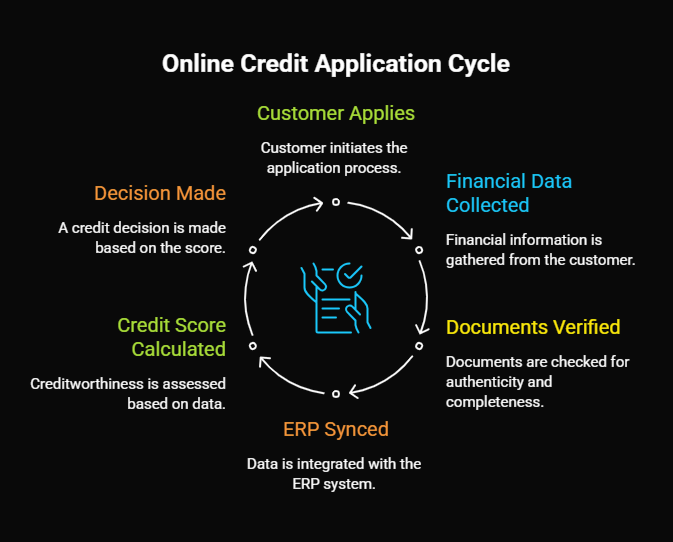
Modern credit application platform digitizes the entire application-to-approval workflow, giving customers a faster way to submit information while giving credit teams the data, controls, and automation needed to process applications at scale.
Key capabilities to look for in credit application software:
Digital credit applications: Replace paper and PDF-based applications with online forms that make it easier for customers to submit required information.
Automated document collection: Centralize financial statements, trade references, and supporting documents and reduce manual follow-ups for missing information.
ERP integration: Connect application data with ERP and other finance systems to eliminate duplicate data entry and maintain a consistent customer record.
Application workflow and approval routing: Automatically route completed applications to the right reviewers based on predefined policies, thresholds, and approval hierarchies.
Credit bureau and external data integration: Bring relevant customer and credit information into the application workflow without requiring analysts to gather it manually.
Financial data capture and validation: Standardize the collection and validation of financial information required for credit review.
Credit scoring integration: Connect application data with credit scoring and credit risk assessment workflows so analysts can move from application intake to risk evaluation without switching between disconnected systems.
Decision engine connectivity: Enable approved applications to flow into automated credit decisioning and credit-limit workflows based on business policies.
Top 6 Credit Scoring Tool And Credit Application Platforms in 2026: A Comprehensive Review
Modern credit scoring tools is no longer limited to static bureau-based scoring and manual approvals. Today’s leading credit application platforms combine AI-driven credit analysis, automated onboarding, real-time risk monitoring, and ERP-integrated workflows to help finance teams accelerate approvals while reducing exposure risk.
The platforms below were evaluated based on:
AI-driven credit scoring capabilities
Online credit application solution automation
Real-time credit risk monitoring
Blocked-order prevention
ERP and bureau integration depth
Scalability across mid-market and enterprise environments
Automation maturity and workflow intelligence
1. HighRadius
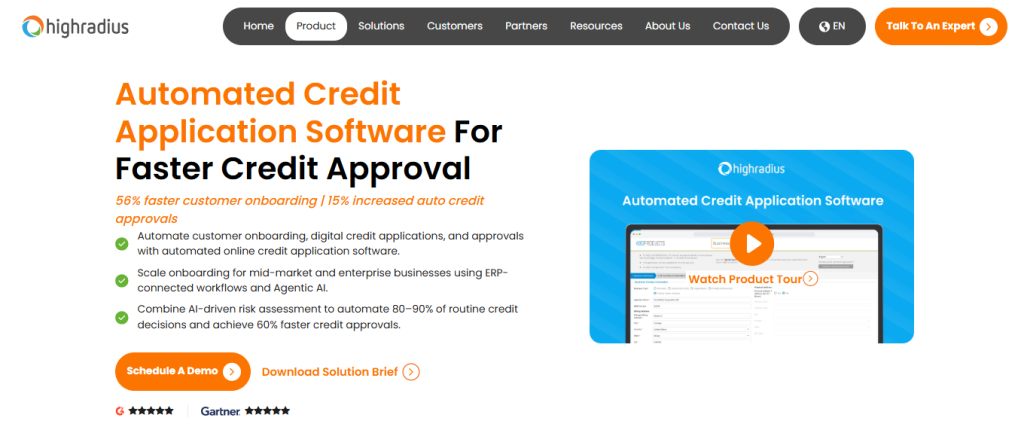
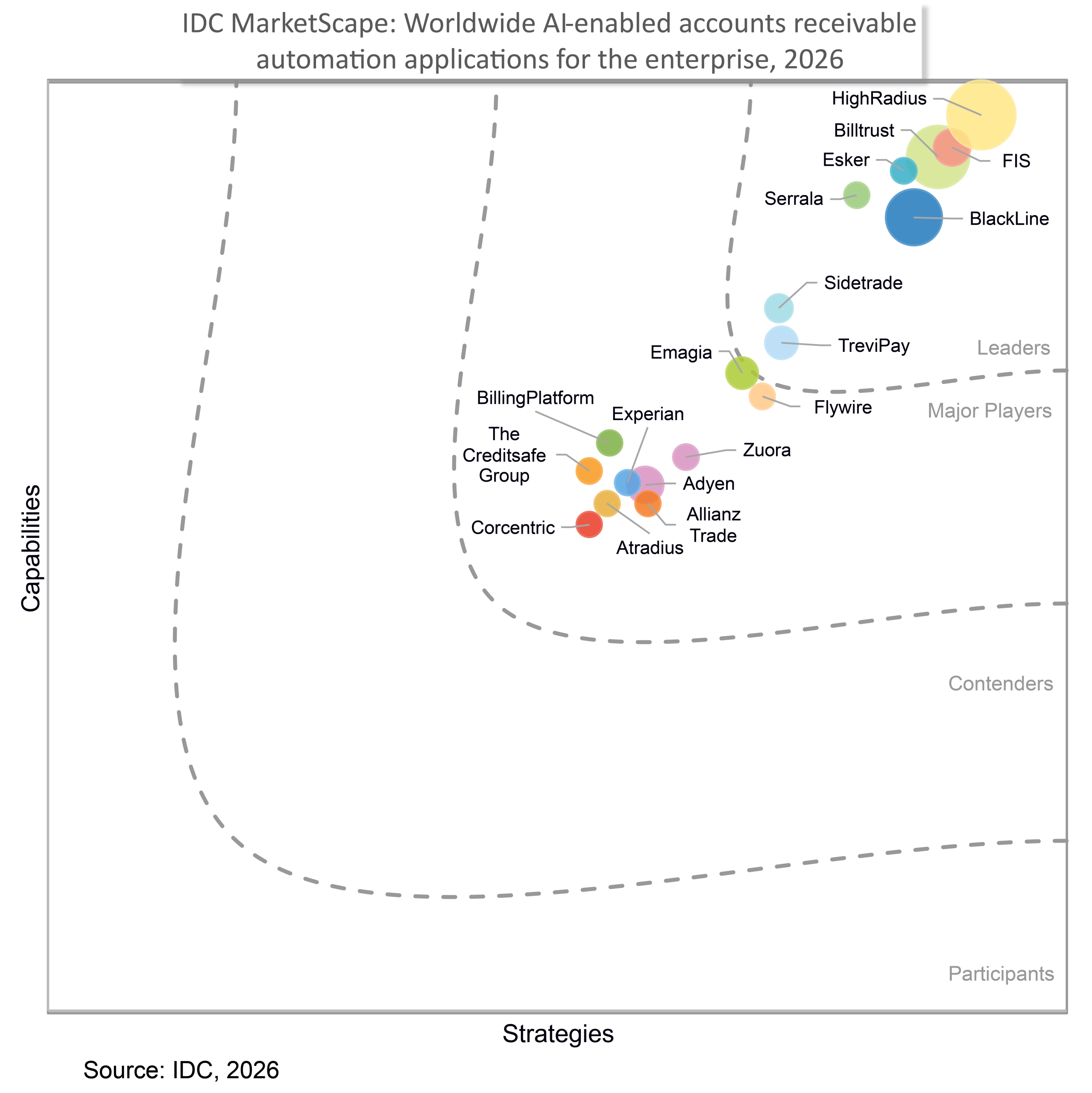
HighRadius Credit Application Tool are the IDC MarketScape-recognized Agentic AI platforms built to automate credit decisioning and credit scoring for both fast-growing mid-market companies and complex global enterprises. With integrations across 35+ credit agencies and AI Agents for predictive risk analysis, HighRadius helps businesses reduce bad debt exposure by up to 20% while improving credit decision speed and operational scalability.
For growing mid-market businesses, HighRadius credit application processing system replaces spreadsheet-driven credit reviews with AI-powered scoring, automated approvals, and ERP-integrated workflows that accelerate onboarding by up to 70%, automate 80–90% of low-risk approvals, and deliver 2–3× faster credit decisions without increasing analyst headcount.
For enterprises managing diverse customer portfolios across multiple ERPs, regions, and legal entities, HighRadius delivers predictive blocked-order prevention, continuous global risk monitoring, ad-hoc and periodic credit reviews, and enterprise-wide policy orchestration. Businesses use HighRadius to reduce blocked orders by up to 40%, improve analyst productivity, and standardize global credit governance at scale.
Key Features:
AI-Driven Credit Decisioning: Autonomous AI agents evaluate applications using configurable scoring models, payment behavior, bureau data, and real-time risk signals.
Automated Online Credit Applications: Digital onboarding workflows capture, validate, and route applications with automated document extraction and verification.
Global Credit Data Integration: Connects with 35+ credit bureaus and multiple public financial data sources to analyze 100+ risk variables automatically.
Predictive Blocked Order Management: AI models anticipate blocked orders and recommend proactive credit actions before fulfillment disruption occurs.
Continuous Risk Monitoring: Real-time alerts for bankruptcies, rating changes, exposure thresholds, and deteriorating payment behavior.
Multi-Level Approval Workflows: Configurable routing, SLA tracking, audit trails, and automated approval correspondence improve governance and consistency.
Customer Hierarchy Management: Consolidates parent-child relationships and global exposure visibility across entities and regions.
Business Impact:
Predictive blocked-order prevention and global policy standardization
Up to 90% faster credit approvals
Up to 20% reduction in bad debt exposure
80–90% automation of low-risk approvals
Up to 70% faster onboarding cycles
HighRadius Named a Leader for the 3rd Year in the Gartner Magic Quadrant
Gartner recognized HighRadius for AI-led capabilities across Order To Cash functions.
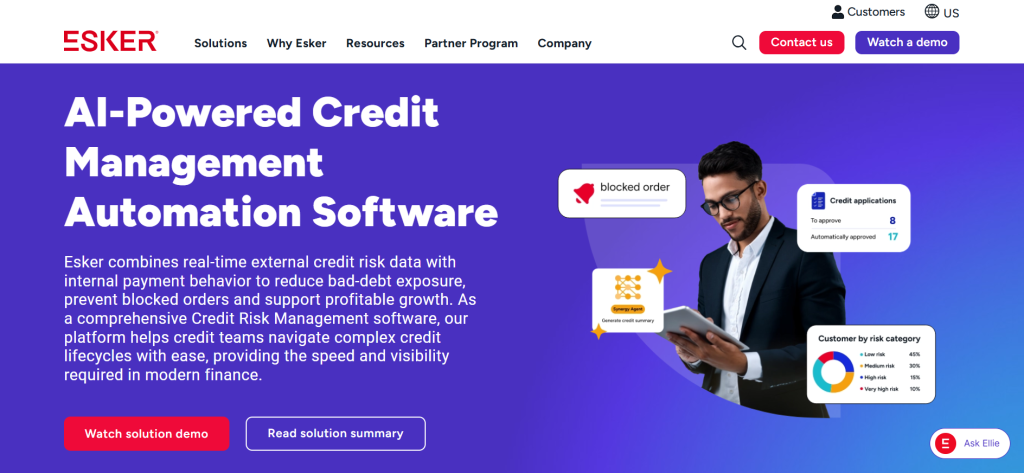
Esker’s credit application processing system aggregates data from credit bureaus, financial documents, and ERP systems to produce reliable risk scores. AI assists with document validation and data extraction, minimizing manual review.
Key Capabilities:
Automatically calculates risk using a customizable scoring model that blends internal data with external credit-agency insights.
Integration with global credit bureaus to automatically import and update risk data.
Automated credit decisioning based on scoring thresholds and predefined policies.
Real-time risk alerts that flag changes in customer financial behavior for timely review.
Esker is ideal for companies requiring consistent, compliant decisioning across multiple regions, offering visibility, audit trails, and predictive insights to manage credit exposure effectively.
3. SideTrade
SideTrade’s credit application solution and credit scoring tool emphasizes predictive analytics to help businesses assess customer risk more effectively. It consolidates financial data, payment histories, and market trends to generate actionable risk scores, highlighting accounts that may require attention.
Key Capabilities:
AI-driven scoring engine that automates risk assessment and credit-decisioning based on aggregated data.
Integration with 20+ credit bureaus and rating agencies to enrich scoring with external financial and credit data.
Real-time risk monitoring & alerts, giving up-to-date visibility into credit exposure and triggering reviews when customer risk changes.
SideTrade is especially suited for companies managing extensive customer portfolios, offering a blend of automation, predictive insights, and analytics-driven credit decisioning.
4. Quadient
Quadient’s credit scoring systems and credit application processing system focuses on automation and process compliance. It captures and validates customer data, generates risk scores based on internal and external inputs, and routes applications through predefined approval paths.
Key Capabilities:
Automated credit application that eliminates manual evaluations and external tools.
Scorecards combining external bureau data and internal payment history for accurate risk assessment.
Instant creditworthiness evaluation to speed up credit decisions and onboarding.
Flexible credit limit management based on real-time customer risk levels.
Quadient is particularly suitable for companies that value structured, compliant processes and need a solution that integrates credit scoring with document validation efficiently.
5. Gaviti
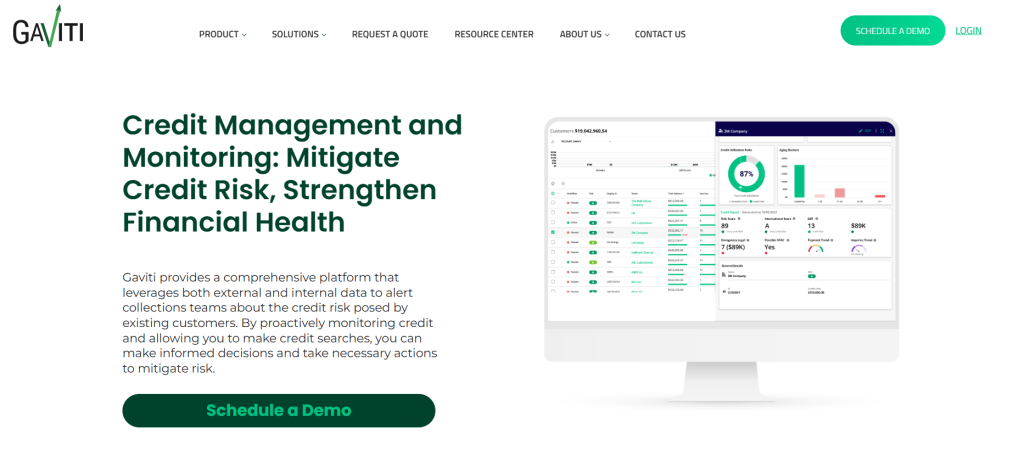
Gaviti provides credit management solution with smarter credit application functionality aimed at simplicity and speed for SMBs and mid-market organizations. It digitizes document collection, validates customer data, and calculates risk assessments using financials, payment history, and predefined credit rules.
Key Capabilities:
Send digital credit-application forms to customers and prospects for easy data collection.
Automate the full approval workflow based on predefined company rules.
Assign credit limits automatically using configurable criteria.
Monitor customer credit status continuously and receive alerts when behavior changes.
Gaviti is ideal for businesses moving away from spreadsheets and email-based approvals, offering a streamlined workflow that improves turnaround times while maintaining risk control and operational efficiency.
6. Serrala
Serrala provides ERP-native credit application software solution for SAP-centric enterprises. It analyzes financials, credit exposure, and bureau data to generate contextual risk scores.
Key Capabilities:
AI-powered credit application tool that evaluates customers using internal financials, payment behavior, and external credit agency data.
Integrated risk data ingestion from credit insurers and bureaus to enhance scoring accuracy and due diligence checks.
Real-time score updates driven by continuous data inputs from SAP, AR records, and customer activity.
Automated credit-limit and decision recommendations based on predefined rules and risk thresholds.
Serrala is best suited for large SAP users seeking embedded, policy-aligned credit decisioning within their core ERP system, combining speed, accuracy, and governance.
Key Features of the Credit Application Tools
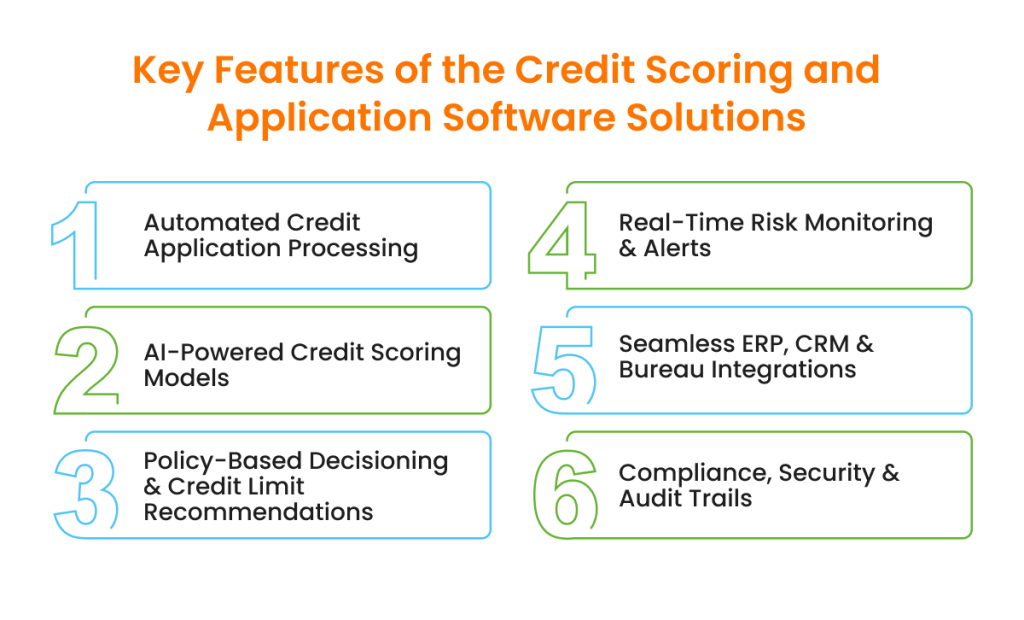
When evaluating credit application platform and credit scoring tool, it is important to understand the core capabilities that enable accurate risk assessment, faster decisioning, and consistent credit governance. The most effective platforms bring together automation, integrated data sources, and advanced analytics to streamline the entire credit lifecycle - reducing manual effort, lowering bad-debt risk, and supporting confident, policy-aligned credit approvals.
Automated Credit Application Processing - Look for credit application solution that digitize the entire credit application process – data capture, document submission, verification, and routing. This would remove manual steps and accelerate customer onboarding while reducing errors.
AI-Powered Credit ScoringPlatform- Go for advanced credit scoring systems making use of AI to evaluate payment history, financials, third-party data, and behavioral patterns. These models update continuously, offering more accurate and dynamic credit risk assessments than static scorecards.
Policy-Based Decisioning & Credit Limit Recommendations - Choosing a strong solution would enforce internal credit policies automatically and suggest credit limits based on risk thresholds, historical trends, and industry benchmarks.
Real-Time Risk Monitoring & Alerts - Visibility is critical in credit management. Top tools provide ongoing monitoring of customer risk, automated alerts for score changes, and triggers for re-evaluation.
Seamless ERP, CRM & Bureau Integrations - Seamless ERP connectivity with systems like SAP, Oracle, NetSuite, Salesforce, and external credit bureaus would ensure unified data flow, centralized customer records, and enriched risk assessment using internal and third-party information.
Compliance, Security & Audit Trails - Comprehensive audit logs, version control, and compliance checks are mandatory to ensure transparency and support regulatory requirements across regions. Most leading platforms ensure compliance with said regulations and provide detailed audit trails for every decision made.
Does Credit Application Software Include Credit Scoring?
Not necessarily. Credit application solution and credit scoring solve different stages of the B2B credit workflow.
Credit application software primarily digitizes how prospects submit company information, financial statements, trade references, and supporting documents. More advanced platforms connect that application data to the next stages of the credit process like risk assessment, scoring, approval, and ongoing monitoring.
For credit teams, that distinction matters. Collecting an application digitally only solves the intake problem if analysts still have to manually gather external credit data, analyze financial statements, calculate risk, and route every decision for approval.
What happens after a credit application is submitted?
1. Risk assessment Customer information, financial statements, payment history, credit-agency data, and other risk signals can be consolidated to build a more complete view of customer creditworthiness.
2. Credit scoring AI-based scoring models can evaluate customer risk using both external data, such as credit-agency and public financial data and internal signals such as average days to pay, credit-limit utilization, and past ordering behavior. Models can also be configured based on customer segment and region.
3. Credit decisioning and approval Once risk has been assessed, applications can move through predefined approval rules and credit-limit thresholds. Low-risk applications can potentially be auto-approved, while exceptions can be routed to the appropriate analyst or approval authority.
4. Ongoing credit monitoring The process doesn't end when an application is approved. Continuous monitoring can track changes in payment behavior, credit exposure, financial health, and other risk signals so credit teams can respond before risk turns into bad debt or blocked orders.
The takeaway: The best credit application software doesn't simply replace a PDF form. It creates a connected path from application → risk assessment → scoring → decisioning → ongoing monitoring, helping credit teams move from manual data collection to faster, more consistent credit decisions.
Real-World Use Cases of AI Credit Application Solution
Modern B2B credit application software is no longer limited to static scorecards and manual approvals. Businesses now credit application platforms to automate onboarding, accelerate credit decisioning, predict blocked orders, and continuously monitor customer risk across complex portfolios. From mid-market finance teams scaling beyond spreadsheets to enterprises managing global receivables operations, the focus has shifted toward real-time, automated credit orchestration that protects both revenue and working capital.
1. Accelerating Customer Onboarding and Preventing Blocked Orders
Fast-growing businesses often struggle with spreadsheet-driven onboarding, delayed approvals, and reactive blocked-order management that slows revenue realization. HighRadius automates online credit applications, AI-driven credit scoring, approval routing, and predictive blocked-order monitoring to help finance teams accelerate onboarding and reduce operational friction.
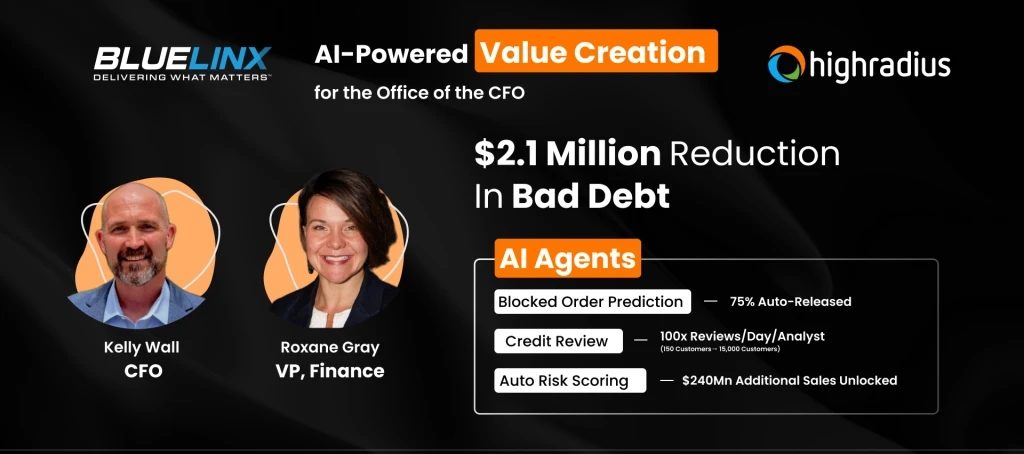
BlueLinx reduced blocked orders by 30%, accelerated customer onboarding by 70%, and achieved 3× more credit reviews daily using AI-powered credit workflows and predictive risk monitoring.
Case Studies
How BlueLinx Achieved 70% Faster Onboarding with AI-led Credit Solution
See how this firm managed high-volume credit operations across 15,000+ customers.
2. Standardizing Global Credit Reviews Across Enterprise Portfolios
Large enterprises managing multiple ERPs, regions, and business units often face fragmented credit policies, inconsistent reviews, and limited visibility into enterprise-wide risk exposure. HighRadius centralizes credit scoring, customer hierarchies, approval workflows, and real-time portfolio monitoring into a unified credit management platform.
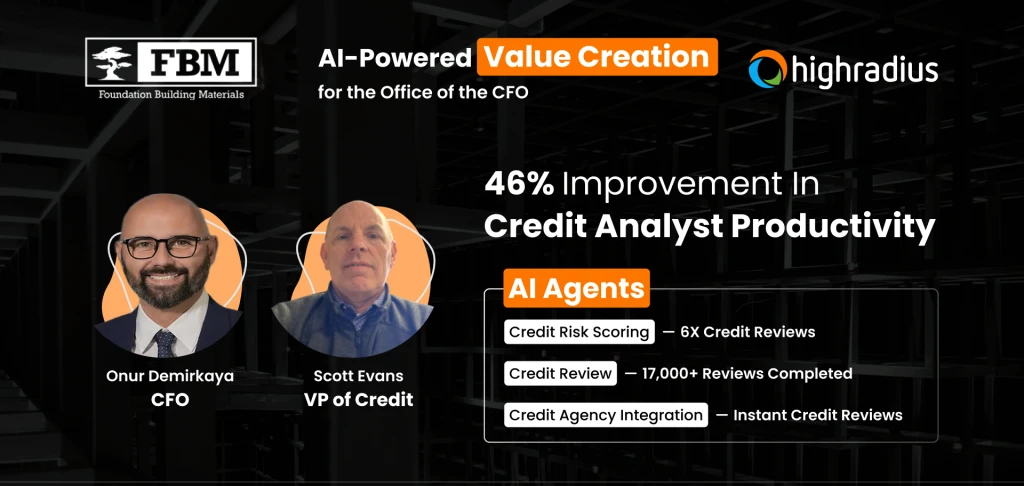
Foundation Building Materials increased analyst productivity by 46%, completed 17,000+ annual reviews, and achieved 6× more credit reviews through AI-driven credit automation and centralized workflows.
Case Studies
How this manufacturing giant unlocked 17,000+ annual credit reviews
Learn how FBM modernize credit operations with AI-driven scoring, automated workflows, and centralized visibility across entities.
3. Enabling Continuous Risk Monitoring to Reduce Bad Debt Exposure
Traditional periodic credit reviews often fail to identify deteriorating customer health before exposure risk increases. HighRadius continuously monitors payment behavior, financial statements, bankruptcy alerts, and external credit signals to help finance teams proactively identify high-risk accounts and strengthen portfolio-wide visibility.
Chevron Phillips Chemical achieved zero bad debt for four consecutive years while significantly accelerating onboarding and reducing credit review cycles through AI-driven credit risk monitoring and automated decisioning.
Case Studies
How Chevron Phillips Achieved Zero Bad Debt for 4 Consecutive Years
Learn how this industry pioneer modernized enterprise credit operations with continuous risk monitoring and predictive workflows
How HighRadius Helps Modernize Credit Applications and Credit Scoring
HighRadius Credit Management Software helps mid-market finance teams automate credit decisioning, standardize risk evaluation, and gain real-time visibility into customer exposure without increasing analyst headcount. Built for organizations scaling beyond spreadsheet-driven approvals, the platform combines AI-driven credit scoring, automated workflows, and continuous monitoring to accelerate onboarding, reduce manual reviews, and improve control over credit risk.
With real-time credit risk management software and AI-powered credit management solutions, finance teams can receive alerts for changes in customer credit profiles and make faster, data-driven decisions using unlimited credit reports. The platform integrates with ERP systems and can begin monitoring customers in as little as 30 days.
With real-time credit risk analysis software and credit decisioning software, you can receive alerts for any changes in your customers’ credit profile and make data-driven credit decisions from unlimited credit reports. Our software integrates with your ERP system and can start monitoring your customers in just 30 days.
We offer configurable credit scoring software and approval workflows that can be customized based on geography, customer segments, business units, and other factors. You can fast-track credit approvals through complex corporate hierarchies, making the credit application process more efficient and streamlined.
Our highly configurable online credit application allows you to onboard customers across the globe with multi-language, customized credit applications embedded on your website. You can automatically capture financials, personal guarantees, and check bank references, reducing the need for manual data entry.
Our software also automatically extracts credit data from over 40+ global and local agencies, including credit ratings, financials, and credit insurance information. You can configure the auto-extracted data in your preferred currency, making it easier to analyze and interpret.
With AI-based blocked order management, you can auto-predict blocked orders based on the customers’ credit limit utilization and payment history. You can leverage AI-based release or partial payment recommendations for faster credit decisions, reducing the need for manual intervention.
Struggling With Slow Credit Approvals and Credit Reviews?
Explore the #1 software that makes onboarding customer faster and easier
Accelerate payment recovery from delinquent customers and boost cash flow through automated collection workflows.
Cash App
Achieve same day cash application with automated remittance aggregation
Credit
Mitigate credit risk, reduce bad debt, and streamline customer onboarding with AI-powered insights.
Deductions
Reduce Revenue Leakage with AI Prediction models that identify valid and invalid deductions.
Online Credit Application
Onboard customers seamlessly with a configurable online credit application. Cut down on back-and-forth and collect all customer details in one go.
FAQs
1. Can credit application software integrate with banking or ERP systems?
Yes, modern credit application solutions integrate with banking platforms, ERP, and accounting systems, allowing real-time access to financial data. This enables automated credit decisions, synchronized records, improved workflow efficiency, and reduced errors. Integration ensures that credit evaluations are based on the most accurate and up-to-date financial information available.
2. Which industries benefit the most from credit application tools?
Almost all industries extending credit benefit from credit application solutions to manage risk and streamline processes. This includes banking, B2B commerce, retail, e-commerce, telecommunications, utilities, healthcare, and insurance. These sectors rely on accurate credit assessments to reduce financial risk, speed up approvals, monitor customer portfolios, and ensure that both consumer and business clients meet their payment obligations reliably.
3. What is the cost of credit application platforms in 2026?
The cost depends on the business size, software features, and deployment type. Cloud-based solutions for small businesses are more affordable, while mid-sized and large enterprises investing in AI-driven scoring, advanced analytics, and full system integrations can expect higher subscription or licensing fees.
4. What is a credit scoring tool?
A credit scoring tool is a system that evaluates customer risk by analyzing financial data, payment behavior, and credit exposure to generate a credit score or risk classification. Modern credit scoring tools function as part of a broader credit scoring platform that supports onboarding, risk assessment, and credit limit management.
5. What features should a credit scoring platform include?
A strong credit scoring platform should include automated credit application workflows, configurable scoring models, real-time risk monitoring, enterprise-grade reporting, and integration with credit score systems. Scalability and governance controls are critical for large portfolios.
Resource Library
Resource Hub
Order to Cash
Order to Cash software data sheet
Disconnected workflows can leave teams chasing data, while automated O2C has delivered 20% lower past dues.
HighRadius recognized as a "Leader" in IDC Marketscape: Worldwide AI-enabled accounts receivable automation applications for the enterprise 2026 vendor assessment
Recognized as a Leader in 2026 Vendor Assessment for unifying credit, collections, cash application, deductions, e-invoicing, and payments on one AI platform to advance enterprise-wide invoice-to-cash transformation.
Forrester Recognizes HighRadius in The AR Invoice Automation Landscape Report, Q1 2023
Forrester acknowledges HighRadius’ significant contribution to the industry, particularly for large enterprises in North America and EMEA, reinforcing its position as the sole vendor that comprehensively meets the complex needs of this segment.