The AI Credit Scoring Guide: How Is AI Transforming Credit Decisioning And Risk Monitoring
3 July, 2023
13 minute read
Soumi Sarkar, Fintech content strategist
S
Soumi Sarkar
Soumi specializes in O2C, finance, and accounting transformation with a focus on bringing a domain-led perspective to accounting, finance and order-to-cash transformation. She crafts insight-driven, CFO-aligned content that helps finance teams optimize operational workflows and drive measurable outcomes. Beyond her professional work, Soumi is a published author of two books, a poetess, an avid reader, and a storyteller who enjoys exploring narratives across both B2B and creative formats.
Last updated: 7 September, 2026
Is Your Credit Tool cutting review times by 50 % and increasing control? Find out with our free credit management ROI tool.
– AI credit scoring replaces static bureau reviews with continuous, real-time credit risk monitoring and automated credit decisioning.
– Modern credit scoring software combines ERP data, financial statements, behavioral payment trends, and external credit intelligence to improve scoring accuracy and reduce manual reviews.
– AI-powered credit scoring platforms help finance teams accelerate onboarding, automate low-risk approvals, reduce blocked orders, and strengthen working capital visibility across customer portfolios.
AI in Credit Scoring Has Shifted From Static Risk Assessment to Continuous AI Decisioning
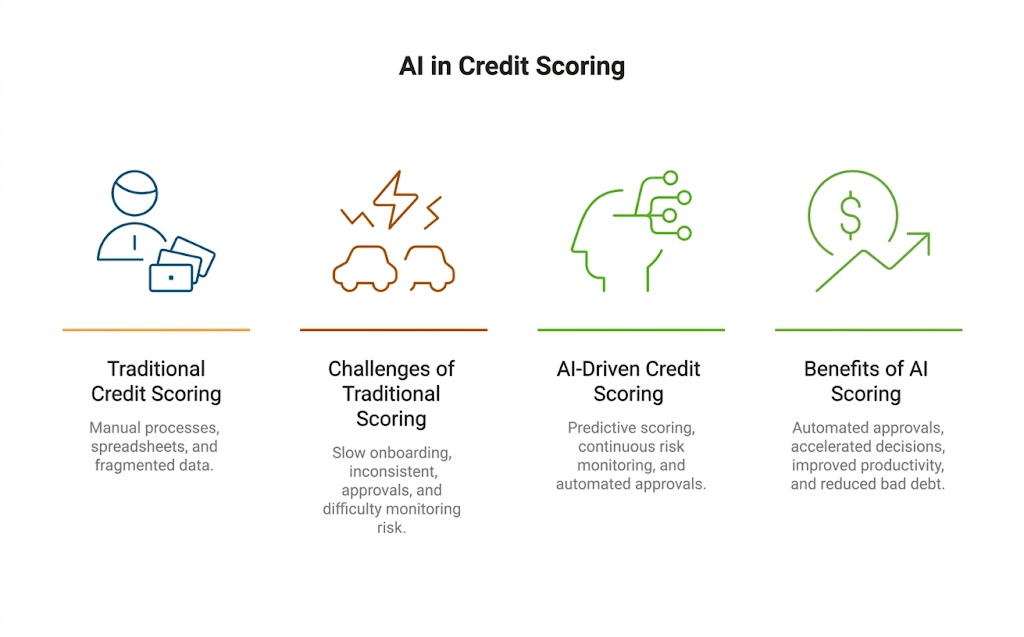
Credit scoring is no longer just about reviewing bureau reports and assigning customer credit limits periodically. As payment volatility, bankruptcy risk, and working capital pressure continue rising, finance teams are expected to accelerate customer onboarding and revenue realization while simultaneously reducing exposure risk across increasingly complex customer portfolios. Traditional credit scoring processes built around spreadsheets, manual reviews, fragmented ERP data, and static bureau scores can no longer keep pace with changing customer behavior and real-time risk exposure.
This is why businesses are adopting AI-driven, automated credit scoring platforms that combine predictive scoring, continuous risk monitoring, automated approvals, and ERP-integrated workflows into a unified decisioning engine. Businesses using automated credit scoring models now automate routine low-risk approvals, accelerate credit decisions, improve analyst productivity, and strengthen risk visibility through continuous AI-driven monitoring and predictive credit risk analysis. In this guide, we’ll explore how AI in credit scoring works, the technologies powering modern credit scoring platforms and how businesses are modernizing credit decisioning using AI-powered risk intelligence.
Table of Contents
What Is AI Credit Scoring?
Why Static Credit Scoring Models Break at Scale
Why Is AI credit scoring needed?
How AI Credit Scoring Actually Works
Benefits of AI in Credit Scoring
Real-World Use Cases of AI in Credit Scoring
Credit Scoring Tools Features Checklist
Use HighRadius' Credit Scoring AI Software To Improve Credit Decisioning And Risk Monitoring
FAQs on Credit Scoring Software
What Is AI Credit Scoring?
AI credit scoring uses machine learning, predictive analytics, and real-time financial data to evaluate customer creditworthiness more accurately than traditional scoring models. Instead of relying only on static bureau reports and periodic manual reviews, AI-powered credit scoring models continuously analyze ERP data, payment behavior, financial statements, credit utilization, trade references, and external credit agency signals to generate dynamic risk assessments and automated credit decisions.
Modern AI credit scoring software helps businesses accelerate customer onboarding, automate low-risk approvals, reduce blocked orders, streamlines credit application processing and proactively identify deteriorating customer risk before it impacts cash flow or bad debt exposure. By combining internal financial data with external risk intelligence and real-time credit risk monitoring, AI-driven credit scoring systems improve decision accuracy, strengthen working capital visibility, and eliminate many of the operational bottlenecks created by spreadsheets, fragmented data, and manual credit reviews.
33% of firms admit to rushed credit approvals due to tiring manual processes!
While AI not only reduces automates workflows but reduces bad-debt and DSO by 15%.
Modern, AI-led credit scoring models eliminate these gaps by introducing continuous, model-driven credit evaluation. Here's a difference between manual vs modern credit score software.
Capability
Manual Credit Scoring
AI-Led Credit Scoring Software
Risk Assessment
Periodic reviews based on static bureau reports
Continuous AI-driven credit risk monitoring using real-time data
Data Sources
Limited bureau data and spreadsheets
ERP data, payment behavior, financial statements, bureau data, trade references, and public filings
Credit Decisions
Analyst-driven and highly manual
Automated credit decisioning with configurable approval workflows
Onboarding Speed
Delayed onboarding due to manual reviews
Faster customer onboarding through automated scoring and approvals
Financial Analysis
Manual financial spreading and data consolidation
AI-powered financial statement extraction and automated ratio analysis
Risk Visibility
Fragmented visibility across systems and spreadsheets
Reactive blocked-order reviews after disruption occurs
Predictive blocked-order prevention using AI risk models
Approval Consistency
Inconsistent approvals based on analyst judgment
Standardized policy-driven credit scoring and approvals
Monitoring Frequency
Quarterly or periodic reviews
Real-time monitoring of payment trends, bankruptcies, rating changes, and exposure risk
Analyst Productivity
High manual workload and operational bottlenecks
Automated workflows that improve analyst productivity and scalability
Scalability
Requires additional headcount as volumes grow
Scales high-volume credit operations without proportional staffing increases
Auditability
Limited documentation and approval traceability
Explainable AI decision trails with audit-ready workflows
Why Is AI credit scoring needed?
Traditional credit scoring models were built around delayed bureau updates, manual financial analysis, and periodic customer reviews. They still rely on spreadsheet-driven scoring, static bureau reports, fragmented ERP data, and analyst judgment to evaluate customer risk. Analysts manually gather financial statements, validate trade references, consolidate risk signals across systems, and review blocked orders before assigning credit limits or approving customers. This creates inconsistent approvals, delayed onboarding, limited portfolio visibility, and reactive risk management. Without continuous monitoring, businesses often detect deteriorating customer health only after blocked orders disrupt revenue, exposure increases, or payment defaults begin impacting working capital.
AI-powered credit scoring platforms solve these challenges by combining automated financial data extraction, credit decision platforms, predictive scoring models, real-time risk monitoring, and ERP-integrated decision workflows into a unified credit decisioning engine. Modern AI credit scoring software continuously analyzes payment behavior, credit management, financial statements, external bureau data, public filings, and real-time risk alerts to automate low-risk approvals, prioritize high-risk reviews, predict blocked orders proactively, and standardize credit decisioning across customer portfolios.
Key aspects of AI credit scoring
Modern AI credit scoring platforms involves:
Internal ERP data such as payment trends, order history, deductions, and credit utilization
External credit agency data, public filings, trade references, and financial statements
Real-time risk monitoring for bankruptcies, rating changes, blocked orders, and adverse events
Automated scoring models that continuously recalculate customer risk dynamically
Workflow-based automated approvals that reduce manual reviews and accelerate onboarding
This allows finance teams to standardize credit decisioning, improve analyst productivity, reduce bad debt exposure, and make faster, data-driven credit decisions across large customer portfolios.
Templates
Still relying on slower risk assessment?
Use this free vendor evaluation scorecard to find the right credit risk tools.
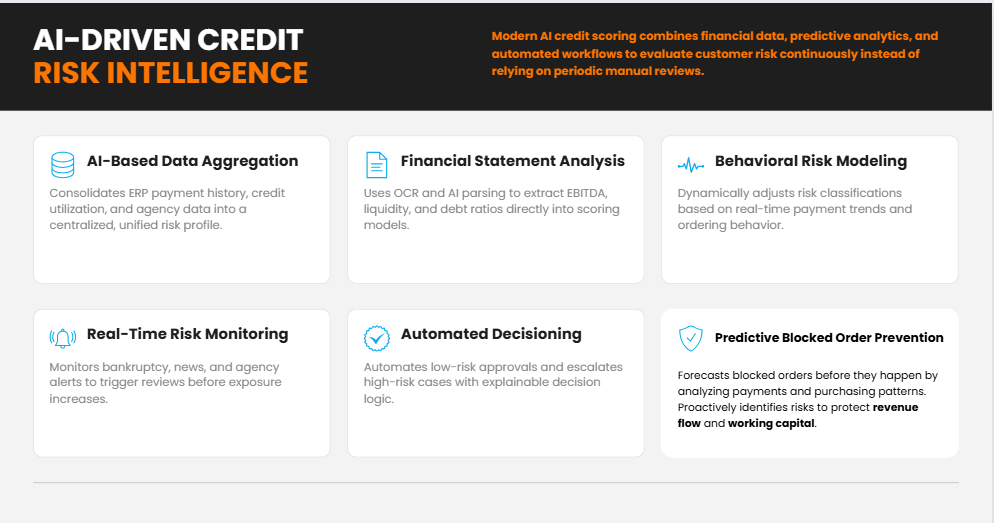
Modern AI credit scoring software combines internal financial data, external credit intelligence, predictive analytics, and automated workflows to evaluate customer risk continuously instead of relying on periodic manual reviews.
1. AI-Based Data Aggregation
AI-powered credit scoring platforms consolidate ERP payment history, credit utilization, financial statements, trade references, public filings, and credit agency data into a centralized risk profile. This eliminates fragmented spreadsheets and gives finance teams a unified view of customer exposure.
2. AI-Powered Financial Statement Analysis
AI models automatically extract key financial data points such as EBITDA, liabilities, cash flow, debt-to-equity ratio, and liquidity metrics from uploaded financial statements using OCR and AI-based parsing. The data is mapped into standardized financial attributes that feed directly into credit scoring models.
3. Behavioral Risk Modeling
Modern credit scoring engines continuously analyze payment trends, ordering behavior, dispute patterns, historical aging, and credit limit utilization to identify changing customer risk patterns. Unlike static bureau scores, AI scoring models dynamically adjust risk classifications based on real-time customer behavior.
4. Real-Time Risk Monitoring
AI-driven credit scoring systems monitor bankruptcy filings, rating downgrades, mergers, adverse news events, and agency alerts continuously. When risk signals change, the platform automatically triggers credit reviews, escalations, or reassessment workflows before exposure increases.
5. Automated Credit Decisioning
AI-based credit decisioning platforms automate low-risk approvals using configurable thresholds, scoring rules, and approval workflows. Higher-risk applications are automatically escalated with explainable decision logic, supporting faster and more standardized credit approvals.
6. Predictive Blocked Order Prevention
Advanced AI credit scoring platforms use predictive analytics to forecast blocked orders before disruption occurs. By analyzing expected customer payments, purchasing patterns, credit utilization, and open receivables, the system proactively identifies orders likely to be blocked and recommends preventive actions to protect revenue flow and working capital.
Benefits of AI in Credit Scoring
AI-powered credit scoring software helps finance teams move beyond static bureau reviews and manual credit analysis by combining automated credit scoring, predictive analytics, and continuous risk monitoring into a unified decisioning process. Modern AI credit scoring platforms improve decision accuracy, accelerate approvals, strengthen working capital visibility, and reduce operational bottlenecks across high-volume credit operations.
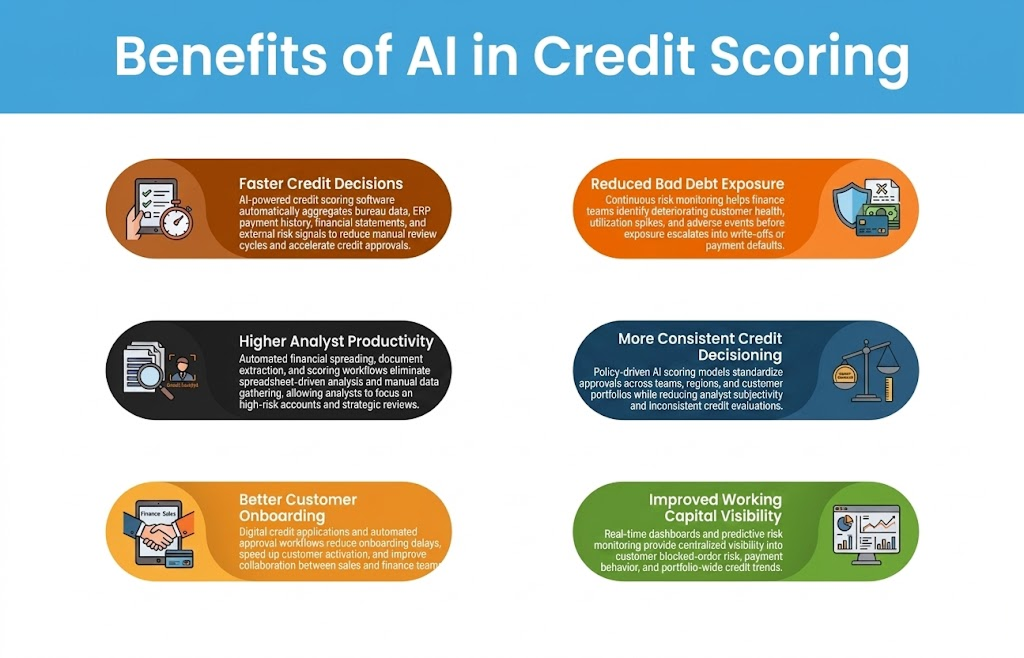
1. Faster Credit Decisions
AI-powered credit scoring software automatically aggregates bureau data, ERP payment history, financial statements, and external risk signals to reduce manual review cycles and accelerate credit approvals.
2. Reduced Bad Debt Exposure
Continuous risk monitoring helps finance teams identify deteriorating customer health, utilization spikes, and adverse events before exposure escalates into write-offs or payment defaults.
3. Higher Analyst Productivity
Automated financial spreading, document extraction, and scoring workflows eliminate spreadsheet-driven analysis and manual data gathering, allowing analysts to focus on high-risk accounts and strategic reviews.
4. More Consistent Credit Decisioning
Policy-driven AI scoring models standardize approvals across teams, regions, and customer portfolios while reducing analyst subjectivity and inconsistent credit evaluations.
5. Better Customer Onboarding
Digital credit applications and automated approval workflows reduce onboarding delays, speed up customer activation, and improve collaboration between sales and finance teams.
6. Improved Working Capital Visibility
Real-time dashboards and predictive risk monitoring provide centralized visibility into customer exposure, blocked-order risk, payment behavior, and portfolio-wide credit trends.
Ebooks
Do you AI-led credit scores can reduce credit risk by 15-20%?
Learn how top businesses are accelerating credit decisioning with AI
Modern AI credit scoring software is no longer limited to assigning risk scores. Finance teams now use AI-driven credit scoring platforms to automate onboarding, standardize credit decisioning, monitor customer risk continuously, and proactively prevent blocked-order disruption across large customer portfolios.
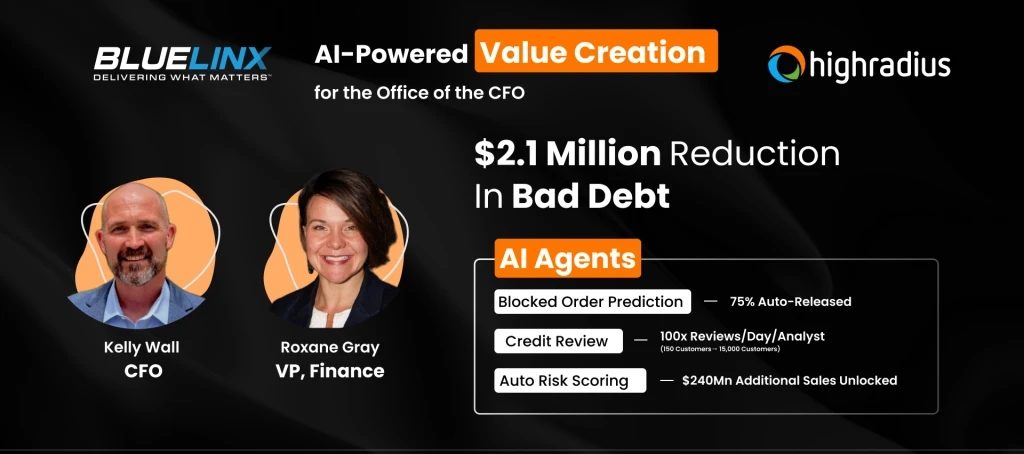
BlueLinx: Preventing Blocked Orders and Accelerating Onboarding
BlueLinx modernized its credit operations by using AI-driven credit scoring, predictive blocked-order monitoring, and automated approval workflows to reduce onboarding delays and improve operational visibility. By continuously monitoring payment behavior, utilization trends, and customer exposure, the organization reduced blocked orders by 30% while significantly increasing the number of daily credit reviews completed by analysts.
Case Studies
How BlueLinx Achieved 70% Faster Onboarding with AI-led Credit Solution
See how this firm managed high-volume credit operations across 15,000+ customers.
Chevron Phillips Chemical: Continuous Risk Monitoring Across Complex Portfolios
Chevron Phillips Chemical adopted AI-driven credit risk monitoring to improve visibility into changing customer exposure across its receivables portfolio. Automated credit reviews, real-time risk alerts, and continuous monitoring of financial and behavioral risk signals helped the organization proactively manage customer risk and maintain stronger control over bad-debt exposure while accelerating credit review cycles.
Case Studies
How Chevron Phillips Achieved Zero Bad Debt for 4 Consecutive Years
Learn how this industry pioneer modernized enterprise credit operations with continuous risk monitoring and predictive workflows
As businesses modernize credit operations, finance teams are evaluating AI credit scoring software based on its ability to automate credit decisioning, improve real-time risk visibility, and reduce manual credit reviews. The best credit scoring software combines AI-driven credit scoring, automated workflows, predictive analytics, and continuous monitoring to help organizations make faster, more consistent credit decisions across large customer portfolios.
Real-Time Risk Monitoring and AI Credit Scoring
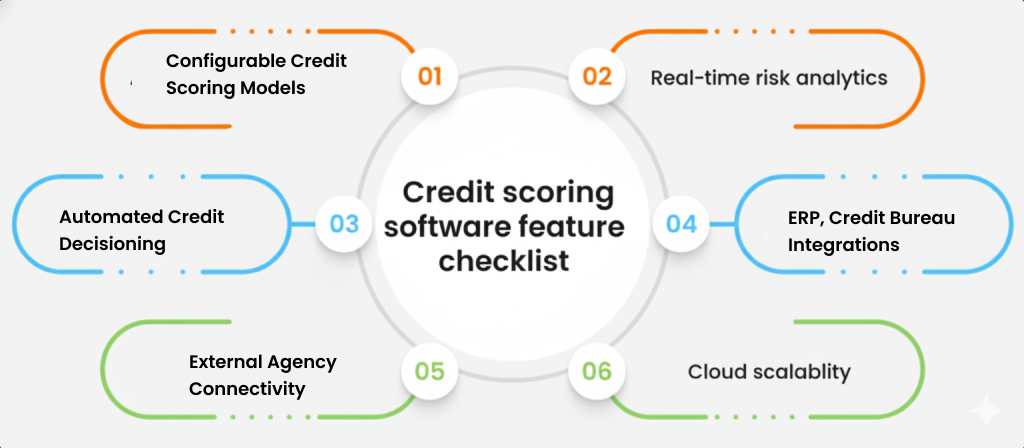
Modern AI credit scoring platforms should continuously monitor payment behavior, credit utilization, financial statements, bankruptcy alerts, and external credit agency updates in real time. Unlike traditional credit scoring systems that rely on periodic reviews and static bureau scores, AI-powered credit scoring software continuously recalculates customer risk as new financial and behavioral data becomes available.
Configurable Credit Scoring Models and Policy Controls
The best credit scoring software allows finance teams to configure AI-based credit scoring models using internal ERP data, payment trends, financial ratios, external bureau data, and industry risk indicators. Configurable scoring thresholds, approval matrices, and automated workflows help standardize credit decisioning while reducing analyst subjectivity and inconsistent approvals.
ERP, Credit Bureau, and Financial Data Integrations
Effective credit scoring software and credit analysis software should integrate seamlessly with ERP systems, financial statements, public filings, trade references, and external credit agencies. Centralized data aggregation improves scoring accuracy, accelerates credit application reviews, and eliminates fragmented risk analysis across spreadsheets and disconnected systems.
Automated Credit Decisioning and Workflow Automation
Modern credit scoring platforms should support automated credit approvals, blocked-order workflows, escalation routing, and explainable AI decision trails. Automated credit decisioning reduces manual review cycles, accelerates customer onboarding, and improves governance through policy-driven approval workflows and audit-ready decision tracking.
External Credit Agency Connectivity
Leading AI credit scoring software integrates with multiple credit bureaus, insurance providers, trade credit associations, and public financial data sources. Multi-source credit data improves predictive risk scoring, strengthens creditworthiness analysis, and enables more accurate credit decisions than relying on static bureau reports alone.
Scalability for High-Volume Credit Operations
As businesses grow, finance teams need credit scoring systems that can scale across large customer portfolios, multiple business units, and global receivables environments. The best AI credit scoring platforms automate periodic reviews, prioritize high-risk accounts, and support continuous credit monitoring without increasing analyst headcount or operational complexity.
Use HighRadius' Credit Scoring AI Software To Improve Credit Decisioning And Risk Monitoring
HighRadius Credit Management Software helps mid-market finance teams automate credit decisioning, standardize risk evaluation, and gain real-time visibility into customer exposure without increasing analyst headcount.
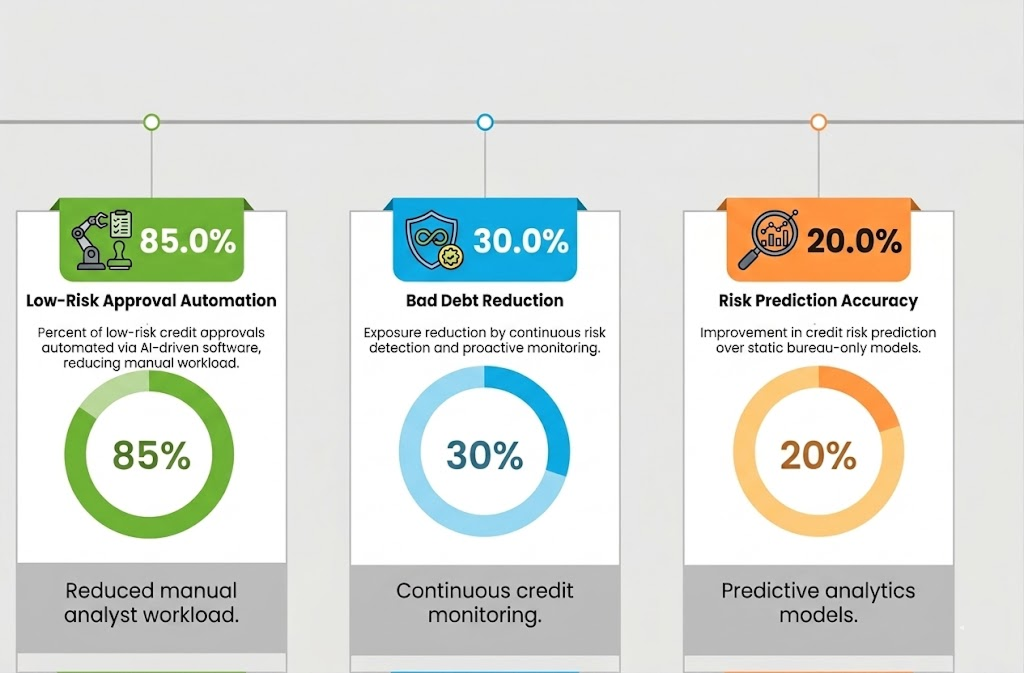
For growing mid-market businesses, HighRadius replaces spreadsheet-driven credit reviews with AI-powered scoring, automated approvals, and ERP-integrated workflows that accelerate onboarding by up to 70%, automate 80–90% of low-risk approvals, and improve analyst productivity by 46% without increasing headcount.
For enterprises managing receivables across multiple ERPs, regions, and legal entities, HighRadius delivers predictive blocked-order prevention, real-time portfolio monitoring, and enterprise-wide policy orchestration powered by integrations with 35+ credit agencies and external risk sources. Businesses use HighRadius to reduce blocked orders by up to 30%, perform 3× more credit reviews daily, and lower bad debt exposure by 20–40%.
With real-time credit risk analysis software and credit decisioning software, you can receive alerts for any changes in your customers’ credit profile and make data-driven credit decisions from unlimited credit reports. Our software integrates with your ERP system and can start monitoring your customers in just 30 days.
We offer configurable credit scoring software and approval workflows that can be customized based on geography, customer segments, business units, and other factors. You can fast-track credit approvals through complex corporate hierarchies, making the credit application process more efficient and streamlined.
Our highly configurable online credit application allows you to onboard customers across the globe with multi-language, customized credit applications embedded on your website. You can automatically capture financials, personal guarantees, and check bank references, reducing the need for manual data entry.
Our software also automatically extracts credit data from over 40+ global and local agencies, including credit ratings, financials, and credit insurance information. You can configure the auto-extracted data in your preferred currency, making it easier to analyze and interpret.
With AI-based blocked order management, you can auto-predict blocked orders based on the customers’ credit limit utilization and payment history. You can leverage AI-based release or partial payment recommendations for faster credit decisions, reducing the need for manual intervention.
Learn More about HighRadius's Accounts Receivable Software
Lower DSO, boost working capital, and increase productivity with our AI-driven accounts receivable platform, integrated with modern ERPs.
Accelerate payment recovery from delinquent customers and boost cash flow through automated collection workflows.
Cash App
Achieve same day cash application with automated remittance aggregation
Credit
Mitigate credit risk, reduce bad debt, and streamline customer onboarding with AI-powered insights.
Deductions
Reduce Revenue Leakage with AI Prediction models that identify valid and invalid deductions.
FAQs on Credit Scoring Software
1. What is credit scoring solutions?
Credit scoring tools and engines analyze financial and behavioral data to assess a customer’s creditworthiness. It automates credit evaluations, assigns risk scores, and helps finance teams make faster, data-driven credit decisions while minimizing bad debt exposure.
2. How does AI improve credit scoring accuracy?
AI enhances scoring accuracy by learning from historical payment behavior, macro trends, and real-time data. It continuously refines risk models, reducing human bias and improving predictive precision for better credit decisions.
3. What features should enterprises look for in credit scoring software?
Key features include AI-based scoring models, ERP and CRM integration, real-time data ingestion, explainable risk insights, and compliance tracking. These capabilities help enterprises scale credit operations and ensure consistent, policy-driven decisions.
4. What is AI credit scoring?
AI credit scoring uses machine learning to assess creditworthiness using both traditional data (credit history) and non-traditional data like transactions, payment behavior, and digital activity. It enables faster, more accurate risk assessment and helps evaluate borrowers with limited or no credit history.
HighRadius Named an IDC MarketScape Leader for the Second Time in a Row For AR Automation Software for Large and Midsized Businesses
HighRadius stands out as an IDC MarketScape Leader for AR Automation Software, serving both large and midsized businesses. The IDC report highlights HighRadius’ integration of machine learning across its AR products, enhancing payment matching, credit management, and cash forecasting capabilities.
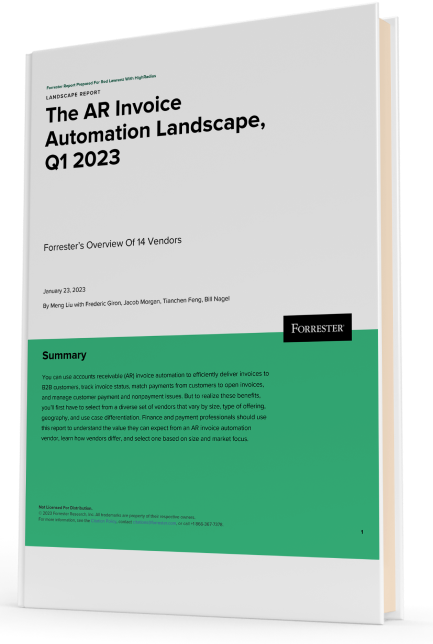
Forrester Recognizes HighRadius in The AR Invoice Automation Landscape Report, Q1 2023
Forrester acknowledges HighRadius’ significant contribution to the industry, particularly for large enterprises in North America and EMEA, reinforcing its position as the sole vendor that comprehensively meets the complex needs of this segment.