How Agentic AI Is Transforming Credit Risk Assessment
Last Updated: 28 August, 2026
•
Anisha Jha Content Writer
2026 Automation Benchmark Report
HighRadius 2026 Automation Benchmark Report For The Office Of The CFO
Understand if your performance is on par with top 10% of the organizations. Identify gaps, best practices and know how you can drive value through Agentic AI-Driven Automation.
Still Using Spreadsheets for Credit Risk Reviews? Use automated credit risk management to unlock 40% reduced blocked orders 3x faster credit decisions.
How Agentic AI Is Transforming Credit Risk Assessment
Credit teams are no strangers to walking the line between growth and exposure. On one side, there’s pressure to approve accounts quickly to support sales momentum. On the other hand, constant vigilance is required to protect working capital and minimize bad debt. Most teams are managing this tension with dated tools, fragmented data, and reactive processes. And while traditional automation has helped streamline certain tasks, it rarely changes how credit risk is actually managed.
This is where agentic AI is starting to reshape the equation. Rather than simply executing predefined steps, agentic AI systems are actively analyzing, recommending, and in many cases, making decisions on behalf of the credit team.
In this blog, we explore how finance teams are applying Agentic AI in credit operations—and its impact on their results.
80–90% of Credit Evaluations Don't Need Manual Review.
Automate routine approvals, focus analysts on high-risk accounts, and improve portfolio visibility with continuous AI-driven risk monitoring.
AI for credit risk assessment uses machine learning models and automation to evaluate customer creditworthiness using real-time financial, behavioral, and external data.
It enables:
automated risk scoring
real-time monitoring
faster credit decisions
AI for credit risk assessment is closely connected to core capabilities such as credit scoring and credit decisioning. AI-powered credit scoring models continuously evaluate customer risk using dynamic data inputs, while credit decisioning systems apply predefined policies to automate approvals, limit assignments, and exceptions. Together, they ensure that risk evaluation and decision execution happen in real time, improving both speed and consistency across the credit lifecycle.
70% of Credit Scoring Software Never Delivers the Business Case It Promised.
Use this free vendor evaluation scorecard to find out if your credit platform will improve customer approval, risk review, and credit decision for years.
Most credit workflows still revolve around a one-time evaluation. A credit application comes in, analysts pull a few credit reports, check for red flags, and assign a limit. After that, unless something breaks, the customer’s risk profile often goes untouched.
There are several inherent problems with this approach:
Risk assessments quickly become stale, especially in volatile sectors.
Analysts spend more time compiling data than analyzing it.
Siloed information across ERPs, portals, and credit bureaus slows down the process.
This lag between insight and action is where risk quietly grows. Without real-time visibility, credit teams are often reacting to problems after they've already taken a toll. A customer might start delaying payments, show signs of financial stress, or get downgraded by a credit bureau, but if those signals aren’t picked up quickly, there's little room to respond effectively.
By the time a red flag surfaces in the system, it’s usually too late to make a meaningful change. The credit limit has already been extended, orders have been fulfilled, and now collections may be at risk. What should have been a proactive decision turns into damage control and that’s exactly what strong credit operations are designed to avoid.
61% of Companies Still Can't Prove AI Is Improving the Bottom Line.
Don’t be one of them. Use this credit analysis software buyer guide to buy solutions that scale across business and provide higher ROI.
The difference is subtle at first glance but meaningful. Traditional AI helps automate steps within a process. Agentic AI changes how the process itself behaves. It monitors risk conditions in real time, reevaluates customer profiles as new data becomes available, and takes initiative when intervention is warranted.
For credit teams, this means that customer reviews can happen continuously, not just quarterly. Credit limits can be adjusted based on shifting behavior, not just scorecards. And blocked orders can be resolved based on predicted repayment behavior, not just static thresholds.
Agentic AI Use Cases in Credit Risk Assessment
Agentic AI is already helping finance teams move faster, work smarter, and manage risk more proactively. Here are five real-world use cases showing how it’s driving impact today.
1. Continuous Credit Scoring with Live Data
Instead of relying on outdated credit reports, agentic systems pull in financial data, agency scores, ERP activity, and trade behavior on an ongoing basis. These inputs update a customer's score dynamically, so teams can react to emerging risks instead of chasing them after the fact.
One global manufacturer saw a 70 percent reduction in time spent reviewing low-risk accounts by automating an advanced B2B credit scoring tool.
2. Automated Alerts for Risky Accounts
The system proactively flags accounts showing signs of deterioration. That could be a rise in dispute activity, partial payments becoming more frequent, or aging balances creeping up. These alerts feed into a prioritized worklist that helps analysts focus their time where it matters most.
It’s not about more data—it’s about getting the right data at the right time.
3. Accelerated Credit Approvals
Agentic AI is increasingly used to fast-track onboarding for low-risk customers. By automatically verifying agency reports, pulling trade references, and checking internal exposure, it allows analysts to make decisions faster or even fully automate approvals for standard profiles.
Some organizations report up to a 70 percent reduction in onboarding cycle times using this model.
4. Smarter Blocked Order Management
Blocked orders are often the result of rigid credit policies rather than actual risk. Agentic systems assess historical payment patterns, current AR behavior, and order cadence to determine whether a hold is necessary. In many cases, they recommend a course of action—release, escalate, or hold—and push that action into the ERP.
This reduces both sales friction and manual overrides, while keeping exposure in check.
5. Proactive Handling of Collateral and Insurance
When customers approach or exceed risk thresholds, agentic AI recommends protective actions like requiring a bank guarantee or obtaining credit insurance. It also tracks the expiration of existing collateral agreements and alerts analysts before coverage gaps appear.
For high-risk accounts, this creates a tighter safety net without adding operational overhead.
Case Studies
How this manufacturing giant unlocked 17,000+ annual credit reviews
Learn how FBM modernize credit operations with AI-driven scoring, automated workflows, and centralized visibility across entities.
How Finance Leaders Are Benefitting From This Change
The organizations adopting this approach are already reporting measurable improvements:
Analyst productivity gains of 30 to 40 percent, driven by fewer manual reviews and cleaner prioritization
A 10 to 15 percent reduction in bad debt through earlier interventions
Smoother customer experiences with fewer order holds and faster account approvals\
Traditional vs AI-Based Credit Risk Assessment
Feature
Traditional
AI-Based
Data
Historical
Real-time
Analysis
Manual
Automated
Speed
Slow
Instant
Monitoring
Periodic
Continuous
Is AI-Based Credit Risk Assessment Secure?
AI-based credit risk assessment systems are designed with enterprise-grade security, ensuring data privacy, auditability, and compliance across the credit lifecycle. These systems are built to handle sensitive financial data while maintaining strict governance and control.
They provide:
Secure data integrations AI systems integrate with multiple internal and external data sources such as credit bureaus, financial databases, and ERPs through controlled and secure channels. Data collected during credit application processing is validated against trusted third-party sources, ensuring both accuracy and integrity.
Audit trails for decisions Every credit action, including scoring, approvals, limit changes, and reviews, is logged and traceable. Automated workflows ensure that all credit decisions, communications, and approvals are recorded, enabling full transparency for audits and compliance requirements.
Controlled access and governance Role-based access ensures that only authorized users can view or act on sensitive credit data. Approval workflows follow predefined hierarchies, ensuring that high-risk decisions are escalated appropriately while maintaining policy compliance.
Standardized and validated data processing AI-driven systems validate customer data at the point of entry, extract key financial information from documents, and map it into structured formats. This reduces the risk of manual errors and ensures consistent data handling across all credit evaluations.
Continuous monitoring and risk alerts These systems continuously monitor credit agency updates, financial signals, and external events. When risk thresholds are breached, automated alerts trigger review workflows, ensuring that security and risk controls are enforced in real time.
Secure and governed decision automation AI models apply predefined policies and thresholds to automate credit decisions while maintaining control. Low-risk decisions can be executed automatically, while exceptions are routed through governed approval workflows, ensuring a balance between automation and oversight.
Ebooks
Manual Credit Reviews Are Driving Up Costs—Automation Can Cut Them by 20%+.
Reduce operational overhead while improving speed, accuracy, and decision consistency.
How HighRadius' AI Agent-Led Credit Management Helps Accelerate Credit Decisioning
HighRadius Credit Management helps finance teams automate credit decisioning, standardize risk evaluation, and gain real-time visibility into customer exposure. By combining AI-driven scoring with automated workflows, it enables faster approvals, reduces manual effort, and improves control over credit risk.
With real-time credit risk analysis software and credit decisioning software, you can receive alerts for any changes in your customers’ credit profile and make data-driven credit decisions from unlimited credit reports. Our software integrates with your ERP system and can start monitoring your customers in just 30 days.
We offer configurable credit scoring software and approval workflows that can be customized based on geography, customer segments, business units, and other factors. You can fast-track credit approvals through complex corporate hierarchies, making the credit application process more efficient and streamlined.
Our highly configurable online credit application allows you to onboard customers across the globe with multi-language, customized credit applications embedded on your website. You can automatically capture financials, personal guarantees, and check bank references, reducing the need for manual data entry.
Our software also automatically extracts credit data from over 40+ global and local agencies, including credit ratings, financials, and credit insurance information. You can configure the auto-extracted data in your preferred currency, making it easier to analyze and interpret.
With AI-based blocked order management, you can auto-predict blocked orders based on the customers’ credit limit utilization and payment history. You can leverage AI-based release or partial payment recommendations for faster credit decisions, reducing the need for manual intervention.
Struggling With Incomplete Credit Applications?
Explore the #1 software that makes onboarding customer faster and easier
Accelerate payment recovery from delinquent customers and boost cash flow through automated collection workflows.
Cash App
Achieve same day cash application with automated remittance aggregation
Credit
Mitigate credit risk, reduce bad debt, and streamline customer onboarding with AI-powered insights.
Deductions
Reduce Revenue Leakage with AI Prediction models that identify valid and invalid deductions.
Online Credit Application
Onboard customers seamlessly with a configurable online credit application. Cut down on back-and-forth and collect all customer details in one go.
FAQs:
What is Agentic AI in credit risk assessment? Agentic AI is a real-time, intelligent system that continuously assesses credit risk by analyzing dynamic data from multiple sources. Unlike static models, it adapts instantly to changes in customer behavior, offering proactive insights and recommended actions without waiting for manual intervention.
How is Agentic AI different from traditional automation? Traditional automation executes tasks based on fixed rules. Agentic AI, however, interprets data in context, reprioritizes actions based on new information, and initiates intelligent decisions. It doesn’t just follow instructions—it thinks ahead, adapts, and collaborates with humans to deliver outcomes.
Can Agentic AI make credit decisions autonomously? Yes, Agentic AI can autonomously handle low-risk credit decisions such as approvals or scoring by applying predefined guardrails. For complex or high-risk scenarios, it prepares context-rich recommendations and escalates them to analysts, reducing decision time without compromising on control or oversight.
Does Agentic AI replace credit analysts? No, Agentic AI doesn’t replace credit analysts, it empowers them. By automating repetitive evaluations, data retrieval, and documentation, it gives analysts more time to focus on strategic decisions and high-risk cases that require human expertise, judgment, and relationship management.
Is Agentic AI suitable for SMBs or just large enterprises? While widely adopted by large enterprises, SMBs with high credit exposure, growing portfolios, or limited AR staff can benefit significantly. Agentic AI reduces manual workload, improves decision accuracy, and supports scalability, making it a smart investment even for leaner finance teams.
Resource Library
Resource Hub
Order to Cash
Order to Cash software data sheet
Disconnected workflows can leave teams chasing data, while automated O2C has delivered 20% lower past dues.
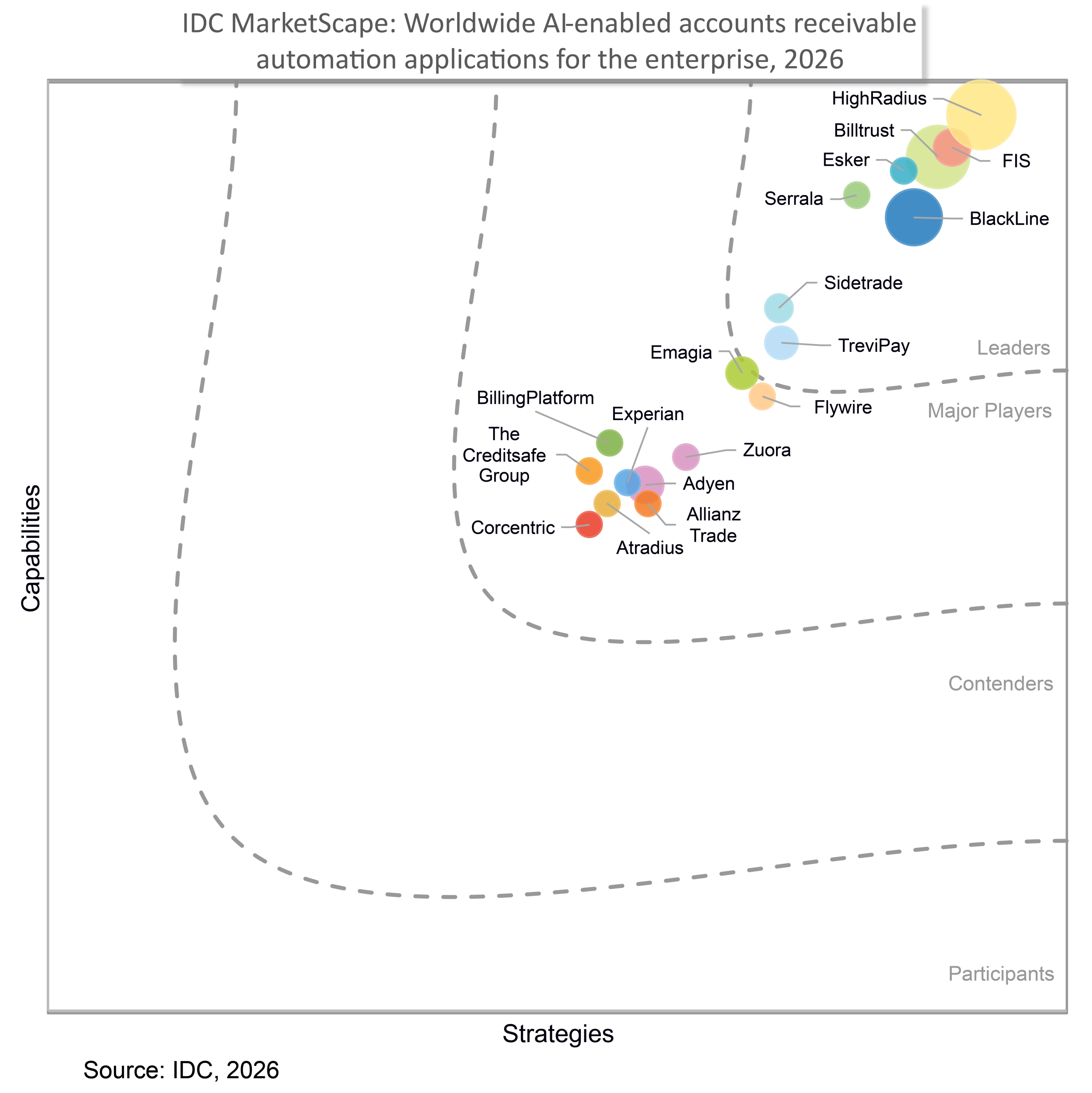
HighRadius recognized as a "Leader" in IDC Marketscape: Worldwide AI-enabled accounts receivable automation applications for the enterprise 2026 vendor assessment
Recognized as a Leader in 2026 Vendor Assessment for unifying credit, collections, cash application, deductions, e-invoicing, and payments on one AI platform to advance enterprise-wide invoice-to-cash transformation.
Forrester Recognizes HighRadius in The AR Invoice Automation Landscape Report, Q1 2023
Forrester acknowledges HighRadius’ significant contribution to the industry, particularly for large enterprises in North America and EMEA, reinforcing its position as the sole vendor that comprehensively meets the complex needs of this segment.