A Credit Review Can Be Accurate and Still Be Too Late
Credit management was once largely a point-in-time exercise: review the customer, assign a limit, approve the account, and revisit it periodically. That model becomes increasingly fragile as customer exposure grows and payment behavior changes faster than review cycles. A customer can move from healthy to high-risk while still sitting inside an approved credit limit.
Modern credit management is shifting toward continuous risk assessment, automated credit scoring models, and AI-driven decisioning—using payment behavior, financial data, credit intelligence, and exposure signals to determine when action is needed. The opportunity is not simply to automate more tasks, but to give credit teams broader portfolio coverage, earlier risk visibility, and faster decisions without adding proportional headcount.
This guide answer 20 frequently asks questions (FAQs) on B2B credit management works, from assessing business credit risk and scoring customers to monitoring deterioration, automating low-risk decisions, and using AI to manage credit risk at scale.
Unlock 20% Less Bad Debt and 3× More Credit Reviews.
See how AI-powered credit management helps finance teams accelerate decisions, monitor risk, and protect revenue, without scaling analyst workload.
Download Solution Guide
1. What is credit management, and why is it important for B2B businesses?
Credit management is the process of evaluating customer creditworthiness, setting appropriate credit limits and payment terms, approving credit, and continuously monitoring exposure and payment behavior. In B2B commerce, suppliers effectively extend financing by delivering goods or services before payment. Effective credit management process helps businesses support sales while controlling bad debt, overdue exposure, and cash-flow risk.
2. What are the key stages of the B2B credit management process?
The B2B credit management process typically spans new-customer onboarding, credit assessment and approval, credit-limit management, ongoing customer reviews, risk monitoring, bankruptcy detection, and blocked-order management. It also involves reviewing financial statements, payment behavior, external credit information, trade relationships, and collateral. The process should continue after onboarding because customer risk can change significantly during the relationship.
3. How does credit management balance revenue growth and credit risk?
Credit management balances growth and risk by determining how much exposure a business can extend to each customer without unnecessarily restricting sales. Overly conservative limits can block legitimate orders and constrain revenue; excessive exposure increases the potential for bad debt. The objective is therefore not simply to reduce credit risk, but to optimize credit exposure while enabling profitable customer transactions.
4. How is business credit risk assessed?
Business credit risk is assessed by combining indicators of a customer's financial health, payment behavior, existing exposure, and external creditworthiness. Credit teams can evaluate financial statements, credit-agency information, Days Beyond Terms, past-due balances, credit-limit utilization, ordering behavior, trade references, and available collateral. The resulting assessment informs risk classification, credit limits, approvals, and ongoing monitoring.
5. What factors are used to assess business credit risk?
Key factors include payment history, Days Beyond Terms, past-due exposure, credit-limit utilization, financial statements, profitability and liquidity indicators, external credit ratings, credit-agency data, ordering behavior, trade relationships, and collateral or guarantees. For private companies, financial statements can be particularly important because publicly available information may be limited.
6. How does customer payment behavior affect credit risk?
Payment behavior is one of the most direct indicators of how a customer is managing its obligations. A customer with a $1 million credit limit may appear acceptable based on exposure alone, but consistently increasing Days Beyond Terms (DBT) can indicate deteriorating payment performance. Tracking these trends allows credit teams to reassess limits or initiate reviews before additional exposure becomes difficult to recover.
Your Credit Decisioning Transformation Starts With Choosing the Right Technology.
Use this 5-step framework to assess your processes, evaluate technology partners, build an ROI case, and move from AI evaluation to execution.
Download eBook
7. How does credit scoring work for businesses?
Business credit scoring converts multiple risk indicators into a standardized score or risk classification. Inputs can include payment history, financial health, credit-agency information, credit utilization, and ordering behavior. The score provides a consistent basis for comparing customer risk and can support decisions such as credit-limit assignment, review prioritization, approval, or escalation.
8. What are credit score systems used for in B2B credit management?
Credit score systems help credit teams standardize how customer risk is evaluated and translate diverse data into an actionable risk classification. In B2B credit management, scores can support new-customer approvals, credit-limit decisions, periodic credit decision and credit reviews, online B2B credit application, and ongoing risk monitoring. Their value increases when scoring incorporates both internal customer behavior and external credit intelligence.
9. How does automated credit scoring improve credit reviews?
An automated credit scoring system reduces the manual effort required to gather risk information, evaluate customers, and calculate scores. Models can combine internal signals such as payment behavior, credit-limit utilization, and ordering patterns with external credit-agency and public-financial data. HighRadius uses prebuilt and configurable AI-based scoring models and can dynamically adjust model weightings by customer segment and region.
10. What is AI credit scoring, and how does it differ from traditional scoring?
AI credit scoring uses AI-based models to evaluate patterns across multiple customer-risk signals rather than relying solely on manually maintained assessments or static scorecards. It can incorporate internal payment behavior, exposure, ordering patterns, financial information, and external credit data. HighRadius supports prebuilt and configurable AI-based scoring models, with weightings that can be adjusted based on customer segment and region.
11. How does AI improve credit risk assessment?
AI improves credit risk assessment by processing multiple risk signals at scale, identifying changes in customer behavior, and helping credit teams prioritize where human attention is needed. HighRadius combines internal indicators such as Average Days to Pay, credit-limit utilization, and past ordering behavior with external credit-agency and public-financial data. Its scoring models can also adapt weightings by customer segment and region.
12. How does AI credit decisioning work?
AI credit decisioning tools combines customer data, risk scoring, business rules, and approval policies to determine the appropriate credit action. Instead of producing only a risk score, the process can determine whether an application or credit-limit request qualifies for automated approval or requires human review. HighRadius, for example, supports automated decisions for low-risk customers and smaller credit-limit increases while routing exceptions through configured approval workflows.
What could 70% faster customer onboarding mean for your bottom line?
Calculate your potential annual savings from automating credit reviews, customer onboarding, approvals, reporting, and risk monitoring.
Download Free Calculator
13. How can businesses automate low-risk credit decisions?
Businesses can automate low-risk credit decisions by defining risk thresholds, approval rules, and escalation paths that allow routine cases to pass without manual intervention. The best credit risk management solutions can automatically approve qualifying low-risk customers or minor credit-limit increases, while more complex cases are routed to the appropriate reviewer or approval level. This allows analysts to focus their time on exceptions rather than routine decisions.
14. What is the difference between credit scoring and credit decisioning?
Credit scoring measures risk; credit decisioning determines the action to take based on that risk. A credit score may classify a customer as low, medium, or high risk using payment, financial, and external data. Credit decisioning then applies that assessment alongside business policies to approve, reject, escalate, adjust a credit limit, or trigger further review.
15. How are business credit limits determined?
Business credit limits should reflect both the customer's ability to pay and the supplier's acceptable level of exposure. Credit teams can consider financial strength, payment behavior, existing exposure, credit-limit utilization, ordering patterns, external credit information, and collateral or guarantees. Limits should not be treated as static: changes in payment behavior or financial health can justify reassessment.
16. What is continuous credit risk monitoring, and why does it matter?
Continuous credit risk monitoring tracks customer-risk signals between scheduled credit reviews so deterioration can be identified earlier. This can include changes in payment behavior, credit utilization, financial health, external credit events, and bankruptcy indicators. It is particularly important because periodic reviews can leave large portions of a customer portfolio without timely reassessment. The source material identifies a common coverage gap in which only 20% of existing customers are reviewed regularly.
17. How can credit monitoring help reduce bad debt?
Credit monitoring helps reduce bad-debt exposure by identifying deterioration early enough for a business to change its credit strategy. For example, worsening payment behavior or a declining financial-health trend can trigger a credit review, limit adjustment, or freeze before additional exposure accumulates. HighRadius uses predictive bankruptcy monitoring that analyzes Altman Z-Score trends over time and can automatically initiate a proactive bankruptcy-review workflow when deterioration reaches defined conditions.
18. What data should be considered when making a business credit decision?
A robust business credit decision should combine internal customer behavior with external credit intelligence. Relevant inputs include payment history, Average Days to Pay, past-due balances, credit-limit utilization, ordering behavior, financial statements, credit-agency reports, public financial data, trade relationships, and collateral. HighRadius integrates with 35+ credit agencies and 15+ public data sources to automate access to external credit and financial information.
19. How does HighRadius use AI to automate credit management?
HighRadius uses an AI orchestration layer comprising automated and assisted agents across the credit-management workflow. Automated agents integrate with different ERPs and support work such as new credit applications, risk scoring, financial-statement analysis, bankruptcy alerts, credit-agency integration, and blocked-order prediction, while assisted agents support blocked-order release, credit review, and credit approval.
20. What AI agents does HighRadius Credit Management use to manage credit risk?
HighRadius Credit Management uses 10+ AI agents across key credit workflows. The automated agents cover work assignment and prioritization, bankruptcy alerts, financial-statement analysis, new credit applications, risk scoring, blocked-order prediction, agency integration, and verification activities. Assisted agents keep humans involved in higher-judgment activities such as credit review, approval, and blocked-order release.
Analyst Reports
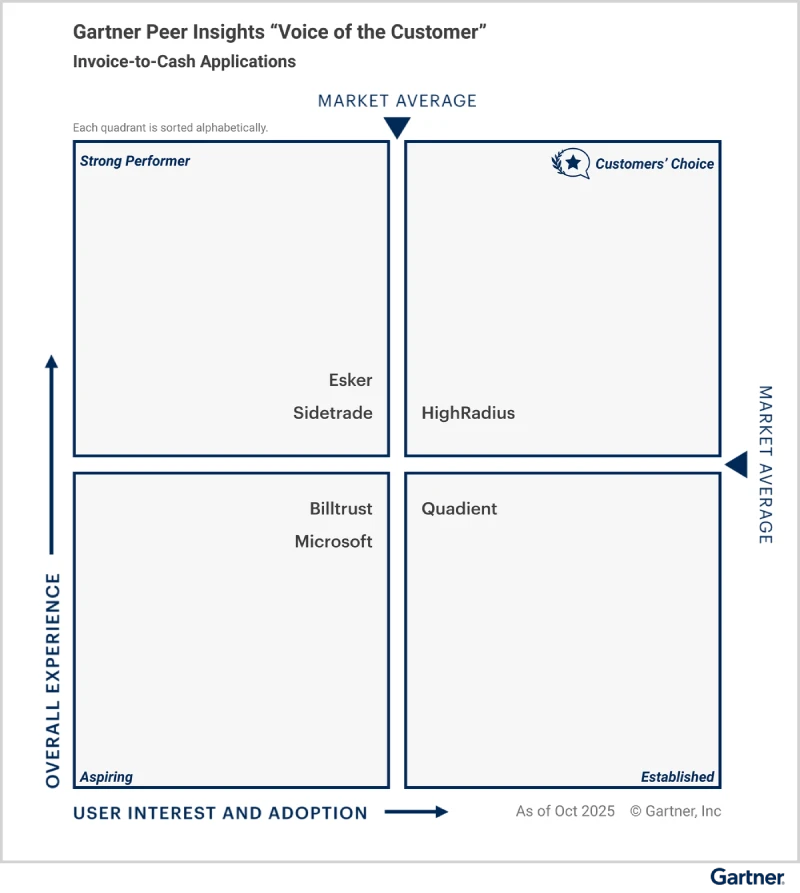
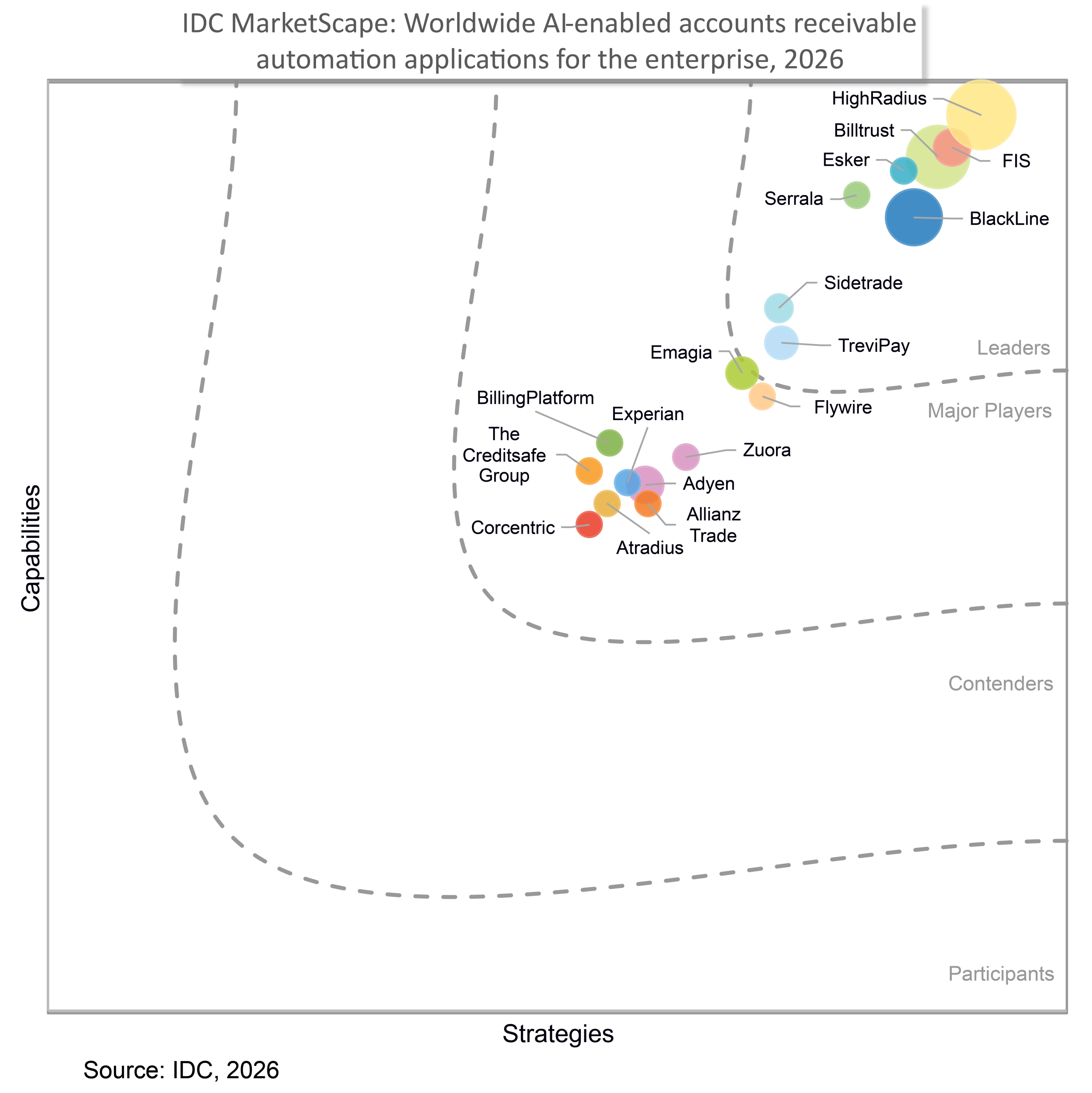
Recognized as an IDC MarketScape Leader in AR Automation
IDC recognized HighRadius for AI-driven AR automation across both enterprise and mid-market organizations.
-
Best for all industry players
-
Automated O2C solutions
-
200+ Agentic AI
Download Report
How HighRadius Credit Risk Software Helps Improve Credit Risk Assessment
HighRadius Credit Management Platform helps mid-market finance teams automate credit decisioning, standardize risk evaluation, and gain real-time visibility into customer exposure without increasing analyst headcount. Built for organizations scaling beyond spreadsheet-driven approvals, the platform combines AI-driven credit scoring, automated workflows, and continuous monitoring to accelerate onboarding, reduce manual reviews, and improve control over credit risk.
With real-time credit risk management tools and AI-powered credit management solutions, finance teams can receive alerts for changes in customer credit profiles and make faster, data-driven decisions using unlimited credit reports. The platform integrates with ERP systems and can begin monitoring customers in as little as 30 days.
- With real-time credit risk analysis software and credit decisioning software, you can receive alerts for any changes in your customers’ credit profile and make data-driven credit decisions from unlimited credit reports. Our software comes with your Netsuite, SAP integrations and can start monitoring your customers in just 30 days.
- We offer configurable credit scoring software and approval workflows that can be customized based on geography, customer segments, business units, and other factors. You can fast-track credit approvals through complex corporate hierarchies, making the credit application process more efficient and streamlined.
- Our highly configurable online credit application allows you to onboard customers across the globe with multi-language, customized credit applications embedded on your website. You can automatically capture financials, personal guarantees, and check bank references, reducing the need for manual data entry.
- Our software also automatically extracts credit data from over 40+ global and local agencies, including credit ratings, financials, and credit insurance information. You can configure the auto-extracted data in your preferred currency, making it easier to analyze and interpret.
- With AI-based blocked order management, you can auto-predict blocked orders based on the customers’ credit limit utilization and payment history. You can leverage AI-based release or partial payment recommendations for faster credit decisions, reducing the need for manual intervention.
Struggling With Slow Credit Approvals and Credit Reviews?
Explore the #1 software that makes onboarding customer faster and easier
Request a Demo

Collections
Accelerate payment recovery from delinquent customers and boost cash flow through automated collection workflows.
Cash App
Achieve same day cash application with automated remittance aggregation
Credit
Mitigate credit risk, reduce bad debt, and streamline customer onboarding with AI-powered insights.
Deductions
Reduce Revenue Leakage with AI Prediction models that identify valid and invalid deductions.
Online Credit Application
Onboard customers seamlessly with a configurable online credit application. Cut down on back-and-forth and collect all customer details in one go.