What Will Define Credit Management in 2027 - continuous visibility, agentic AI workflows or governed credit decisions? Find out it in the Future Outlook Playbook.
Download eBook- Credit decisioning requires a connected process that brings together customer information, risk assessment, scoring, policy-based decisions and continuous monitoring.
- A credit decision should not end at customer onboarding while any changes in payment behavior, overdue balances, disputes and customer exposure should inform ongoing credit reviews and risk priorities.
- The strongest credit operations connect risk assessment with action by linking credit and collections, helping finance teams respond to changing customer risk while balancing revenue growth, working capital and bad debt exposure.
For many B2B businesses, extending credit is essential to winning and retaining customers. But deciding how much credit to offer, on what terms and when to review those terms is becoming increasingly complex.
A customer may look financially sound at onboarding, receive an approved credit limit and continue doing business for months. But what happens when its payment behaviour changes? What if overdue invoices increase, disputes remain unresolved or total exposure starts approaching the approved limit?
A credit score or an initial approval cannot answer these questions on its own.
A credit decisioning framework is the process an organisation uses to evaluate customer risk and translate that assessment into decisions about credit approval, limits, payment terms and ongoing exposure. In B2B finance, it must account for both a customer's financial position and its actual payment behaviour over time.
This calls for a more connected approach: one that brings together credit applications, risk intelligence, scoring, decision-making and continuous monitoring and connects these activities with downstream collections.
80–90% of Credit Evaluations Don't Need Manual Review.
Automate routine approvals, focus analysts on high-risk accounts, and improve portfolio visibility with continuous AI-driven risk monitoring.
Download solution guideWhy Traditional Credit Decisioning Falls Short
Traditional credit processes rely on external credit reports, financial statements, analyst reviews and predefined credit policies. These inputs remain important, but they do not always provide a complete or current picture of customer risk.
Three gaps commonly limit their effectiveness.
1. Risk is assessed at specific points in time. A credit review may establish a customer's risk profile during onboarding or an annual review. However, its financial position and payment behaviour can change between reviews.
2. Important information sits across different systems. Credit teams may use bureau data, ERP records, financial statements and customer payment histories without having a consolidated view of risk and exposure.
3. Credit decisions and collections actions are often disconnected. Credit teams assess whether customers should receive credit, while collections teams focus on overdue invoices. When these activities operate separately, changes in payment behaviour may not inform credit decisions quickly enough.
The result is a process that can be thorough at the point of approval but less responsive as customer circumstances change. A modern B2B credit management and decisioning approach needs to address all three gaps.

The Modern Credit Decisioning Framework: Five Connected Stages
A modern credit decisioning framework brings five stages together. Each stage builds on the previous one, while information from ongoing customer activity feeds back into future risk assessments and decisions.
| Stage | Purpose | Key Focus |
| Intelligent Credit Application | Build a reliable customer profile | Company and ownership information, financial documents, requested credit limits, payment terms and trade references |
| Multi-Dimensional Risk Intelligence | Develop a complete view of customer risk | External credit data, financial statements, payment history, overdue balances, disputes and existing exposure |
| Dynamic Credit Scoring | Translate risk indicators into a consistent assessment | Configurable scoring models, customer segmentation, transparent scoring logic and periodic reassessment |
| Governed Credit Decisioning | Turn risk assessments into business decisions | Credit approvals, credit limits, payment terms, policy thresholds and exception workflows |
| Continuous Credit Risk Monitoring | Keep credit decisions relevant over time | Changes in credit ratings, payment behaviour, overdue balances, credit utilisation and customer exposure |
1. Intelligent Credit Application: Build a Reliable Customer Profile
The process begins with collecting accurate customer information.
A credit application should capture the details required to establish a customer's identity, financial position and credit requirements. This may include:
- Company and ownership information
- Financial statements and supporting documents
- Requested credit limits and payment terms
- Trade references and banking information
- Relevant business and contact details
The objective is not simply to collect more information. It is to establish a reliable starting point for evaluating customer risk.
Automating application capture, document collection and validation can reduce manual follow-ups and help credit teams move applications through the review process more efficiently.
2. Multi-Dimensional Risk Intelligence: Look Beyond External Credit Data
A customer's creditworthiness cannot always be understood through an external credit score alone.
A more complete credit risk assessment combines external information with the organisation's own customer and transaction data.
External inputs may include credit bureau reports, agency ratings, financial statements, trade references and relevant industry indicators.
Internal inputs may include:
- Historical payment patterns
- Outstanding invoices and overdue balances
- Existing credit utilisation and total exposure
- Dispute and deduction trends
- Previous credit reviews and decisions
Combining these inputs gives credit teams a broader view of customer risk. For example, a customer with a favourable bureau rating may still be showing signs of deterioration through consistently delayed payments or increasing overdue balances.
The key is to assess not only whether a customer appears creditworthy, but also how its financial and payment behaviour is changing.
3. Dynamic Credit Scoring: Translate Risk into a Consistent Assessment
Once the relevant information is available, credit scoring helps translate multiple risk indicators into a structured assessment.
A credit scoring model assigns weights to selected factors and evaluates customers against defined risk criteria. Depending on the organisation's requirements, these factors may include financial strength, payment history, external credit ratings, exposure and industry risk.
An effective B2B credit scoring approach should include:
- Configurable scoring models: Align risk factors and weightages with the organisation's credit policy.
- Customer segmentation: Apply appropriate risk criteria to different customer groups, markets or business units.
- Transparent scoring logic: Make it easier for analysts to understand why a customer received a particular score.
- Periodic reassessment: Update risk assessments as new information becomes available.
Scoring should support credit judgement, not replace it. A score provides a consistent view of risk, but the final decision must also consider business context, exposure and policy requirements.
4. Governed Credit Decisioning: Turn Risk Assessment into Action
A credit score becomes valuable when it informs a clear business decision. Credit decisioning translates risk assessments into actions such as:
- Approving or declining a credit application
- Setting an initial credit limit
- Revising an existing credit limit
- Recommending different payment terms
- Escalating exceptions for analyst or management review
These decisions should be guided by defined credit policies, risk thresholds and approval authorities. For example, a low-risk customer applying for a standard credit limit may qualify for an AI-led credit scoring and approval within predefined policy limits. A customer with a higher risk score, unusual exposure or incomplete financial information may require additional review.
This approach allows routine decisions to move faster while ensuring that higher-risk or exceptional cases receive the appropriate level of attention. It also creates greater consistency across teams and business units, particularly for organisations managing large customer portfolios across multiple markets. Additionally, integrating credit application workflows with ERP systems such as NetSuite can help ensure that customer information and approval decisions are connected to existing business processes. Learn more about NetSuite ERP integration for credit applications.
5. Continuous Credit Risk Monitoring: Keep Decisions Relevant
Credit risk does not remain constant after a customer is approved.
A customer's creditworthiness, financial position, payment behaviour and outstanding exposure can change significantly during the business relationship. Continuous credit risk management using automated tools help identify these changes and determine when a review or intervention may be necessary.
Important indicators include:
- Changes in external credit ratings
- Increasing overdue balances
- Deteriorating payment patterns
- Rising credit utilisation
- Significant changes in customer exposure
- Repeated disputes or unresolved deductions
When these indicators change, credit teams can reassess the customer's risk profile, review existing limits and determine whether additional action is required.This moves credit management away from relying exclusively on periodic reviews towards a more responsive process.
70% of Credit Scoring Software Never Delivers the Business Case It Promised.
Use this free vendor evaluation scorecard to find out if your credit platform will improve customer approval, risk review, and credit decision for years.
Download free scorecardThe Credit Decisioning-to-Collections Feedback Loop: The Missing Link
The five stages establish a stronger credit decisioning framework. But there is one important connection that organisations should not overlook: the relationship between credit decisions and collections performance.
Credit teams determine how much risk the business is willing to take when extending credit. Collections teams see how customers behave after that credit has been extended. These two perspectives should inform each other.
Consider a customer that was classified as low risk during onboarding. Over time, its invoices begin moving beyond agreed payment terms. The customer also develops a pattern of repeated disputes and its outstanding exposure increases.
Each signal provides additional information about the customer's payment behaviour and potential risk.
If collections activity remains separate from credit reviews, these developments may not influence the customer's risk assessment until the next scheduled review.
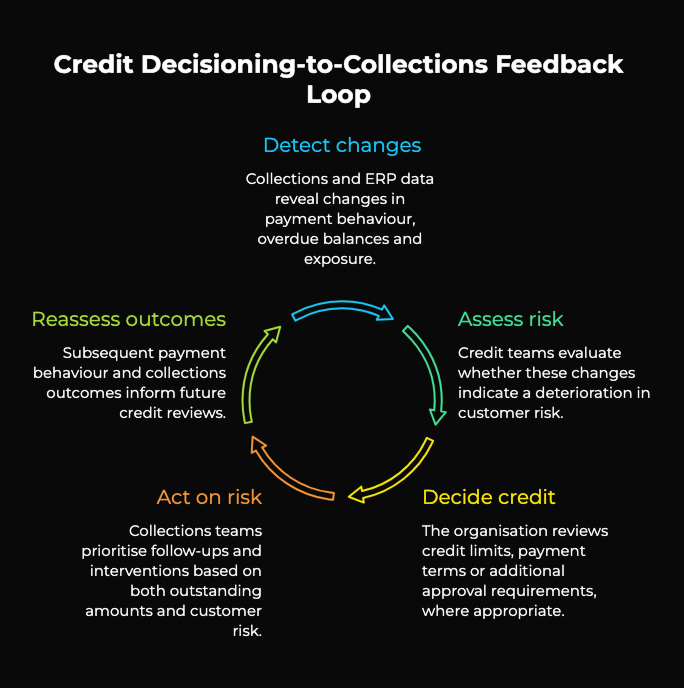
A connected approach creates a Credit Decisioning-to-Collections Feedback Loop:
- Detect: Collections and ERP data reveal changes in payment behaviour, overdue balances and exposure.
- Assess: Credit teams evaluate whether these changes indicate a deterioration in customer risk.
- Decide: The organisation reviews credit limits, payment terms or additional approval requirements, where appropriate.
- Act: Collections teams prioritise follow-ups and interventions based on both outstanding amounts and customer risk.
- Reassess: Subsequent payment behaviour and collections outcomes inform future credit reviews.
For example, a smaller overdue balance from a customer showing a consistent deterioration in payment behaviour may deserve earlier attention than a larger overdue balance from a customer with a strong payment record.
The point is not to replace collections prioritisation based on overdue amounts. It is to add customer risk and change exposure to the decision.
This is what makes credit decisioning continuous: the outcome of one credit decision becomes an input into the next.
It also changes how organisations should think about the relationship between credit and collections. Rather than treating them as separate stages of the order-to-cash process, they become connected sources of information for managing customer exposure.
What a Connected Credit Decisioning Framework Enables
When credit applications, risk assessment, scoring, decisions and monitoring operate as connected stages, organisations can build a more consistent approach to managing customer credit.
The benefits extend beyond faster application approvals:
- More informed credit decisions: Bring external credit information and internal payment behaviour into a broader risk assessment.
- Greater consistency: Apply defined scoring models, risk thresholds and approval policies across customer portfolios.
- Earlier risk identification: Identify changes in customer behaviour and exposure before they become larger credit concerns.
- Better allocation of analyst time: Automate routine decisions within policy limits and focus expert reviews on exceptions.
- Stronger coordination between credit and collections: Use customer risk and payment performance to inform both credit reviews and collections priorities.
For CFOs and finance leaders, the larger opportunity is to balance three business priorities: supporting revenue growth, protecting cash flow and managing bad debt exposure.
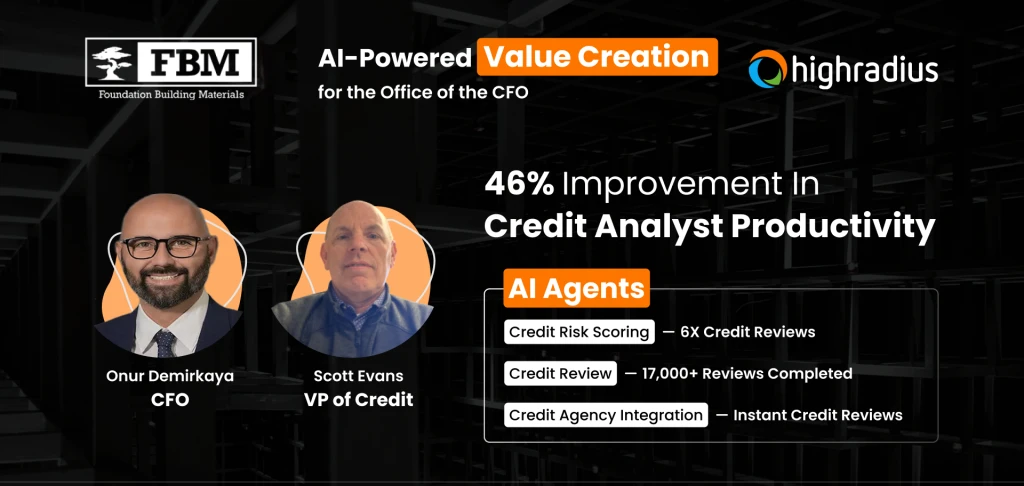
The business case for modernising credit operations is not limited to technology adoption. HighRadius customer outcomes illustrate the operational value of improving credit processes:
- Chevron Phillips Chemical achieved 70% faster onboarding, 89% faster credit reviews and zero bad debt for four consecutive years.
- Foundation Building Materials reported a 46% increase in analyst productivity.
These are customer-specific outcomes, not guaranteed results or proof that every organisation will achieve the same improvements. They demonstrate why credit operations efficiency and decision quality matter to the wider finance function.
What Should Finance Leaders Look for in a Modern Credit Decisioning Solution?
The right credit decisioning solution should support the full credit decisioning process, rather than automate only one activity.
When evaluating a platform, finance leaders should consider five areas:
- Data coverage: Can the solution bring together external credit agency information and relevant internal customer and ERP data? Also is the solution integrating seamlessly with Netsuite and SAP for credit management?
- Scoring flexibility: Can risk models, weightages and customer segments be configured to reflect the organisation's credit policy?
- Decision governance: Can routine approvals, exceptions and credit limit reviews follow defined workflows and approval authorities?
- Ongoing visibility: Can teams identify changes in customer risk, payment patterns and exposure?
- Operational fit: Can the solution support the scale and complexity of the business, whether it is a growing mid-market organisation or a global enterprise?
For mid-market businesses, the priority may be to move beyond spreadsheets and manual reviews without adding to a lean credit team's workload. For global enterprises, the challenge may be to establish consistent credit policies, risk visibility and approval workflows across regions and ERP environments.
HighRadius supports these needs through AI-powered credit applications, credit scoring software solutions, risk monitoring and decision workflows. Its credit management capabilities include integrations with 35+ credit agencies, configurable scoring and workflows designed to support both mid-market businesses and complex global enterprises.
The important consideration is how these capabilities fit the organisation's operating model, data environment and credit policy.
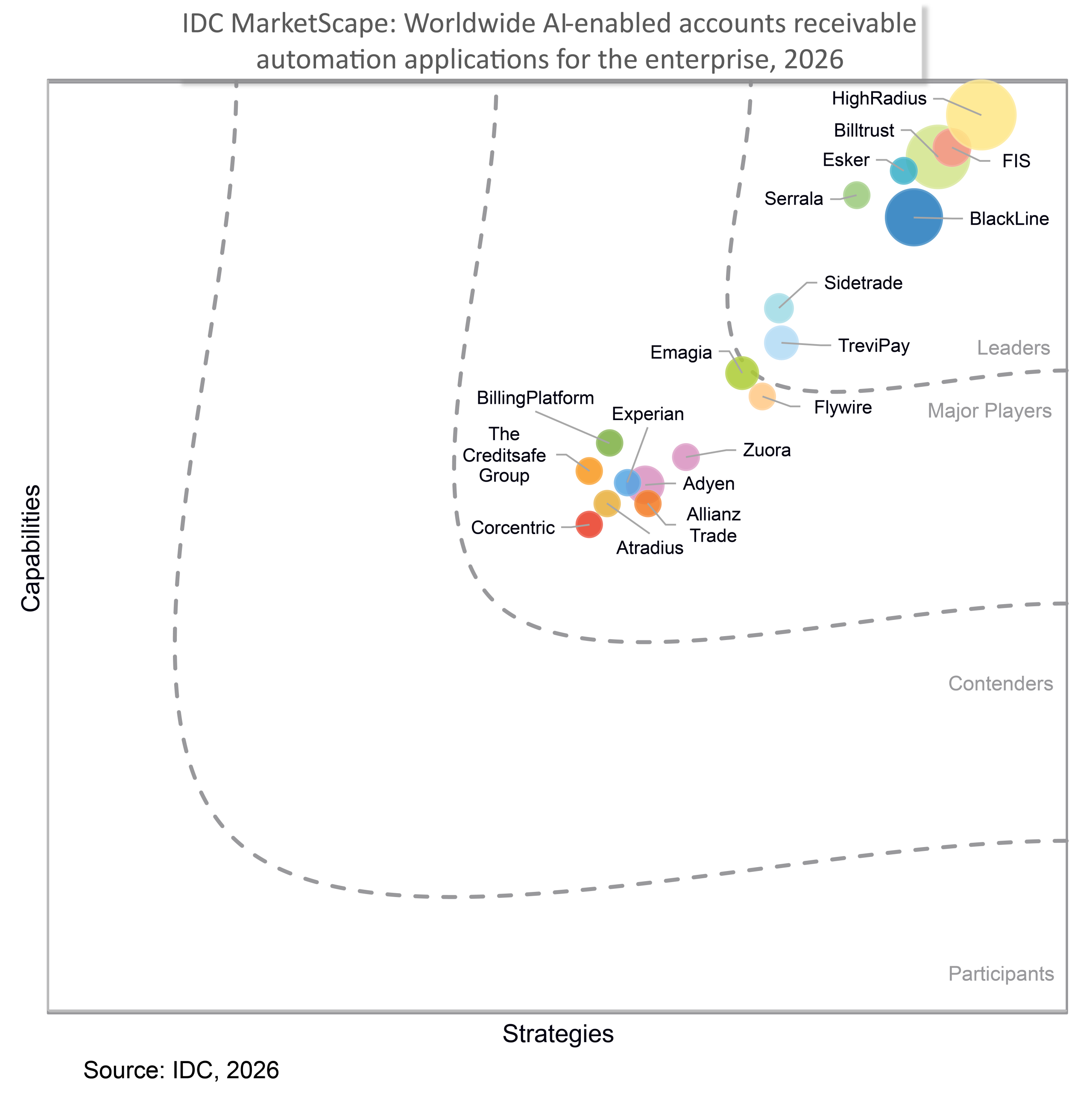
What Sets a Leader in Accounts Receivable Automation Apart?
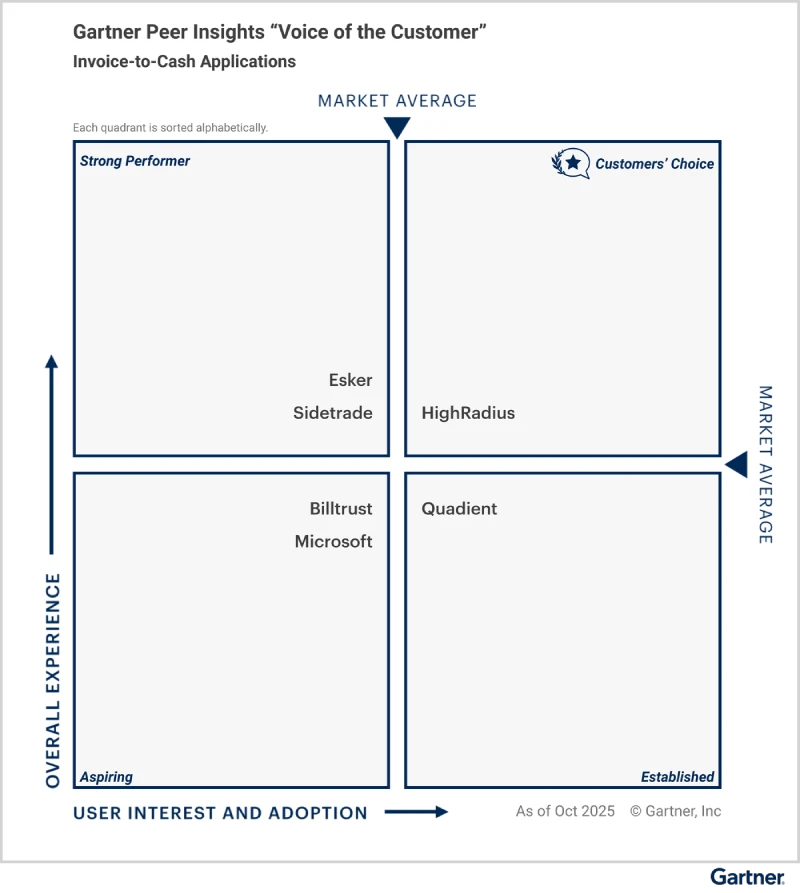
Explore IDC's assessment of HighRadius and the capabilities shaping the future of enterprise AR—from end-to-end automation to agentic AI.
Get the IDC MarketScape ReportBuilding a More Connected Approach to B2B Credit Management
Credit decisioning should not be treated as a one-time exercise that ends when a credit application is approved. It is an ongoing business process that connects customer information, risk assessment, scoring, policy-based decisions and continuous monitoring. Just as importantly, it should account for what happens after credit is extended.
HighRadius Credit Management Software helps organisations bring greater intelligence, consistency and efficiency to the credit decisioning process. Its AI-powered capabilities support the entire credit lifecycle, from digital credit applications tools and multi-source risk assessment to configurable credit scoring, automated decision workflows and continuous risk monitoring. With integrations across 35+ credit agencies, the platform helps credit teams build a more comprehensive view of customer risk, accelerate routine decisions and focus analyst attention on cases that need closer review. Designed to support both growing mid-market businesses and complex global enterprises, HighRadius helps finance teams make informed credit decisions while balancing business growth, customer relationships and credit risk.
- With real-time credit risk analysis software and credit decisioning software, you can receive alerts for any changes in your customers’ credit profile and make data-driven credit decisions from unlimited credit reports. Our software integrates with your ERP system and can start monitoring your customers in just 30 days.
- We offer configurable credit scoring software and approval workflows that can be customized based on geography, customer segments, business units, and other factors. You can fast-track credit approvals through complex corporate hierarchies, making the credit application process more efficient and streamlined.
- Our highly configurable online credit application allows you to onboard customers across the globe with multi-language, customized credit applications embedded on your website. You can automatically capture financials, personal guarantees, and check bank references, reducing the need for manual data entry.
- Our software also automatically extracts credit data from over 40+ global and local agencies, including credit ratings, financials, and credit insurance information. You can configure the auto-extracted data in your preferred currency, making it easier to analyze and interpret.
- With AI blocked order management, you can auto-predict blocked orders based on the customers’ credit limit utilization and payment history. You can leverage AI-based release or partial payment recommendations for faster credit decisions, reducing the need for manual intervention.
Frequently Asked Questions (FAQs)
1. What is a credit decisioning framework?
A credit decisioning framework is a structured process for evaluating customer risk and deciding whether to approve credit, set or revise credit limits, define payment terms or escalate applications for review. It combines customer information, risk assessment, credit scoring, policy rules and ongoing monitoring.
2. What are the five stages of credit decisioning?
The five stages are intelligent credit application, multi-dimensional risk intelligence, dynamic credit scoring, governed credit decisioning and continuous credit risk monitoring. Together, they help organisations assess customer risk, make consistent credit decisions and respond to changing payment behaviour.
3. How is credit scoring different from credit decisioning?
Credit scoring evaluates a customer’s risk using defined financial and behavioural factors. Credit decisioning uses that score, along with business context, exposure and credit policy, to determine an action such as approval, rejection, a credit limit change or further review.
4. Why is continuous credit risk monitoring important?
Continuous credit risk monitoring helps identify changes in customer financial health, payment patterns, overdue balances and credit exposure. It allows credit teams to reassess risk between scheduled reviews and take appropriate action before potential problems become more significant.
5. How does collections data improve credit decisioning?
Collections data provides insight into how customers behave after receiving credit. Payment delays, overdue trends, disputes and outstanding balances can reveal changes in customer risk. Using these signals in credit reviews helps organisations make decisions based on actual payment behaviour, not just initial assessments.
6. What data is used in B2B credit decisioning?
B2B credit decisioning can use external credit bureau reports, financial statements, trade references, industry indicators, ERP payment history, overdue invoices, credit utilisation and total customer exposure. Combining external and internal data provides a more complete view of customer creditworthiness.
7. Can credit decisioning be automated?
Yes. Organisations can automate routine credit approvals and standard decisions using configurable scoring models, policy rules and predefined risk thresholds. Applications with higher risk, unusual exposure or policy exceptions can be routed to analysts for review.