HighRadius 2026 Automation Benchmark Report For The Office Of The CFO
Understand if your performance is on par with top 10% of the organizations. Identify gaps, best practices and know how you can drive value through Agentic AI-Driven Automation.
What if your credit scoring software could deliver 3× faster credit reviews and reduce bad debt exposure by up to 20%? HighRadius' credit scoring does that for you.
Finance teams handling credit operations often face more complexity than expected. Credit analysts are occupied with different tasks like deciding which accounts to approve, determining which ones need further review, and trying to spot risk before it becomes a problem. But things tend to slip when information is all over the place and most of the work is still manual. High-risk accounts aren’t always easy to catch, and keeping decisions consistent across the team takes effort.
Even with good systems, a lot of time still goes into doing the same things over and over. That’s where agentic AI can step in for help. It tracks customer activity, picks up early warning signs, and shows you what needs attention without waiting for someone to ask. This way, analysts can focus on the accounts that need action, not get buried in reports.
This is where agentic AI comes into play. Agentic AI is redefining credit management by moving from rule-based automation to autonomous decision-making systems. Instead of supporting workflows, AI agents now execute core credit processes such as onboarding, risk scoring, monitoring, and approvals in real time.
With AI agents led credit management, businesses can improve credit risk evaluation by 90%, reduces past due by 20%, and improve analyst productivity by a whopping 30%. In this blog, we’ll explore how agentic AI helps credit teams gain a clearer picture of customer risk and act faster, without compromising control or consistency.
Still Reviewing Every Customer Manually? AI Automates 80–90% of Routine Credit Decisions
See how leading finance teams accelerate customer onboarding by up to 70% and deliver 2–3× faster credit approvals with automated credit application tools.
Agentic AI in credit management refers to autonomous systems that execute credit workflows such as onboarding, scoring, monitoring, and decisioning with minimal human intervention.
These AI agents continuously analyze data, trigger actions, and optimize decisions in real time across the credit lifecycle.
Agentic AI systems are deeply integrated with core capabilities such as credit scoring and credit decisioning. They leverage AI-driven credit scoring models to continuously assess customer risk using internal and external data, while credit decisioning engines apply predefined policies and thresholds to automate approvals, limit assignments, and exceptions. This tight integration with Netsuite, Oracle, SAP, etc. ensures that risk evaluation and decision execution happen simultaneously, improving both speed and accuracy across the credit lifecycle.
Slow Credit Reviews = Delayed Revenue + Higher Past Dues.
Fix the process with 3 actionable strategies to accelerate scoring and approvals.
There’s no denying that traditional processes still get the job done. But they leave a lot of room for delay and inconsistency. Most credit evaluations involve pulling data from multiple sources, reviewing reports manually, and making decisions based on static rules, or sometimes, just gut instinct.
These workflows take time. And they introduce not just credit risk, but process inefficiencies that impact cash flow, team productivity, and customer experience. Agentic AI-driven trade credit management addresses those gaps by giving the teams tools that not only process information faster but also understand how that information fits into the bigger picture.
What Exactly Is Agentic AI in Credit?
Agentic AI refers to AI systems capable of independent decision-making and action execution without constant human intervention. It doesn’t just follow a rulebook. It makes its own playbook as it goes. In credit management, that means handling tasks like risk scoring, customer onboarding, and monitoring accounts without someone constantly checking in.
Compared to typical automation (which needs a set of if-this-then-that instructions), Agentic AI is more flexible. It takes in new data, learns from outcomes, and adjusts its actions over time. Imagine a credit analyst who never sleeps, keeps learning, and doesn’t need to be reminded to follow up.
Transforming Credit Operations Through Agentic AI
Agentic AI streamlines credit management by stepping into four critical areas where finance teams often face bottlenecks: risk assessment, credit application processing, credit monitoring, and compliance intelligence. Here's how it works across each.
1. More Informed Credit Risk Assessment
Relying solely on financial statements or credit reports gives an incomplete picture. These sources are static and often lag behind reality. In fast-moving markets, that lag can cost companies.
Credit teams today need visibility into what's changing, not just what happened last year. That’s where AI comes in—not just scraping more data but reading signals like recent payment behaviors, macroeconomic indicators, and even news sentiment tied to a customer or their sector.
The result? A more realistic view of credit risk. One that reflects what’s happening right now, not what happened twelve months ago.
2. Faster Credit Application Processing
Every credit team has seen it. Any business credit application gets held up because one field is blank or a contact couldn’t be verified. These delays seem small, but across hundreds of accounts, they add up fast.
With Agentic AI in place, the review process becomes more fluid. Data from forms, attachments, and even emails is automatically checked against internal records and third-party sources. When something’s missing, the system points it out and suggests what to do next.
No bottlenecks. No unnecessary back-and-forth. Just a clearer path to faster approvals.
3. Always-On Credit Monitoring
Too often, risk reviews happen after the fact. A customer misses a payment, or finance notices a sudden drop in order volume. By then, the problem’s already in motion.
Agentic AI watches continuously. It tracks changes like subtle ones most teams would miss. A slow shift in buying behavior, a pattern of slightly late payments, even changes in the tone of customer emails.
This kind of AI-led credit risk monitoring lets credit teams act sooner. They’re not reacting to problems, they’re catching them before they grow.
4. Better Controls Around Compliance and Fraud
Regulatory pressure is rising. So is the complexity of global credit practices. Mistakes that once passed unnoticed can now trigger audits, fines, or worse.
AI doesn’t replace oversight, but it helps strengthen it. By analyzing patterns in how customers interact, pay, and order, it highlights activity that seems off, something that doesn’t fit the usual pattern.
This gives compliance and risk teams better coverage. It means fewer surprises and more time to respond when something isn’t right.
Case Studies
Transforming Credit Management With Agentic AI: Faster, Smarter, Leaner
Take a look at how Mosaic simplified credit approvals, reducing layers and boosting speed—while cutting FTE costs by 40%.
Agentic AI breaks down credit management into specialized, autonomous agents that execute specific tasks across the credit lifecycle. Each agent combines data, rules, and machine learning to improve speed, consistency, and risk control.
Credit Intake Agents
Automate credit application processing by capturing customer data, validating inputs, and routing applications for review. Agents driven credit application tools collect company details, financials, and supporting documents through digital forms, validate data against third-party sources, and assign applications to the right analyst based on predefined workflows. This reduces onboarding delays and ensures complete, accurate data from the start.
Credit Evaluation AI Agents
Use AI models to assess customer creditworthiness by analyzing financial data, payment behavior, and external signals. These agents integrate credit bureau data, public financials, and internal metrics such as payment trends and credit utilization. They dynamically adjust scoring models based on customer segment and region, enabling more precise and context-aware risk evaluation.
Credit Decisioning Agents
Automate approvals, limit assignments, and workflows based on predefined rules and risk thresholds with AI-driven credit decisioning platforms. Low-risk customers or small credit limit requests can be auto-approved, while higher-risk cases are routed through structured approval hierarchies. These agents also trigger automated communications, ensuring customers receive timely updates on approvals, limits, and payment terms.
Credit Monitoring AI Agents
Continuously track customer risk using credit risk monitoring tools that leverage real-time data, triggering alerts for payment delays, credit changes, or external events. These agents monitor credit agency updates, financial data, and news signals to identify risk events such as bankruptcy filings or mergers. When risk thresholds are breached, they automatically trigger credit reviews, ensuring proactive risk mitigation.
Blocked Order & Release Agents
Predict blocked orders and recommend actions such as payment requests or approvals to prevent revenue delays. Using predictive credit scoring solutions, these agents analyze purchasing patterns, expected payments, and credit utilization to forecast potential order blocks. They then recommend actions such as partial payment requests or escalation workflows to ensure orders are not delayed unnecessarily.
Credit Memo and Correspondence Agents
Automate communication with customers including approvals, payment links, and credit-related updates. These agents send real-time notifications for blocked orders, credit approvals, and payment requests, reducing manual follow-ups and improving customer responsiveness. They also ensure consistent communication across all credit interactions.
Case Studies
From fragmented workflows to 3X faster reviews and 99% automation
From fragmented workflows to 3X faster reviews and 99% automation
Looking Ahead: What’s Next for Agentic AI in Credit?
Agentic AI is still evolving. It’s already helping credit teams work faster and smarter, but it’s not a plug-and-play solution for everything. Teams need to adapt how they work. There’s still a learning curve, and concerns like data security and AI transparency need to be addressed.
But the direction is clear. As finance functions become more data-driven and customer expectations grow, traditional tools won’t be enough to keep up. Teams that adopt Agentic AI will have an edge, not because they’ve automated more but because they’ve freed themselves to focus on what matters most: managing risk with insight, not just rules.
If your credit processes still rely on spreadsheets, disconnected emails, or rigid scoring models, it’s worth considering where things could go from here. As the landscape shifts, the question isn’t just about efficiency, it’s about how credit teams can evolve to meet changing demands with more intelligence and less friction.
Agentic AI vs Traditional Credit Automation
Feature
Traditional Automation
Agentic AI
Execution
Rule-based
Autonomous
Decisioning
Static
Dynamic
Monitoring
Periodic
Continuous
Action
Manual trigger
Self-triggered
Improve Your Credit Scoring With HighRadius' Agentic AI-led Credit Management
HighRadius Credit Management helps finance teams automate credit decisioning, standardize risk evaluation, and gain real-time visibility into customer exposure. By combining AI-driven scoring with automated workflows, it enables faster approvals, reduces manual effort, and improves control over credit risk.
With real-time credit risk analysis software and credit decisioning software, you can receive alerts for any changes in your customers’ credit profile and make data-driven credit decisions from unlimited credit reports. Our software integrates with your ERP system and can start monitoring your customers in just 30 days.
We offer configurable credit scoring software and approval workflows that can be customized based on geography, customer segments, business units, and other factors. You can fast-track credit approvals through complex corporate hierarchies, making the credit application process more efficient and streamlined.
Our highly configurable online credit application allows you to onboard customers across the globe with multi-language, customized credit applications for midmarket and enterprise embedded on your website. You can automatically capture financials, personal guarantees, and check bank references, reducing the need for manual data entry.
With real-time credit risk analysis software and credit decisioning software, you can receive alerts for any changes in your customers’ credit profile and make data-driven credit decisions from unlimited credit reports. Our software integrates with your standalone ERPs and can start monitoring your customers in just 30 days.
With AI-based blocked order management, you can auto-predict blocked orders based on the customers’ credit limit utilization and payment history. You can leverage AI-based release or partial payment recommendations for faster credit decisions, reducing the need for manual intervention.
Struggling With Incomplete Credit Applications?
Explore the #1 software that makes onboarding customer faster and easier
Accelerate payment recovery from delinquent customers and boost cash flow through automated collection workflows.
Cash App
Achieve same day cash application with automated remittance aggregation
Credit
Mitigate credit risk, reduce bad debt, and streamline customer onboarding with AI-powered insights.
Deductions
Reduce Revenue Leakage with AI Prediction models that identify valid and invalid deductions.
Online Credit Application
Onboard customers seamlessly with a configurable online credit application. Cut down on back-and-forth and collect all customer details in one go.
FAQs: Reimagining Credit Operations with Agentic AI
1. How will Agentic AI shape the future of credit management? Agentic AI enables real-time credit monitoring, automatic limit adjustments, and personalized risk strategies—replacing static models with proactive decision-making. It empowers finance teams to act faster, reduce risk exposure, and support growth without manual oversight.
2. Can Agentic AI improve credit risk analysis? Yes. Agentic AI continuously learns from customer behavior, market signals, and payment trends to predict risk. It flags issues early and adapts scoring dynamically—making risk analysis more accurate, timely, and data-driven.
3. Why is Agentic AI critical for the future of finance? Agentic AI helps finance teams manage rising data complexity by automating judgment-based decisions. It scales credit risk workflows, enhances responsiveness, and supports smarter, faster financial operations—making it essential for modern finance functions.
4. How is Agentic AI different from traditional credit risk assessment?
Agentic AI is proactive, adaptive, and context-aware—unlike traditional models that rely on static data and fixed rules. It continuously monitors behavior, uses external signals, and can autonomously act on risks. This enables finance teams to assess creditworthiness in real time and personalize risk strategies at scale.
Resource Library
Resource Hub
Order to Cash
Order to Cash software data sheet
Disconnected workflows can leave teams chasing data, while automated O2C has delivered 20% lower past dues.
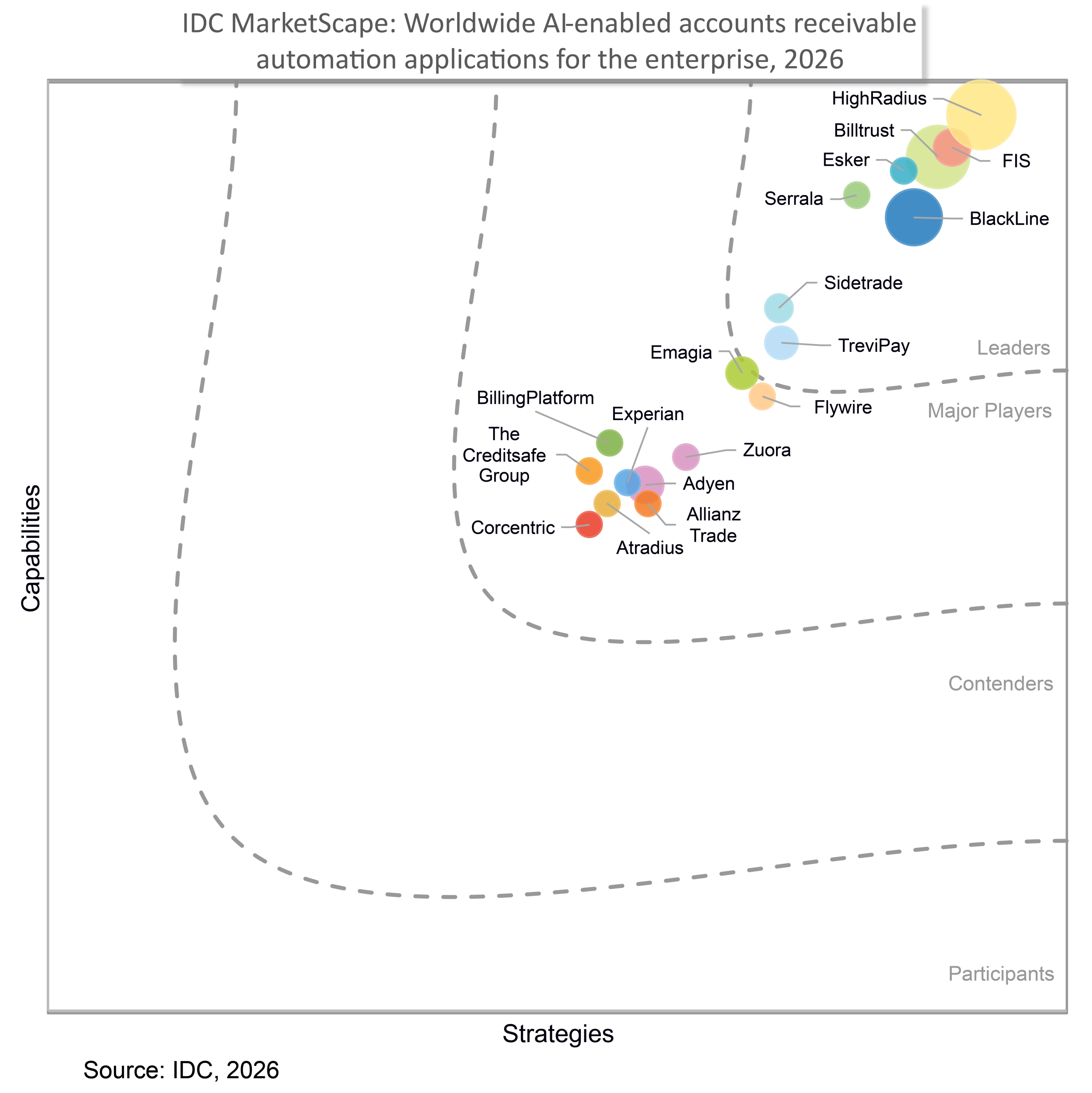
HighRadius recognized as a "Leader" in IDC Marketscape: Worldwide AI-enabled accounts receivable automation applications for the enterprise 2026 vendor assessment
Recognized as a Leader in 2026 Vendor Assessment for unifying credit, collections, cash application, deductions, e-invoicing, and payments on one AI platform to advance enterprise-wide invoice-to-cash transformation.
Forrester Recognizes HighRadius in The AR Invoice Automation Landscape Report, Q1 2023
Forrester acknowledges HighRadius’ significant contribution to the industry, particularly for large enterprises in North America and EMEA, reinforcing its position as the sole vendor that comprehensively meets the complex needs of this segment.